On June 19th we flew into Kathmandu, Nepal ready to hike in the Himalayas. Though we were hoping to be on the trail within two days of arriving, we flew in without a plan, still somewhat uncertain which of the many treks around the Himalayas we’d choose. Prior to arriving we had high hopes of doing a longer 8-10 day hike, but after having problems obtaining our visas for India, we knew we would need to spend more time in the capitol to sort those problems out with the embassy, and less time on the trail.
Upon arrival, we prepaid for a taxi to our hotel and as we hoped in the back, a man from a tourist agency jumped in the front. After being hassled all over the world to buy things, we were pleasantly surprised when he didn’t bring any sales points up until we asked. Somehow, in spite of him hopping into our car without asking, it made us feel welcome. After deciding to stop by his office and chatting for a while, we decided on a trek and agreed on a better price than we thought we could get (it being low season for hiking helped more than we knew it could – we’d planned on needing to piece the hike together ourselves) thus sealing our hopes of getting on the trail sooner than later. We spent one day in the capitol before hopping on a bus to Pokhara where we caught a second bus onto Nayapool to begin our hike.
Hiking in Nepal is incredibly different than hiking in Patagonia. On the W trek we hiked in Patagonia, everything is highly monitored and very expensive. Because camping is only allowed in designated areas, even carrying a tent with you and setting up on a platform in the park can have a hefty price (there actually are a couple of free designated areas, but they book out in advance). To stay in one of the hostels along the trail will currently cost $110 a night (and that’s for a single bed, not a room). To get a room with your spouse/friend with a shared bathroom and meals costs $250 a person per night. That’s $500 a night for a couple to be able to sleep in real beds and not have to carry food on the trail. (For this reason we carried everything except a tent with us, only having to pay for the platform/tent while there).
Nepal, on the other hand, is unbelieveably affordable. Because the hikes in the Himalayas are through villages that have been there for ages, the local people have been able to set up businesses that help hikers and their own economy. “Tea houses” can be found in abundance along the trail where you can find lodging for 2 for $5-$8 a night ($5 for a private room/shared bath an $8 for a private room/private bath) and meals for $2-$8 ($2 for something like an omelette or vegetarian meal, $4 for something like a rice and meat meal, or $8 for something like a yak steak with fries – yes, YAK steak 🙂 ). The tea houses all include bedding and showers, though a towel and toilet paper are things you need to provide yourself – so ultimately, just about the only things you need on the trail are a water bottle, clothes, snacks, toilet paper, and a towel.
Shockingly in Nepal, even with needing a much smaller amount of things on the trail than on W Trek, another common service provided by locals is a “porter” service. For around $15 a day you can pay someone to carry your bags up the mountain while you hike – and even hiking far above sea level, they can carry several bags at a time – it’s unbelievable. For $20-$25 a day you can hire a certified porter/guide who will both carry your bag and ensure you are going the correct direction on the trail (it’s definitively doable on your own, but there are significantly more turns in the Himalayas than on the W Trek simply because of the many villages).
So basically, for the cost of one night lodging in a hostel on the W trek, you can do a multi day hike in the Himalayas without having to carry a single thing (and since you are hiking at atleast 10,000 ft above sea level at some point on pretty much all the trails, that porter can come in handy even for a small bag!)
Having said all that, I’ll return to telling about our hike – we picked the Poon Hill trek, which is one of the easiest multi day treks in the region. You don’t get a view of Everest or a hike in the snow (as you do with many others!), but you still end up hiking in the heart of the Himalayas with awesome views of several of the other humongous snow capped peaks, the tallest in that area being the Annapurna. The Poon Hill trek can take as little as 3 days, but we opted for 5 to put the least amount of strain on our bodies (really, my body) and to spend the most time we could in the mountains. Alongside the several illnesses I’ve caught in the last 7 months of traveling, I’ve also been having lower back problems for the last few months (possibly because of my pack? The stresses of travel have certainly affected my body more than Kirks!) so included in our “hike” package through the agency was a porter/guide to carry my things.
Below are (a lot of) photos from our hike 🙂
As I mentioned before, we first took a bus to Pokhara (the second largest city in Nepal) before traveling to our starting point for the hike. We spent one night there next to the lake before heading on.

The lake beside our hotel
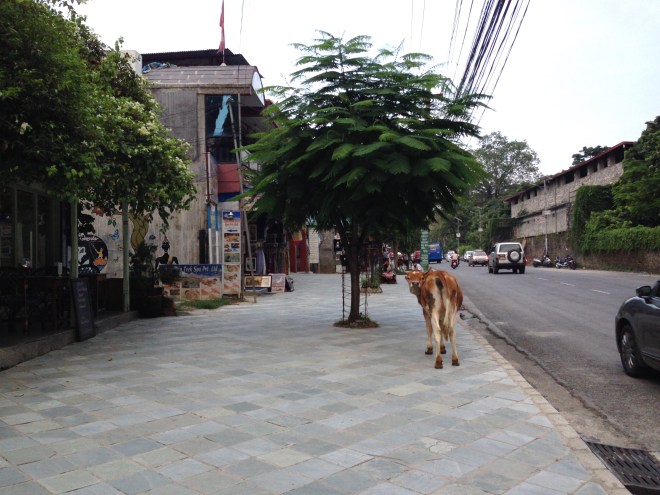
Exploring the area nearby the lake in Pokhara. Cows openly roam the streets all throughout Nepal as they are considered sacred to the Hindu religion, and the majority of Nepal is Hindu.
After one night in Pokhara we caught an early morning bus to Nayapool to begin our hike. This turned out to be a super interesting drive. First, road work on the main road forced us to take a detour – our large bus veered off the road and headed up the rushing riverbed until the road was clear again 😂.
Second, a landslide that had covered a large section of the road forced us to detour up a tiny mountain road that put us constantly passing by oncoming traffic on essentially a single lane road in which the “shoulder” was the edge of a cliff. It’s interesting because I’d experienced roads like this during my time in Peru 11 years ago with no fear. At the time, it felt more like a roller coaster ride – something exhilarating that you know people have done millions of time without problem. When you’re 19 the world is full of possibilities and future, but one of those possibilities in your mind is not usually death. Age and life change a few things. As Kirk and I sat looking out the window, unable to see the edge of the road beneath us because the shoulder was so thin, we began to discuss get away plans. Perhaps we’ve watched too many action films or perhaps my faith in Kirk’s athletic ability is reliable, but we decided that having seats adjacent to the open door made us the most likely to be able to jump out towards the road if we felt the slightest movement downward towards the cliff on our other side.
Thankfully we didn’t have to test that theory, but we were pretty disappointed when we didn’t end up next to the door on the way back 😂.

Driving up the riverbed- I didn’t get any photos of the cliff edge drive.
Once we safely arrived in Nayapool we began our hike. We paused on a bridge while our guide walked ahead and completed our paperwork for us. They have several checkpoints along the trail to keep track of visitors, which is good – because if you get lost, they eventually know it.

These colorful Buddhist prayers flags hang throughout the country, brightening the scenery and giving a taste of the culture and everyday life around you.
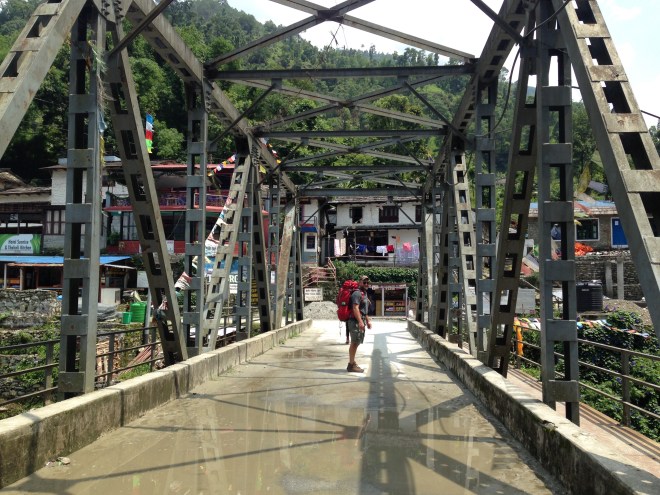
Kirk, carrying his own pack 🙂
We started our hike going up for a couple hours before stopping for lunch.

The view out the window of the tea house at which we stopped for our first meal on the trail.
After lunch we continued walking up for about an hour before our guide turned to us and said, “and now, we go up!” 😂
Having already walked mostly uphill for several hours, it was ironic, but he wasn’t kidding. We’d read the the Poon Hill trek has one day in which you walk up around 3,000 consecutive stairs – and the start of those stairs was then (to the left in the photo below).
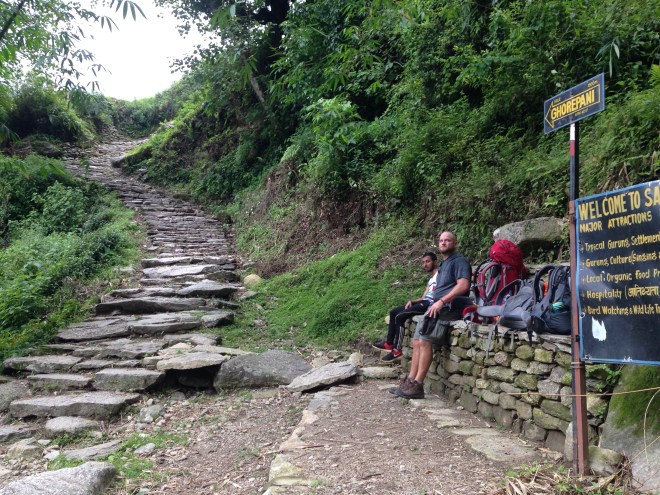
Resting before we began our long hike up the stairs. Our guide, Shrawan, next to Kirk.
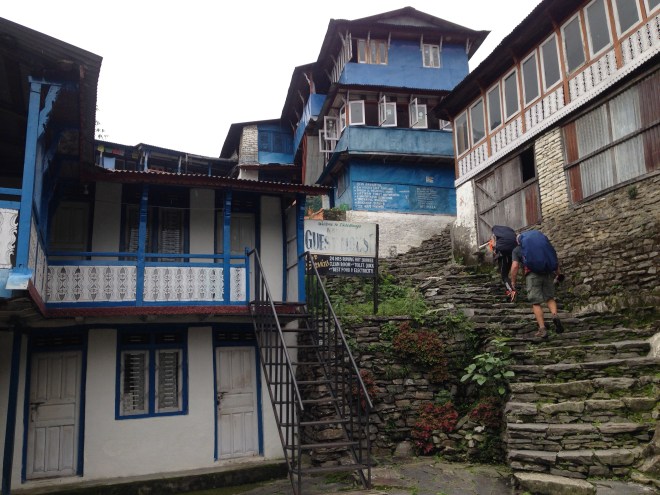
Continuing up through a village
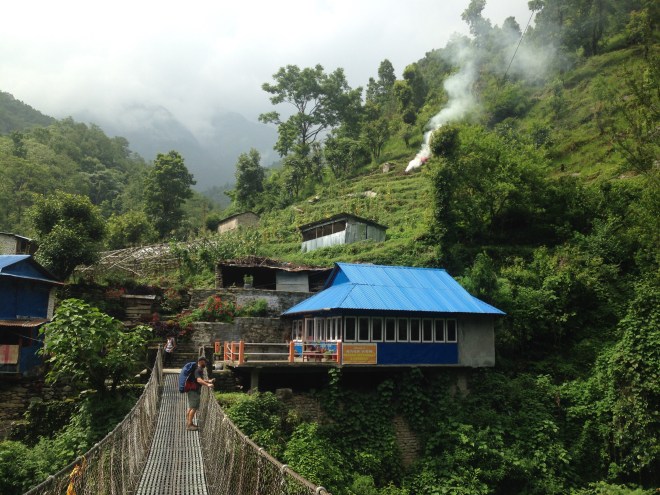
Crossing over a bridge to connect to more stairs.
Somehow, the stairs were not as hard as I had imagined they would be. I went at a snails pace, reminding myself not to move my feet too quickly, which helped keep my breath steady. I’ve heard of people who make it through difficult parts of hikes by telling themselves they only have a few steps to go – this does not work on me. If you are ever hiking with me and tell me I only have 100 steps to go when there are really 1000, I will realize when we’ve passed 100 and my morale will drop to an unhelpful level. If, however, you lie to me in the opposite direction – tell me there are 2,000 ahead of me, I will mentally prepare for the worst, which helps keep me going.
This time in particular, the highest estimated number of stairs I’d read were potentially on this single uphill walk was 4,000, so every step I took I kept telling myself, 4,000 more steps. We’d been walking up stairs for an hour and I kept telling myself – 4,000 more steps. 2 hours – 4,000 more steps. Nearing three hours – 4,000 more…and our guide announced we’d made it to the village we were sleeping in. I was pleasantly surprised and in a great mood 😂!

Walking into the first village in which we were sleeping, Ulleri.

The guest house we stayed in. It did have a nice view, but I didn’t wake up in time to see the clouds clear to see the really nice view.
Day 2: The next day we got up and continued walking up stairs towards our next destination, Ghorepani.
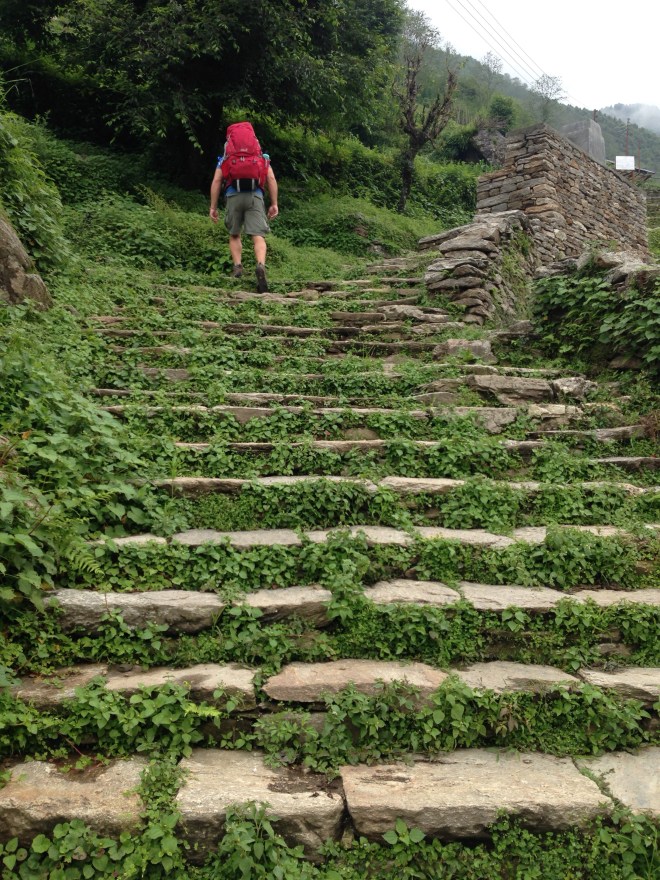
Kirk walking up the stairs, full of greenery.
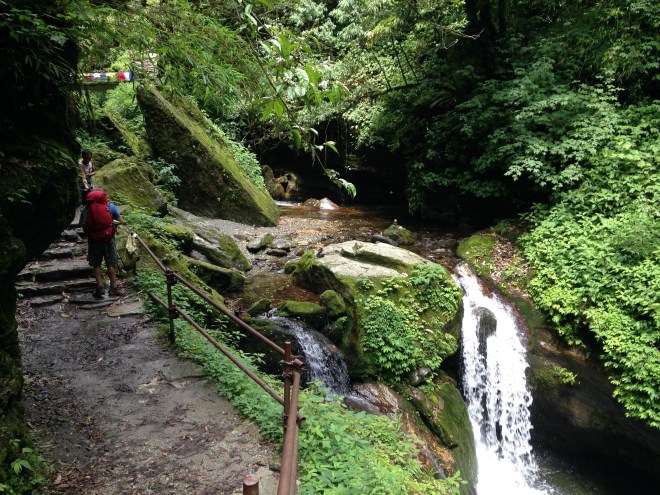
A waterfall we passed on the trail.

Me crossing over the river/waterfall with Shrawan in front, carrying mine and his bag. Even with two bags, he could far out pace me! Kirk can always outpace me too, but usually stays in the back to look out for me :).

Much of what we walked through was jungle and it was beautiful!
After hiking for around 5 hours, we made it to Ghorepani where the main attraction of the trail is located, Poon Hill. Poon Hill is the tallest point of this trek and has the best view of the surrounding mountains. Traditionally, people make it to Ghorepani, sleep there for the night, and then wake up in the wee morning hours to hike up Poon Hill and see the view with the sunrise. We followed suit and did just that.

Us at the entrance into Ghorepani.
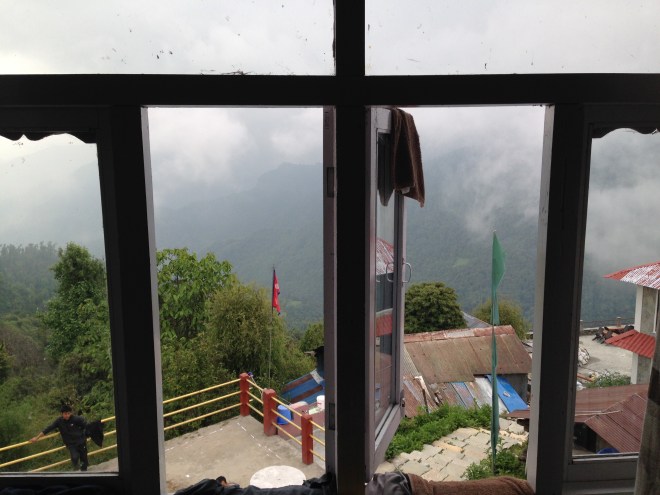
The original view from out window, though by morning the clouds cleared and there were peaks all around us!

Our hotel, Hotel Hilltop, the hotel nearest the stairs that lead up to Poon Hill.
Day 3: The next morning we set an alarm for 3:45am in order to be on the trail to see the sunrise by 4:15am. We slowly ventured out into the dark and made our way towards the stairs that we would climb for the next hour in order to reach the top. Nearly as soon as we arrived at the stairs, it began to rain. Tired and wet I got grumpier with every step, certain that when we arrived at the top no good view would be in sight.
When we finally arrived, I was beyond delighted to find that I was completely wrong. The rain had stopped and cleared off the clouds, leaving a mesmerizing view in front of us.
 One of our first views from the top – it may not look like much in the picture, but those peaks you can kind of see here were grandiose as they stood before us in real life. Looking at those mountains from around the 10,000 feet above sea level mark to which we had hiked, we recognized that they still towered above us by an additional 15,000 feet, able to be seen even though we were miles away. It was unbelievable and breathtaking to consider and see.
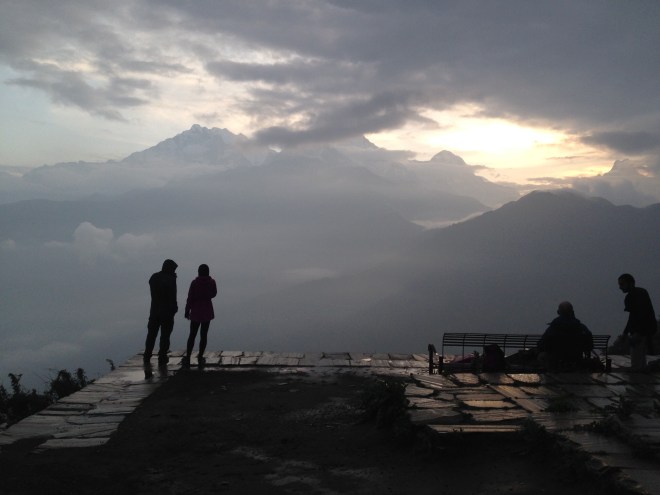
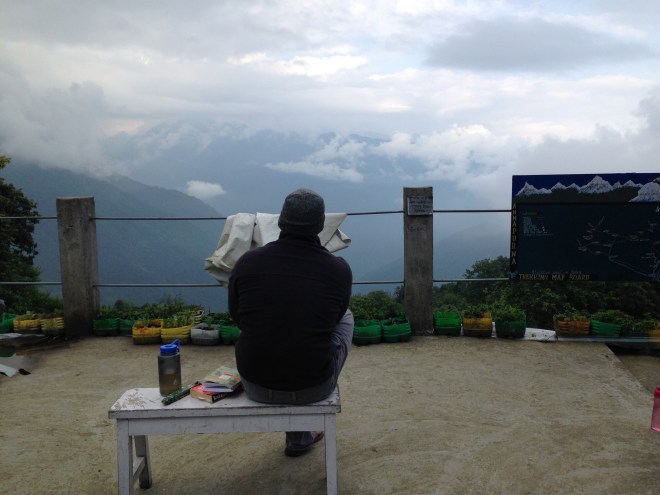
We grabbed some coffee and plopped ourselvess on a bench to watch the view. That’s Kirk on the bench to the right. You can see some of the snow capping the peaks if you look close. In the pictures the clouds blend into the mountains, tainting the view, but in real life, they added depth, layering between these enormous swells and showing how far away and apart they truly are.
Our guide offered to snap some pictures while we looked on.
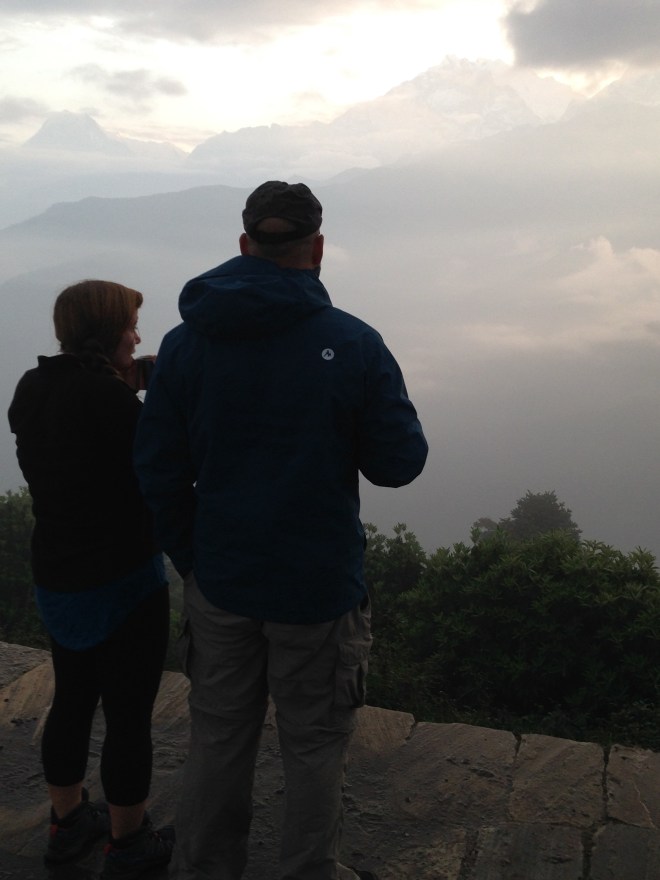
—
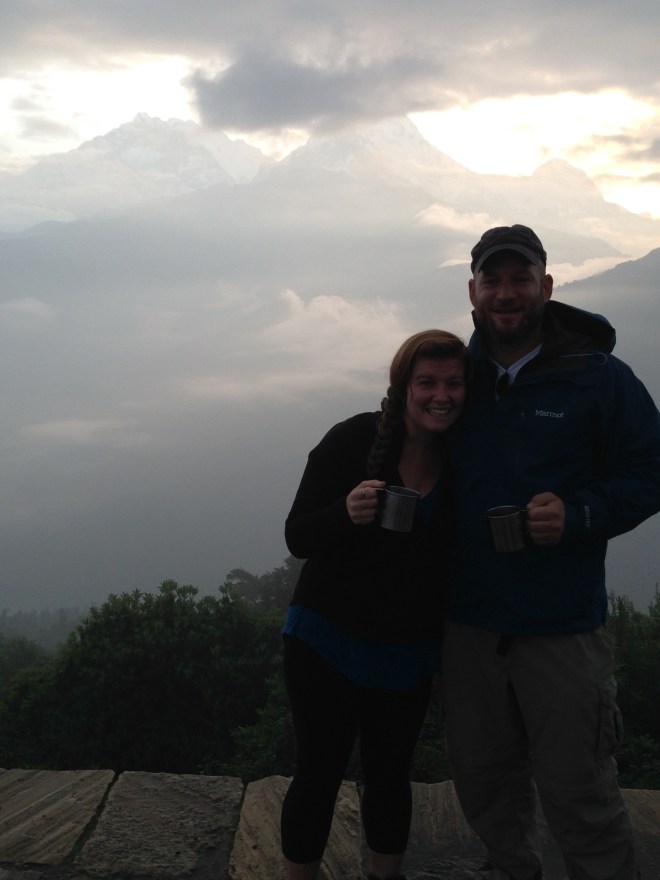
Coffee is so good on a chilly mountain top, especially after waking up that early, and especially with that view!
Gradually the clouds began to roll back in from below.
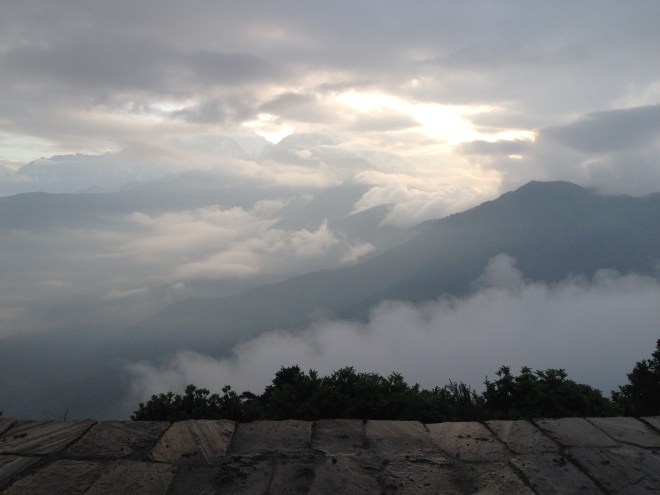
They were so fast you could watch them move!
Within a couple of minutes, this was our view…
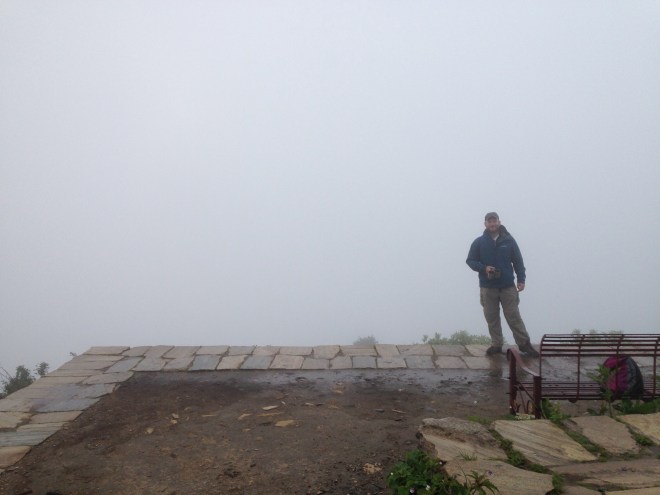
Kirk, now standing in front of the bench he was sitting on in one of the previous pictures, only clouds in view!
We decided it was time to head back down. We snapped a final picture with our guide, marking the heights we’d hiked that morning.

On the way down we passed people heading to the top. I hope it cleared again for them when they arrived!
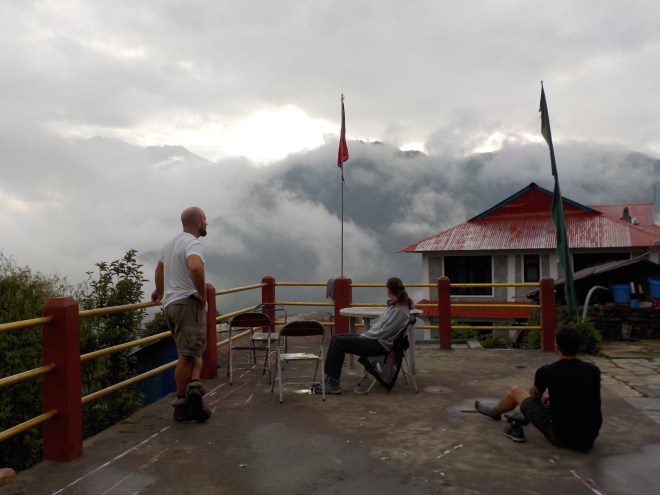
Back down at the hotel, waiting for breakfast to be ready with our new friends on the trail from Spain, Alicia and Jorge.
We ate breakfast at the hotel and then got back on the trail to head to our next village.
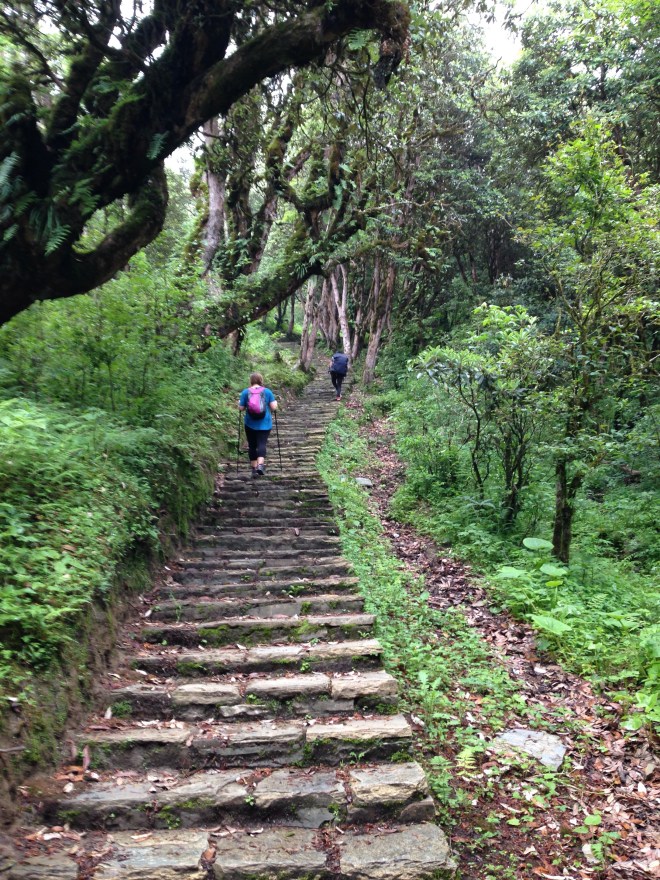
Day three was filled with ups and downs. If you haven’t done a lot of mountain hiking, just know, down gets worse than up. You can pace yourself on the up to help catch your breath and not overwork your muscles, but going down for extended amounts of time works your knees hard!
After a bunch of stairs we came to a meadow in a cloud.

It was around this time that we realized we were in leech country. We’d read blogs of people warning about leeches on the trails in rainy season, but we didn’t realize we’d encounter so many! By the end of this day, we’d found two on my ankle and too many to count crawling up Kirk’s shoes and legs. They latch on even when you don’t brush against the plants, though we likely would have had more had we walked off the trail!
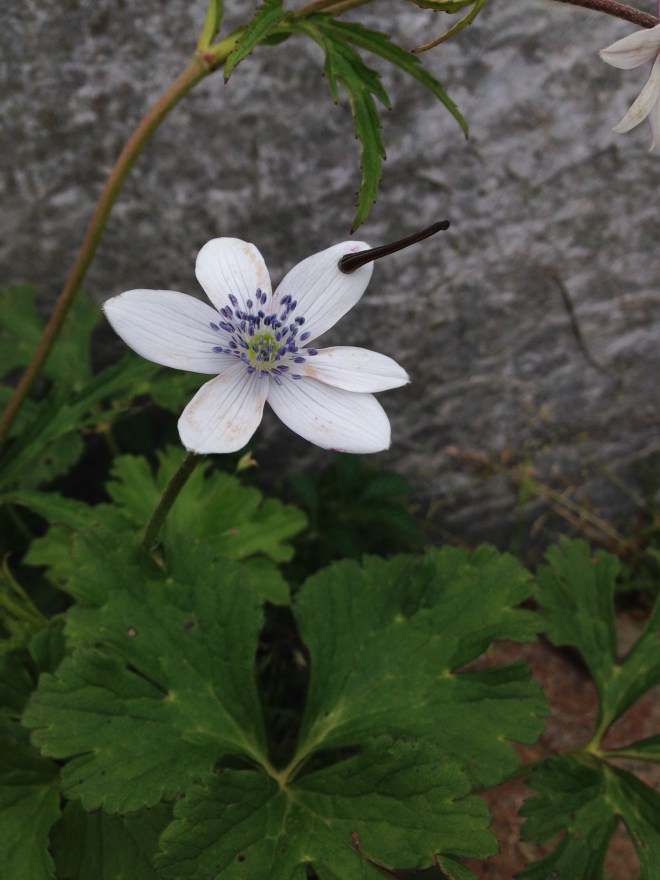
If you’ve never seen a leech, one is pictured above. They reach out when they sense something near them.

At one point on the trail we came across a herd of water buffalo drinking water out of the river with piles of stacked rocks all around. I have no idea what these mean, but I have a feeling it just became a trend amongst hikers.
We arrived at Tada Pani in the early afternoon with this cloudy view…
By evening the mountain called “fishtail” was peaking out…

See why they call it fishtail?
Day four: By the next morning when we woke up, the skies had again mostly cleared and we had another view of the grandeur around us.
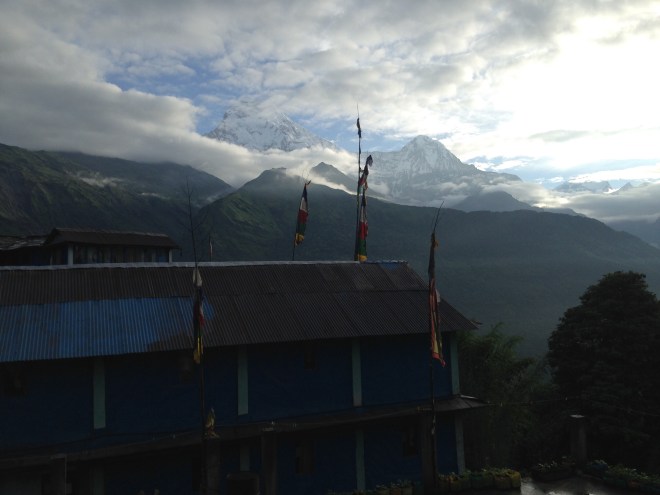
Looking out from the balcony in front of our room

The view from downstairs where we had mostly only seen clouds the evening before.
After breakfast we started out towards our final destination, Ghandruk. Day four was a very easy hike, mostly flat and a little bit down hill.

Walking through the vibrant green, moss covered forest, Shrawan leading the way.
At one point on the trail we heard a man nearby making monkey noises. Shrawan paused and told us to look in the trees. We saw several places where branches were moving and eventually they came near enough for us to have a good view – we’ve seen lots of brown monkeys in our travels, but these were grey with black faces and a white mane. They were beautiful, but hard to get a good picture of! Below is the best we got.
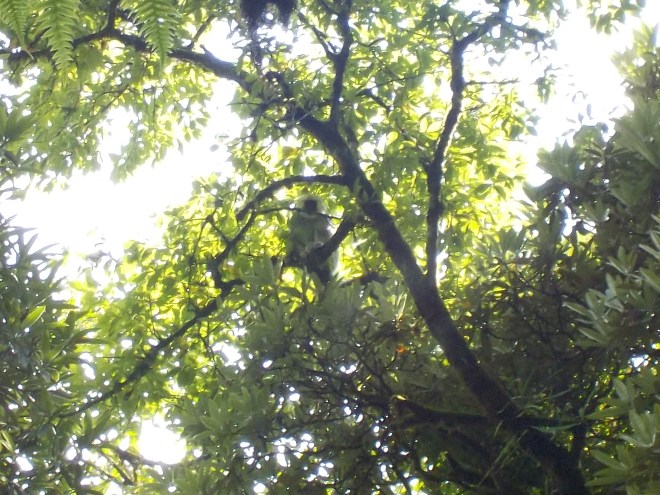
🙂
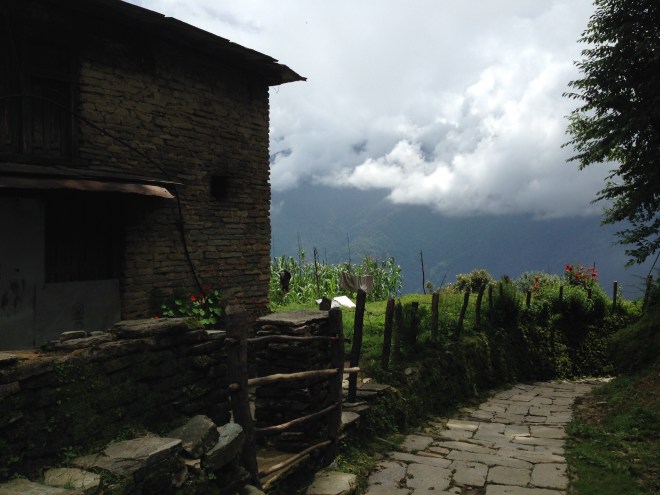
The final path into the village
After settling in at Shangri-la Guesthouse, Shrawan took us by a local museum and on a tour of the town. The museum ended up being a single room filled with everyday items that the Garong people (one of the people groups in the mountains) use – baskets, pots, plates, instruments, etc. (Most of which we’d already seen throughout the trail, in use.) The tour of village itself was pretty fantastic. It’s hard to beat the views you get when walking around a small village built mostly out of stone, situated on the side of a mountain.

Inside the single room museum. Most of these are different types of baskets they weave and use, though, unlike everyday life, in the museum they are covered in lacquer to help preserve them.
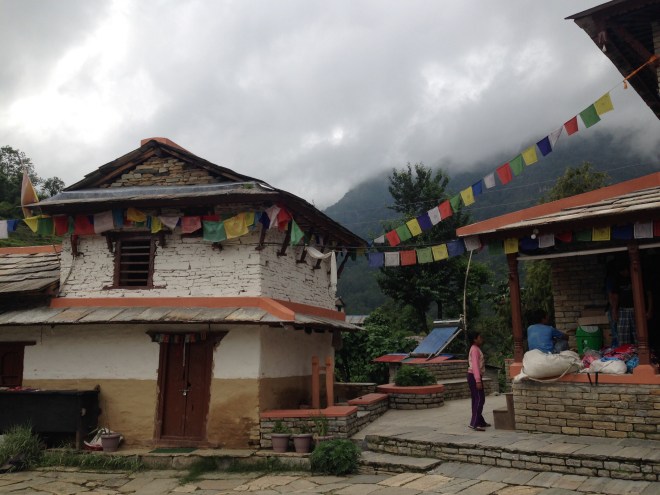
Buildings by the museum.

Kirk checking out how these stones are put together (they are simply stacked with mud between them). On older walls, plants were often growing in the mud between the stones, as seen on the left.

Another part of the village.

Back at the guesthouse, Kirk taking in the view while we waited for dinner.
Like many of our previous views, the evening view was nearly all clouds, but when morning came, it was a different place.

The view that evening, only green shorter mountains in sight.
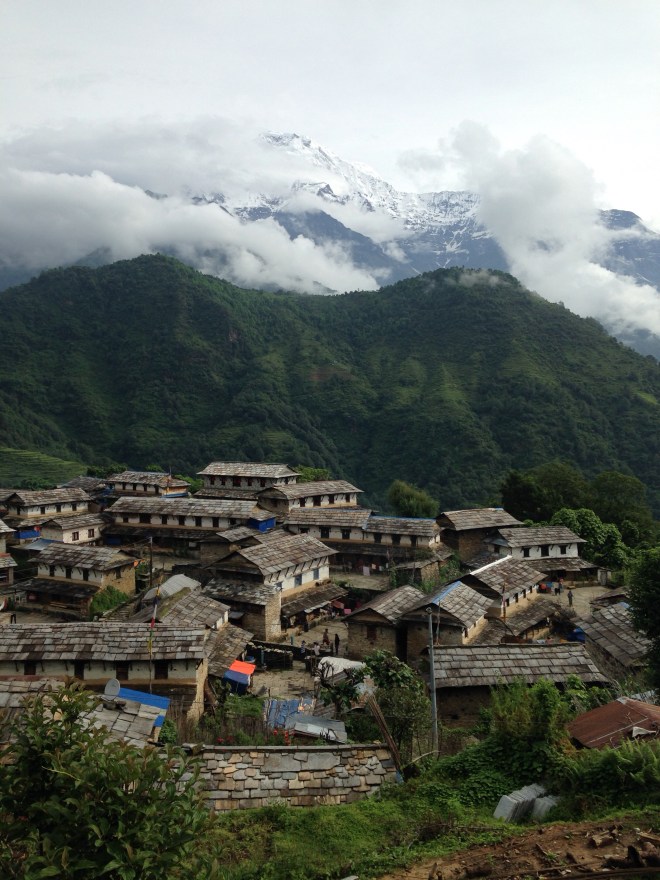
The morning view with the snow caps peaking throug
This final morning, day five, turned out to be the clearest morning we had. Below was our view while eating breakfast.
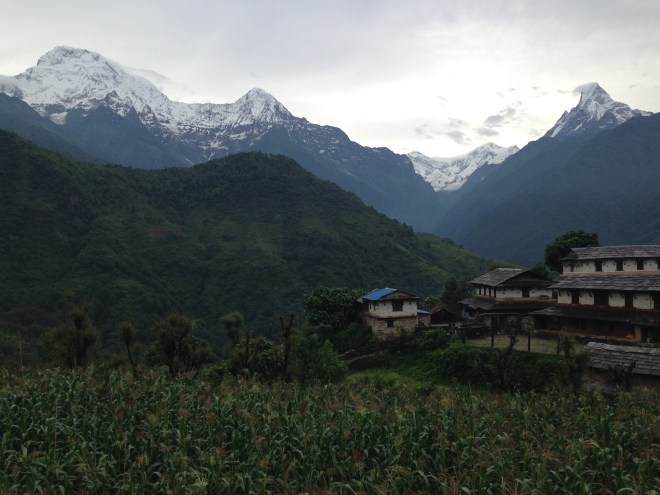
Unbelievable.
Shrawan offered to take our picture, and we didn’t mind 🙂

I’m sad the camera wasn’t good enough to pick both us and the mountains up, but it’s good enough for a memory :).
We set out early for our shortest hike yet – to a bus on the side of the mountain right outside town. Ghandruk is the last village accessible by vehicle in this section of the mountains. 
Last views while leaving town.

Those views!

We passed several trails of these guys carrying concrete up the mountain. The bells on their necks jingle as they pass by and they are always beautifully decorated!
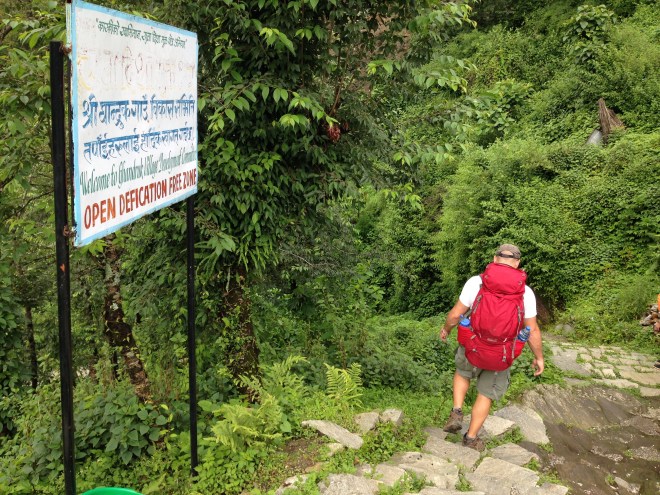
Entering “open defication free zone” 😂 It only lasted about 100 steps, but they were the only 100 steps of the trail without horse/cow/donkey manure nearby!

—

More mules.
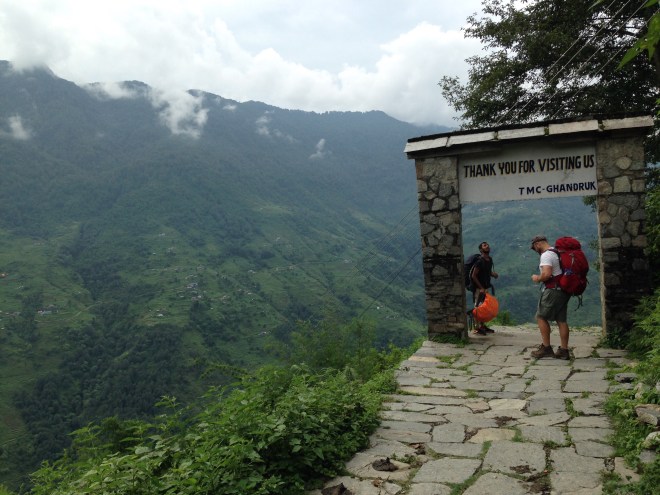
Exiting town.
Soon the bus was in sight, parked right where the road ended – at a huge landslide. We crossed over landslide to reach our ride.

Kirk crossing over
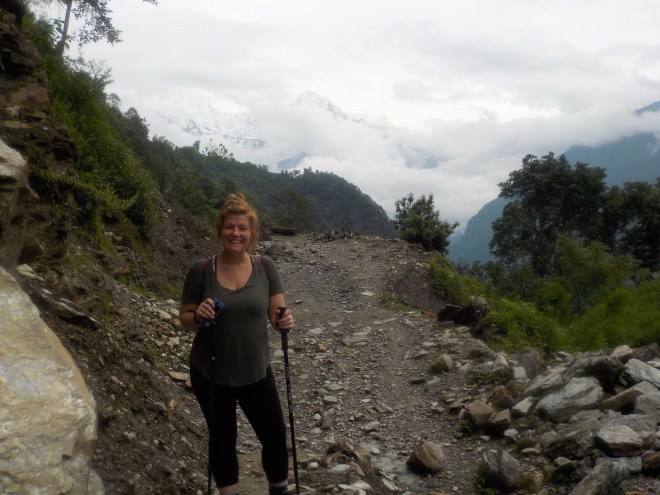
Me behind him.
We boarded the bus and began a long, slow ride back down to the village in which we started.
When we got on we quickly realized we were on a local bus. The more villages we passed through, the more people got on. By the end we were packed in beyond belief 😂!

That poor little guy could hardly move, packed in between his mom’s purse and Kirk’s arm 😂.
At one point a woman got tired of standing and sat right on top of Kirk’s foot and didn’t move for probably a half hour! We were on this bus for 7-8 hours. We were lucky to catch it at the top, or we would have been standing!

I snapped a picture of our tough mountain bus when we stopped for a bathroom break.
On the way back down we had a two hour delay because of a landslide. Traffic was backed up for miles. As we sat at a standstill someone came by to let us know that we were about 22 kilometers from the actual landslide. Because this mountain road is the only main road through, everyone on both sides was stuck. We were lucky they started clearing it long before we arrived. We’d heard of people getting stuck with 15 hour delays! If you ever visit Nepal, make sure you factor in time for travel delays. We hear few people get out of the country without encountering them.
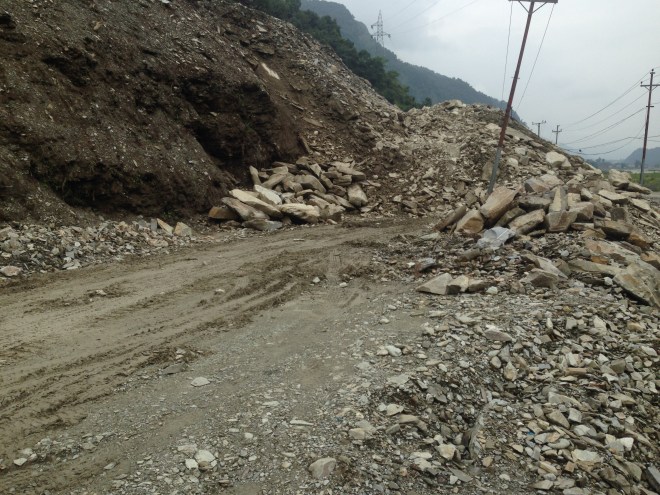
We passed a second landslide on our way back that we were able to go around off road.
We stopped for a gas break before getting back to Pokhara. I snapped a picture of the “fire” buckets in the back.

Those buckets are at all the stations here! Personally, if there is a fire at the gas station, I’m not reaching for tiny buckets – I’m running.
We made it back to Pokhara and spent the evening hanging out with friends from the trail. We ate roasted corn by the lake side and had a few drinks. It was beautiful being there as the sunset.

After staying the night in Pokhara, we got back on a bus to Kathmandu where we stayed nearly a week. Our time in the capital city is the subject of the next blog.

 The Yonderers
Wonderful trip! You two make me tired just reading about you adventures! Stay safe!
LikeLike
Amazing! So happy for both of you! Continuing prayers for y’all.
LikeLike