We went to Siep Reap for the sole purpose of visiting Angkor Wat and the surrounding temple complexes. If you don’t know much about it, Angkor Wat is the largest religious temple complex in the world and is the symbol in the center of the Cambodian flag. The entire walled complex covers about 500 acres, the moat surrounding it is 200 meters across, and the tallest tower reaches 213 feet. It’s huge.
The basic history behind it is that it was built in the early 1100’s by King Suryavarman II who overthrew the last successor. At the time, Kings were consider to be god-like (like, demi-gods), and so to prove his right to the throne (to show that he was more of a Demi god than the king he overthrew), he made a plan to have this humongous temple constructed to the Hindu god Vishnu (their god of war). The temple was completed in around 30 years, which might sound like a long time, but after watching a video of a rock mason describing how he didn’t understand how it was possible that they completed it so quickly, I found myself pretty impressed.
Perhaps what’s most fascinating is the design of it. Some people call it a “floating temple” because though it isn’t actually floating, it is sitting on water. From what I’ve read, the switch between monsoon and dry season in Cambodia changes the land so much that it would be difficult to support a temple like this. Since the rocks are stacked (not cemented together, or at least not in the way we cement today) every time the rainy season came and left, they would shift without some other type of foundation under them. For this reason, they built the temple with what my understanding can only describe as a water support system. The enormous moat around the complex keeps a steady amount of water in the soil underneath the temple through rainy and dry season, ensuring that the stones always have the same foundation. It’s pretty brilliant and fascinating.
Around Angkor Wat are the temples built by the many kings before and after Suryavarman II. All of them were built under the reign of the Khmer Empire (also called Angkor Empire), which was actually a huge world power during it’s time. There are so many temples that Kirk and I just picked a few of the most known ones to go see (our tuk-tuk driver dropped us by a few others he thought we would like too 🙂 ). If you are planning a trip yourself and are interested in what we did, we took the “small circle” backwards, hitting Bayon and Angkor Wat right around lunch time as to avoid the massive tour groups (which worked out incredibly well!)
As a side note, the cost to visit these temples has jumped immensely in the last couple of years for foreigners. Kirk and I have been paying $1-$2 to visit historical sites and museums around Asia – the most being $5 each, but a one day pass to this temple area is now $37 person – and that doesn’t include a tour guide or ride there. We thought we were looking at a tour price the first time we saw the number, but $37 each is the base price. They put your picture on your ticket to ensure it’s only you using it.
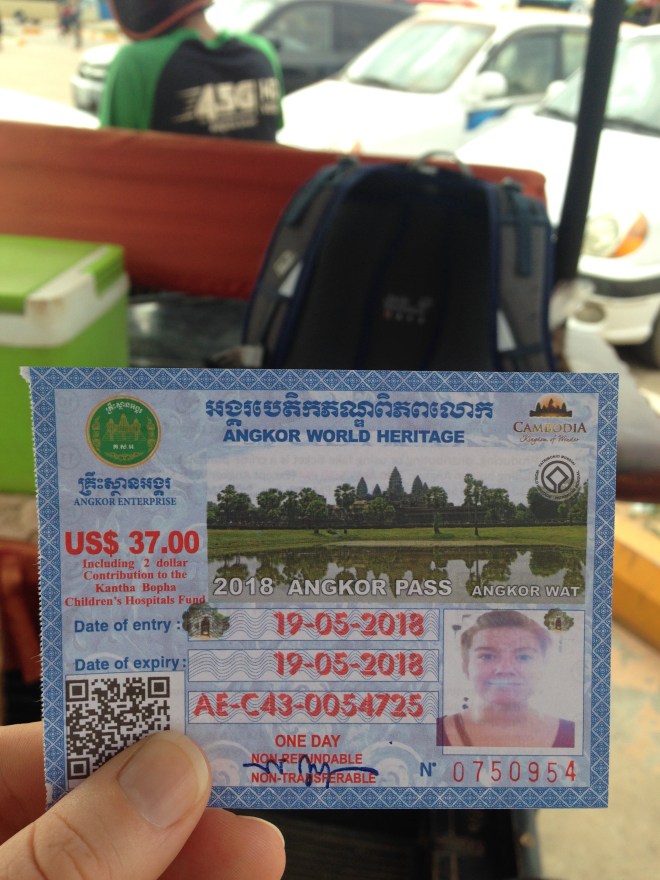
My ticket – that photo 😂
Though none of the other temples compare in size to Angkor Wat, there were certainly others that I enjoyed walking through more. Here are some photos of the temples in the order we saw them (Angkor Wat being last).
First, Banteay Kdei ( I think).
This is the first temple our driver dropped us at – though we still aren’t entirely sure which one it is, but based on the map, this is our best guess 😂. I have little to tell you about it except that it’s bigger than it looks and that the carvings are super intricate.
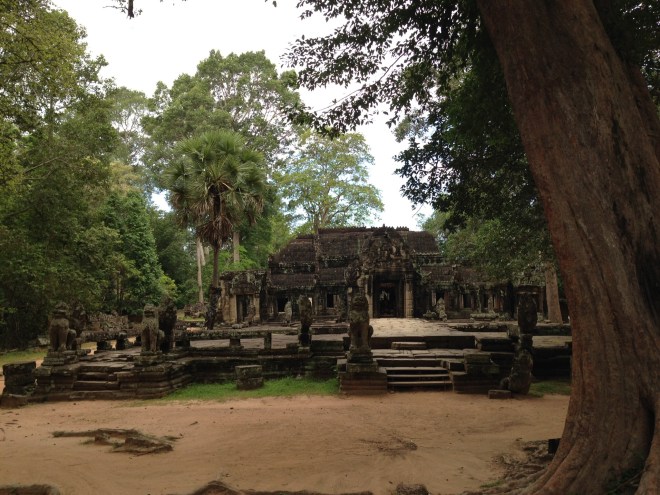
A view from the front

Buddha, just inside the front.
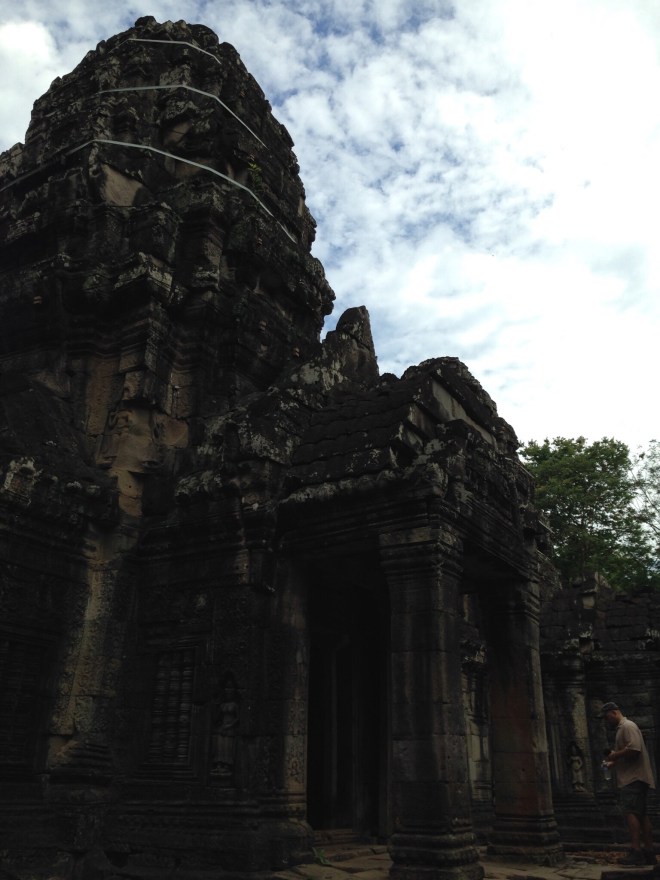
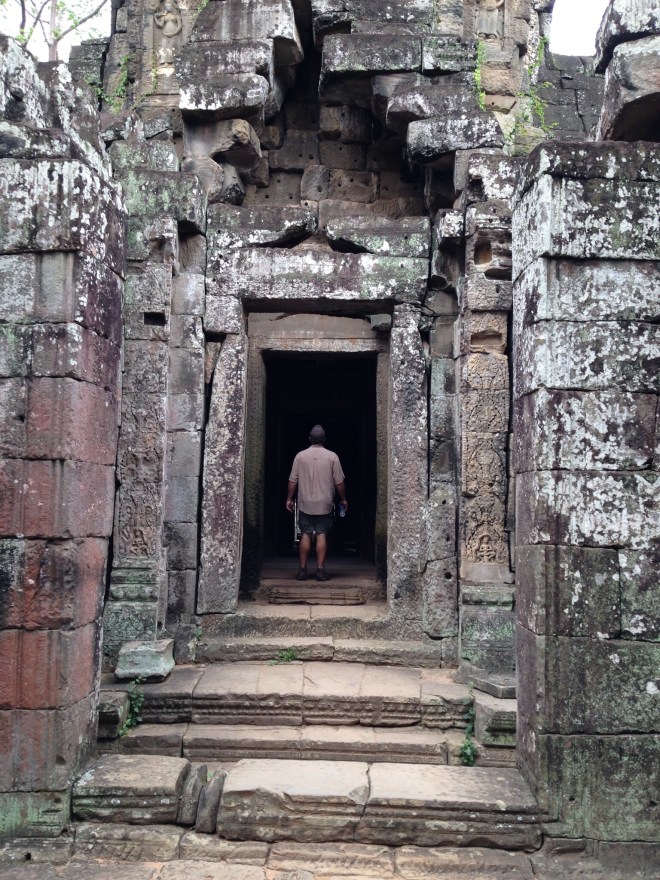
To the right is Kirk – I was trying to show how tall this place actually is.
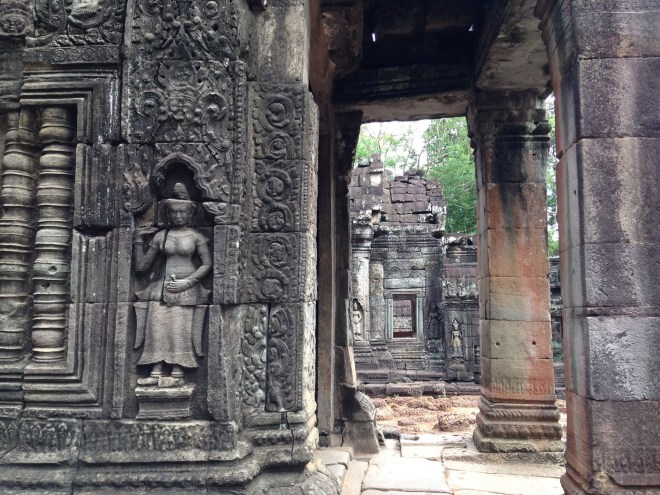
Y’all, imagine the tools they used to carve those details. That had to take forever!
—

A view from the back, which shows more of it’s size.
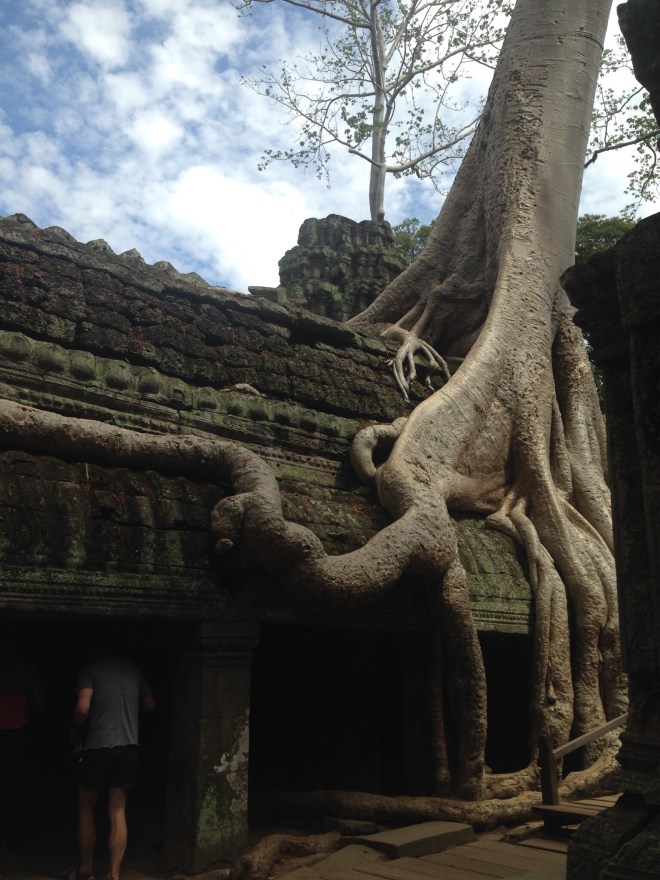
Our next stop was Ta Prohm, one of the more famous of the temples, built just before 13th century (around 1186). This temple is unrestored (other than the visitor path going through it) and still has beautiful humongous trees growing on and around it. The light brown roots of the trees descend down the sides of the walls and wrap around the dark grey stones. It was one of my personal favorites because of the raw beauty. Nature has a way of taking back over that which we’ve taken from it – even these enormous rocks couldn’t keep the trees out. It’s quite a sight.
If any of it looks familiar, it might be because Tomb Raider was filmed here.

The front of Ta Prohm. It’s hard to tell from these pictures, but those giant trees have grown over a heavy stone path leading to the front entrance. The tree seen growing right in the middle of the building is the same one in the next picture.
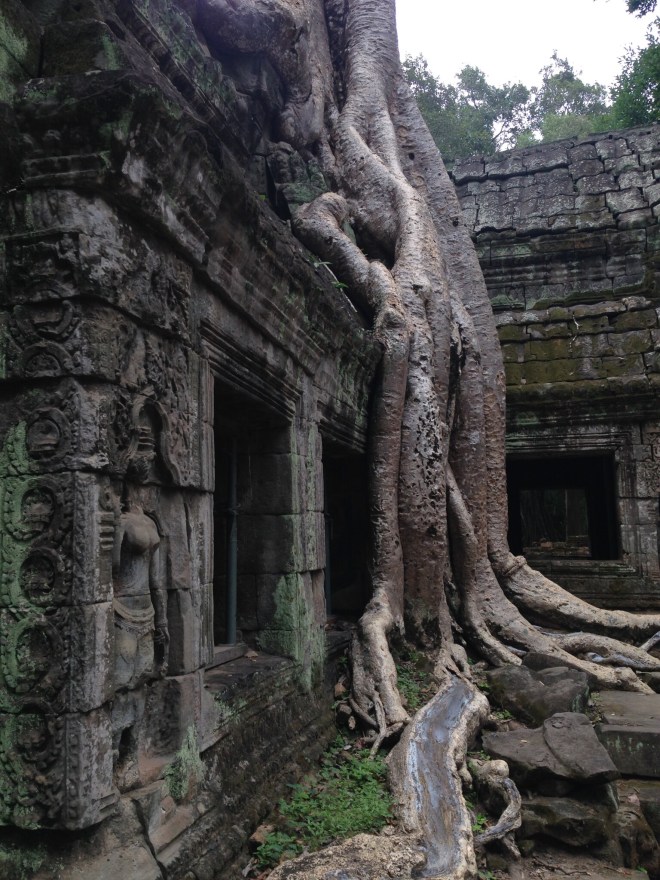
The first of the giant roots we saw. I don’t understand it, but that tree was growing on top of the building, and it was huge!
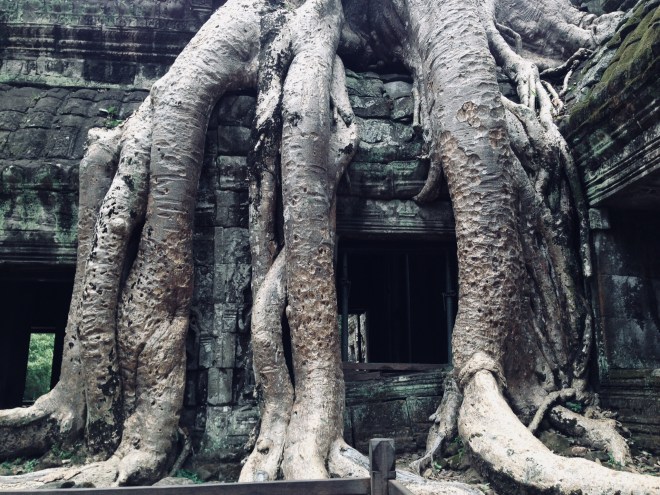
Same tree, different view. The roots followed the walls down, avoiding the window.

Same tree. Those roots are so big!
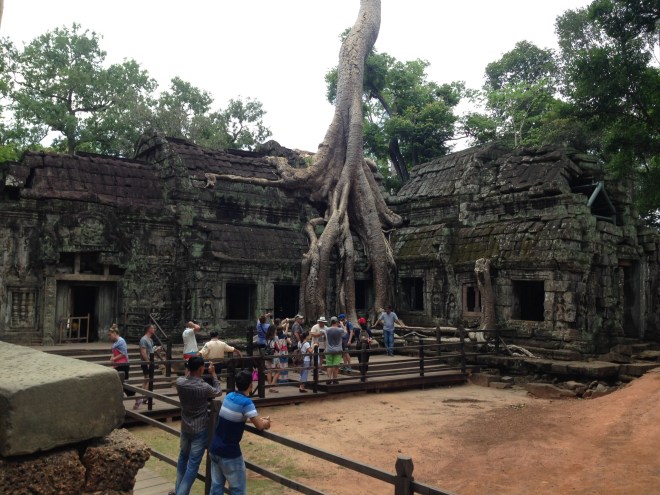
I spend so much time trying to keep other tourists out of my photos, but I’ve found that sometimes they are quite helpful in showing size. That’s still the same tree, from farther away.
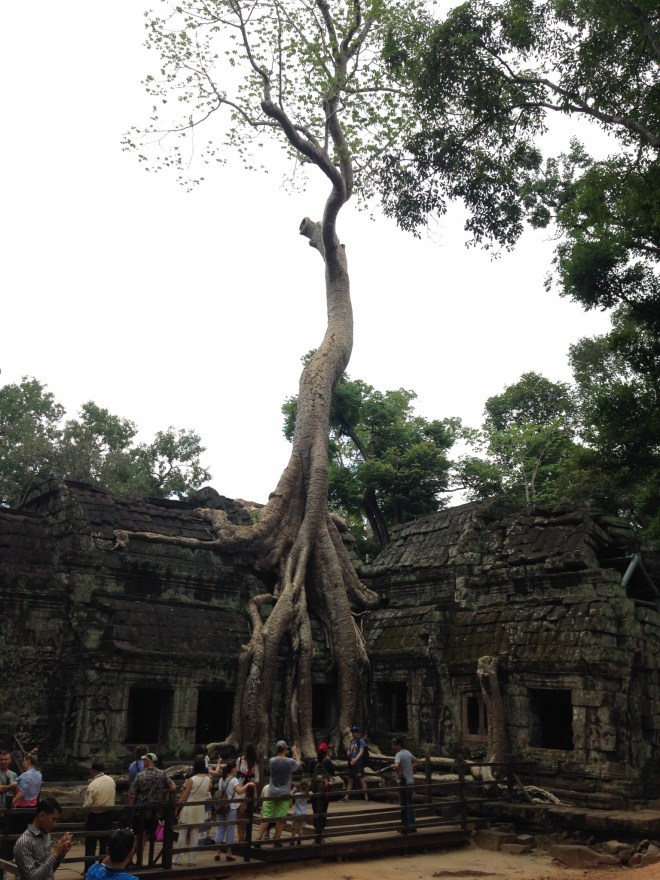
A view of the whole tree.
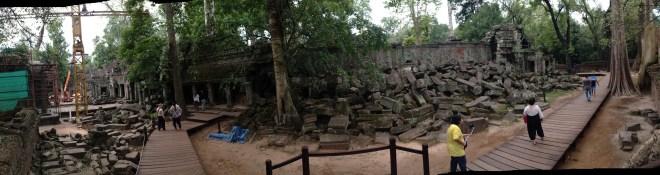
The backside of the building, the stones, for the most part, how they found them.
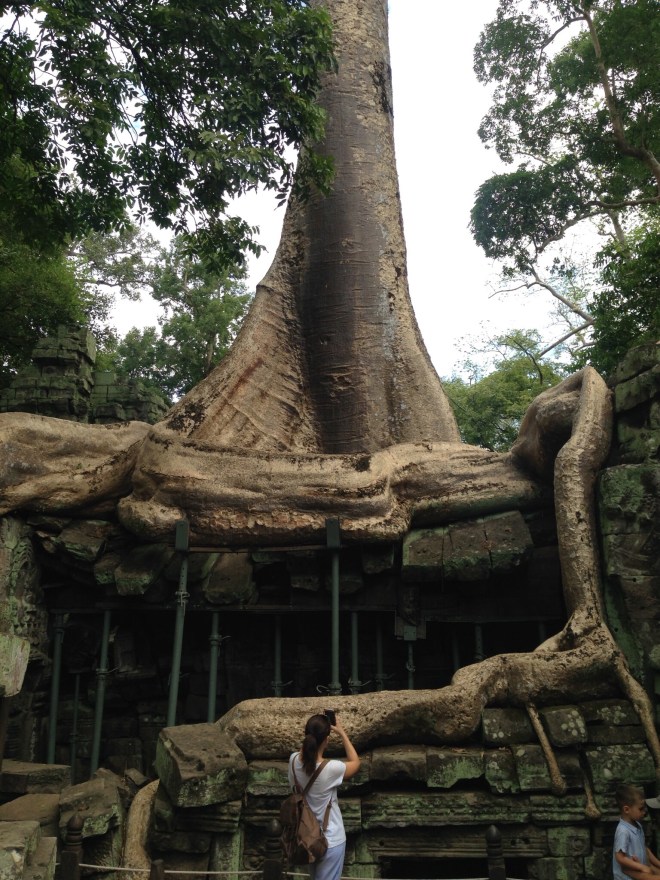
A different tree that they’ve put supports under. I still can’t get over how big they are!

—
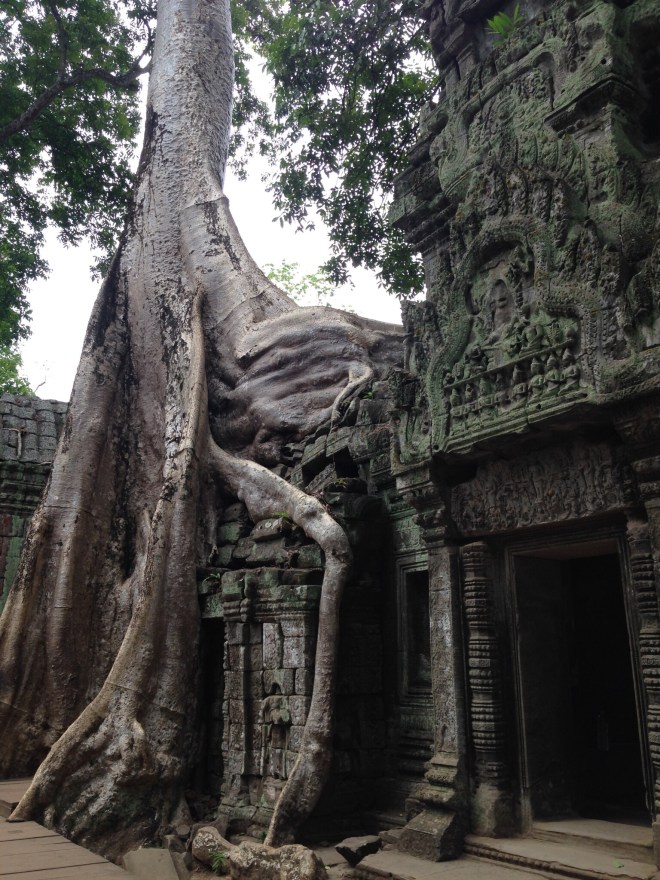
A close up of the tree above

How the roofs look from inside – they are literally just stacked stones. it’s amazing how long they’ve stayed!

Banyon tree – it’s actually a parasitic tree that gradually takes over it’s host tree, but as the roots grow down it’s so beautiful! These grow to be extra huge.
Our final tree/wall sighting.

A picture inside Ta Prohm without any roots – this also shows how lucky we got with the weather!

The exit gate to Ta Prohm
As we walked back and hopped in our tuk-tuk, we saw a line of other drivers with homemade hammocks napping in their tuk-tuks as they waited for their riders to finish looking around. There’s no telling how many days a week they do this.

As a side note, a tuk-tuk is kind of a cart with seats pulled by a motorcycle. They are cheaper than taxis and an easy way to get around.
Next, Ta Keo
This complex is also much larger than it looks. While the other temples we visited were ground level with towers that were tall, this temple is several stories tall with towers on top – so, extra tall. You notice it immediately as you drive by because it’s above the tree line. We climbed to the top and started talking to a guy who told us about the temple. Apparently a king ordered this temple be built, it was finished, and they began adding decorations to the stones. However, before they even finished one side of the building, lightening struck it and the king called the lightening a bad omen. He told the people to leave it as is. It’s remained largely unused and unfinished ever since.
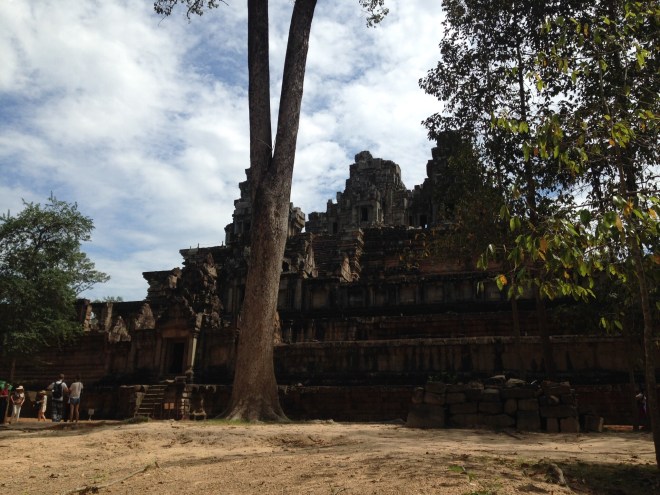
A view of the whole thing.

On the first level – look at how precisely these stones are put together!

Pictures taken from the second level of the temple of the stairs going to the top (with me in the pink and black walking up them – note how large those steps are! The stair is nearly at my knee!) 🙂

On the top level where you can then climb to the top of the towers. Kirk is to the right (for size reference)
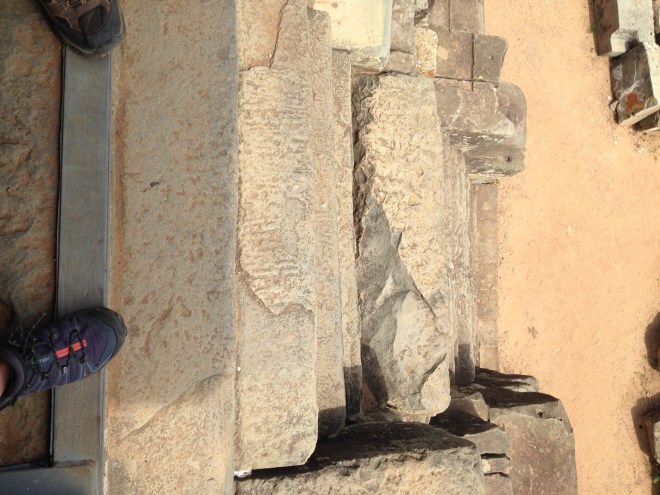
Looking down from inside the top tower – those stairs were so steep!

Going back down, Kirk in front.
After visiting Ta Keo, our driver asked if we wanted to go to one of the less visited unrestored temples that the tourist companies don’t go to because it’s in the middle of the woods (buses don’t fit). Excitedly, we said yes.
It’s called, Ta Nei. I don’t know much about it, but you find it by taking a small bumpy road into the woods. Other than a few support beams to keep it from caving, it’s completely unrestored.
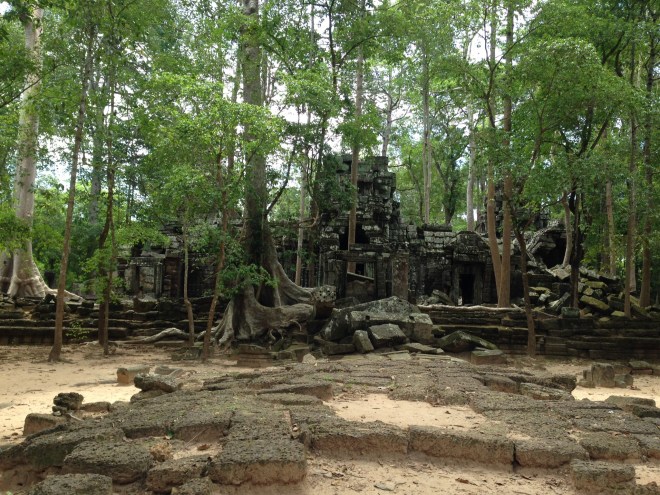
View of the front.
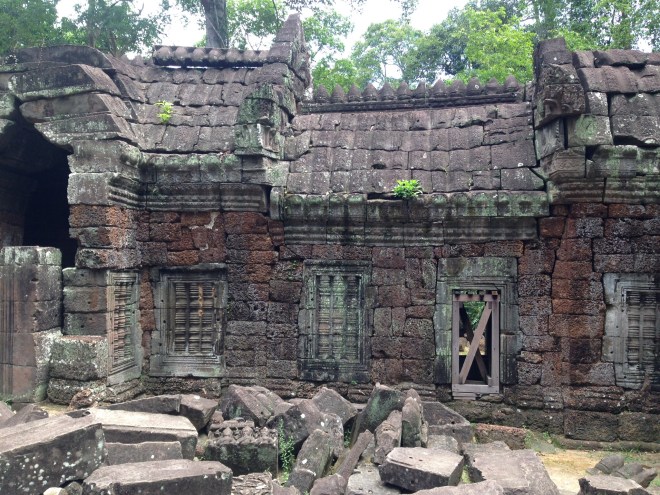
You can really see how perfectly they shaped and stacked the stones on this one. The whole building is a giant puzzle – even the roof!

The parts that have fallen in.
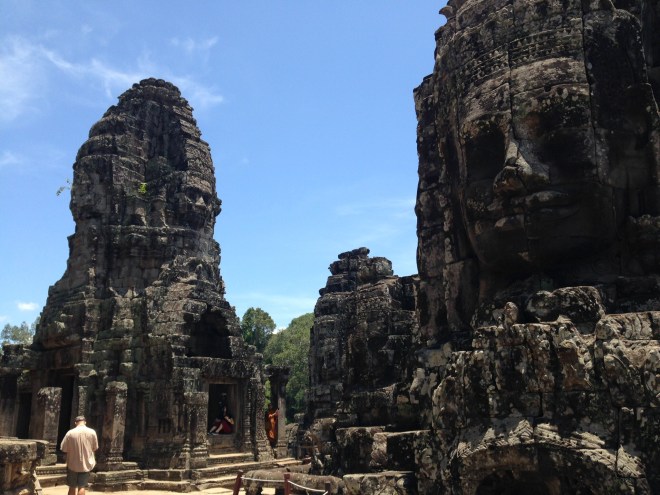
Our next stop turned out to be my favorite. Like, favorite favorite – favorite ruins I’ve seen in the world so far (though there are still plenty to be seen!). I’d seen pictures of it prior to arriving, but actually walking up on this place is something entirely different. It’s known as Bayon, but is also referred to as the temple of faces. This large temple has 54 peaks and is decorated with over 200 large chiseled out faces. The solemn faces perched high on the towers view out of the temple on all sides, greeting you as you approach from every direction. Though there is no gold there, something about this place felt different, as if I were walking up on El Dorado, a place of mystery that you didn’t know existed.
Below: Bayon, built late 12th/early 13 century

The gates entering into the city. Though the temple is the most impressive part of Bayon, much of the old city is still intact too. This gate was similar to others we walked through, but was large enough to drive through. Kirk and I both pulled out our cameras as we approached as the size was strikingly different than any gate we’d seen so far.
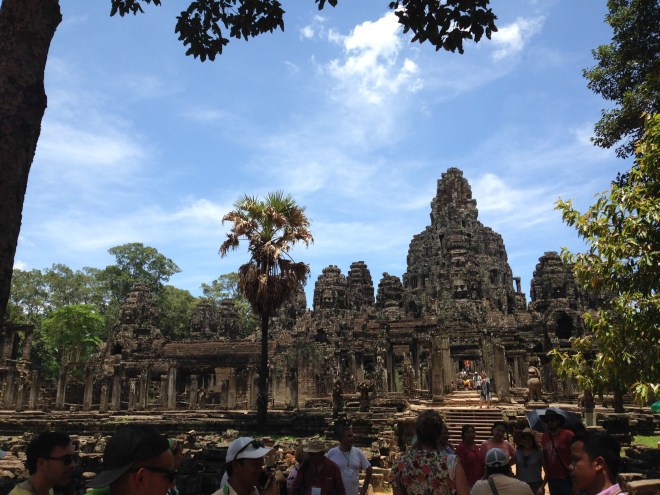
Walking up amidst the tourists.
 Pictures don’t do it justice. Those towers are much farther back and much higher up than a photo shows!
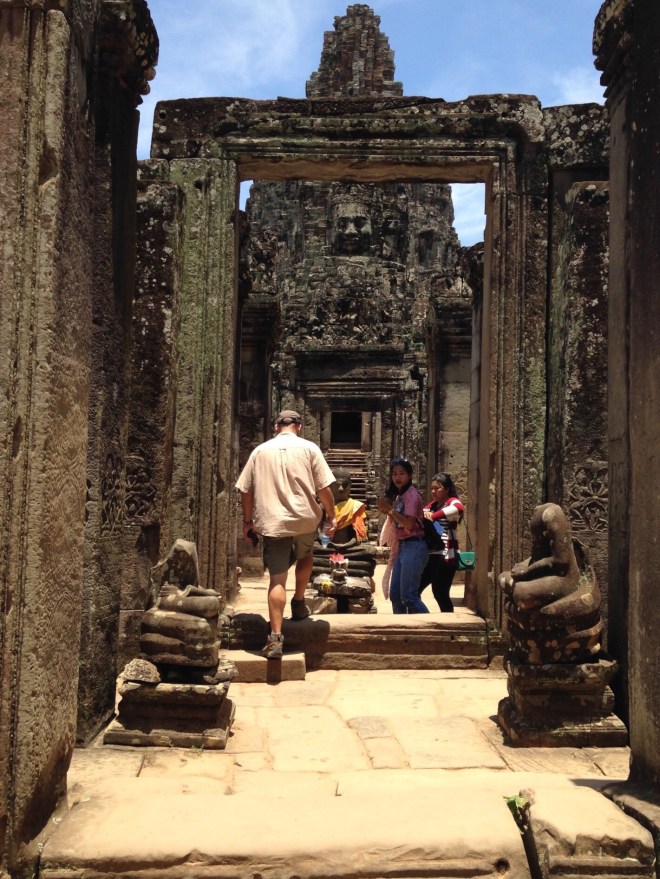
The front entrance with Buddha statues. From far away I kept wondering the significance behind the many “thumbs up” statues. It was only upon a closer look that I realized they were headless Buddha statues 😬. Boy did I feel dumb when we got close 😂. In nearly all the statues we saw in these temples Buddha was depicted sitting on these “layers” (what appeared to be fingers of the thumbs up hand from afar).

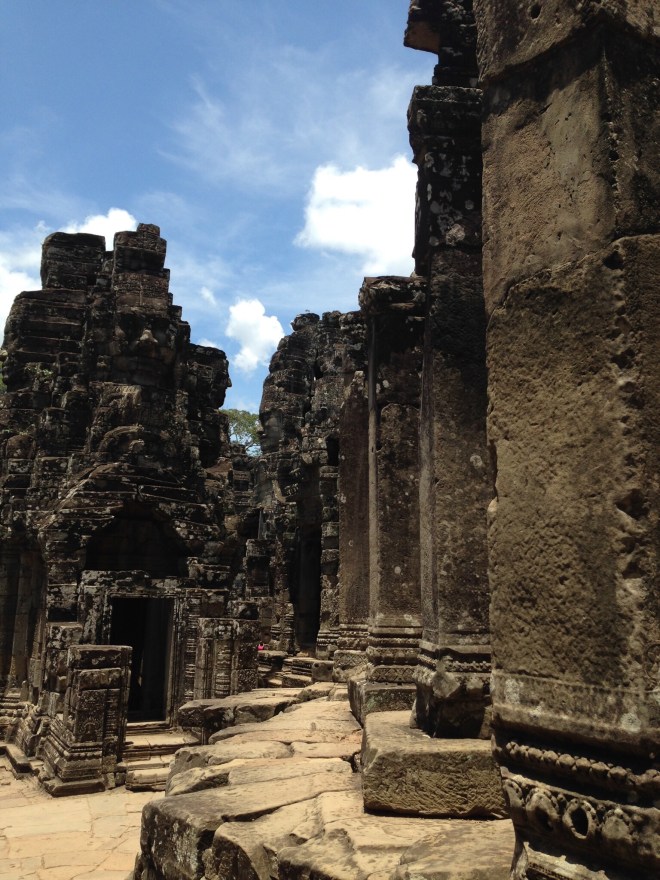
Check out the intricate pattern on these columns! That was all done by hand!

Closer to the faces.
—

The lens on Kirk’s phone shattered and has made many photos look as if they have some kind of filter on them, like above. A new phone is now on the way to us though via my parents who are meeting us in India 🤗!

Faces everywhere. Kirk in the middle as a size reference.
—

We climbed one of the towers and were greeted by faces in the doorways and windows.

Around the sides of the temple, a history of the people is carved – intricate and beautiful!

A final shot of Bayon.
After Bayon, we headed to our last destination, Angkor Wat.
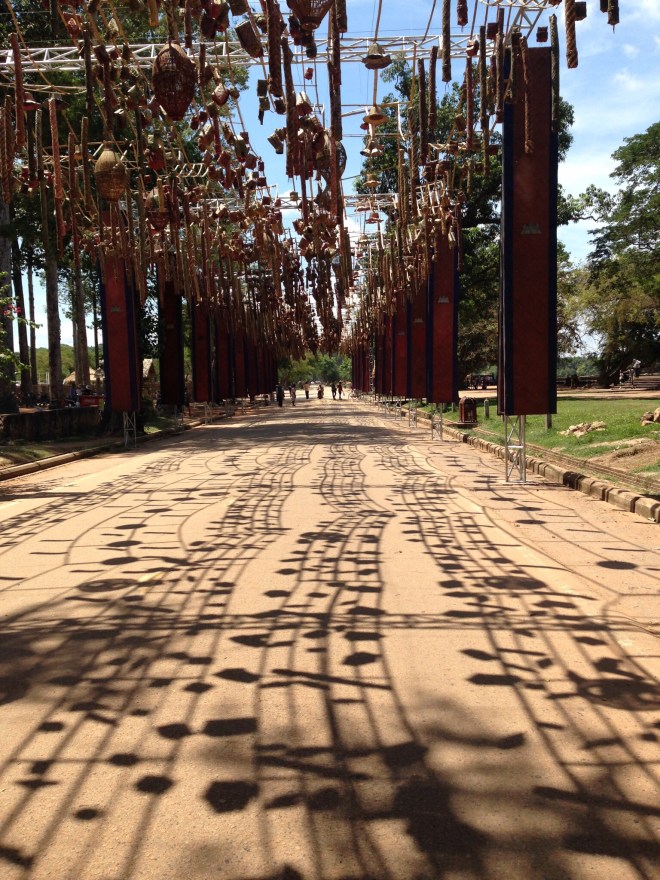
Walking to the official entrance of Angkor Wat, we walked under this art awning. I loved the way the shadows hit the concrete. It looked like an abstract music page :). We took a picture to send to my sister who is a piano teacher, but forgot to send it by the time we had internet again, so, Amy, this is for you 😉.
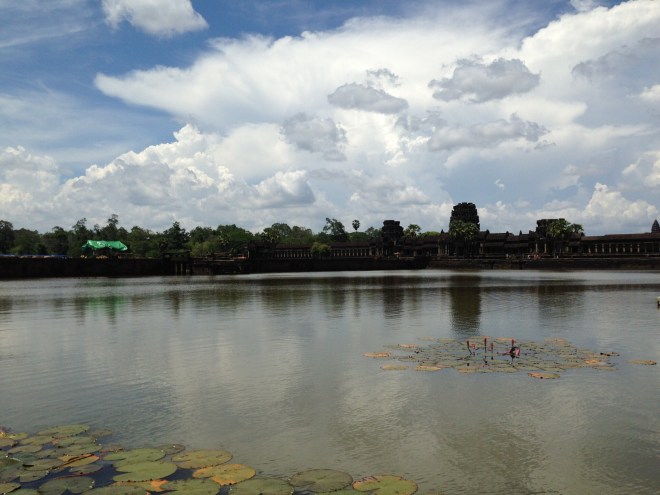
The edge of the moat around Angkor Wat with the entrance gate behind it.

Walking in the entrance gate, we saw this guy hiding behind a column. There are tons of monkeys in the jungle surrounding these temples.
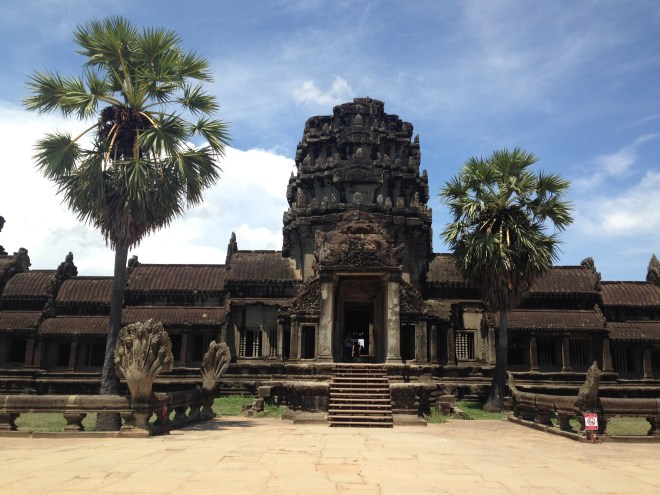
The front entrance, which is still quite a walk from the actual temple.

The famous towers in the background, this picture was taken about halfway down the path between the entrance and the part of Angkor Wat depicted on Cambodia’s flag. In Orange are two young monks. It’s pretty common in Thailand for young and older men to be a monk for a short time before heading back to normal life again. You see them in their brightly colored robes all over the cities.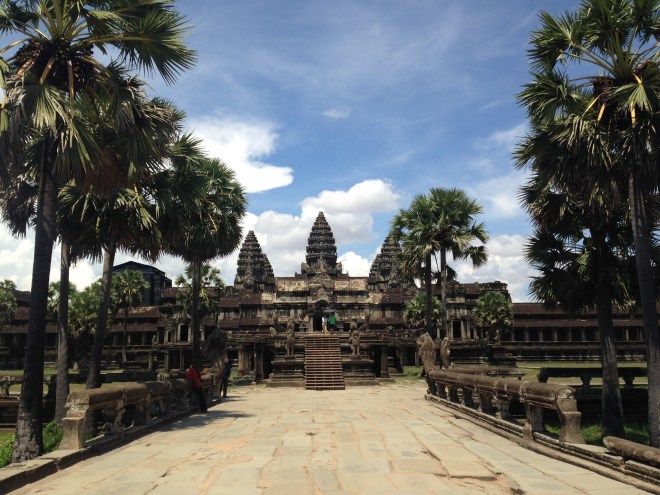
The front of the famous temple.
Though I’m lacking pictures of it, Angkor Wat, like many of the other temples, is highly decorated. Nearly every surface of the walls and columns has designs on it, and like Bayon, the outside wall of Angkor Wat has an extensive history carved in it. Unfortunately, Kirk’s phone quit working entirely before I got all the photos off of it, but hopefully these give you a peek into what you could see if you visit!

One of our first glimpses inside the temple. Everything about this temple is significantly larger than the others. Look at that ceiling height!
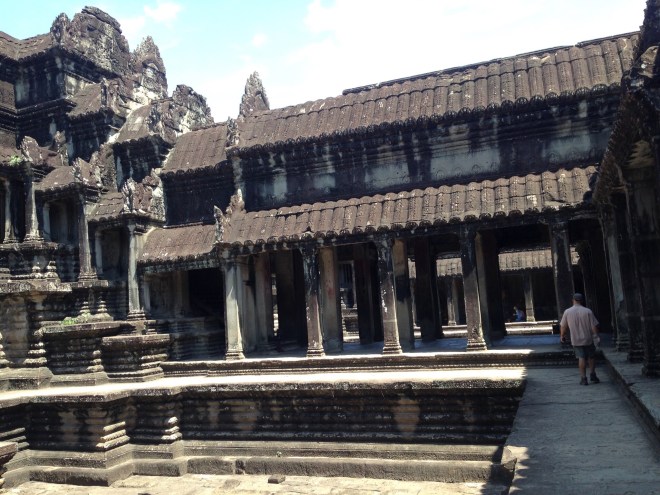
To the left of Kirk is what would have been a large bath in the temple. It was larger than many modern day swimming pools and there were two right next to each other!
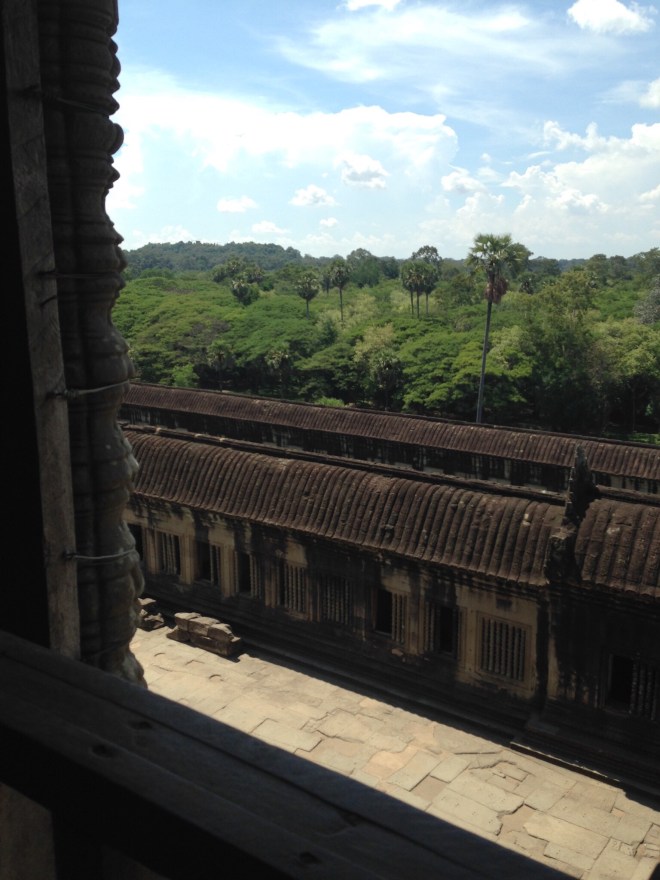
Surrounded by jungle.

—

One of those famous peaks.
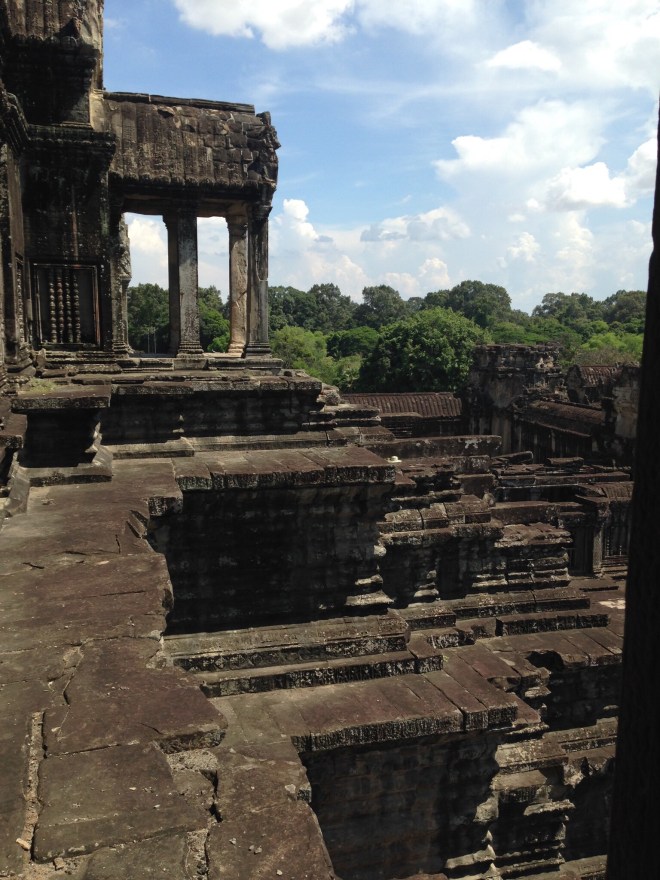
A view from one of the upper towers.

A complete version of one of the Buddha statues. Nearly all were missing their heads.

Exploring the tallest level. If you look close, you can see some if the intricate carvings around the doorway. Some stand out more than others, for example…
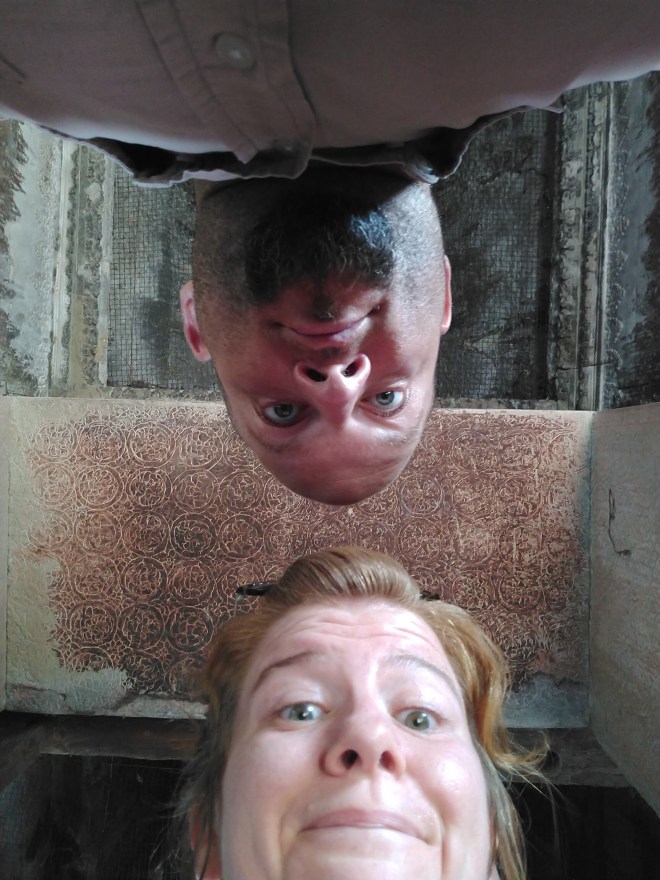 not the best picture of us, but above us is the top of one of the door frames like above. There are far more details than you can see from far away (there is also still a lot of original paint still present)!
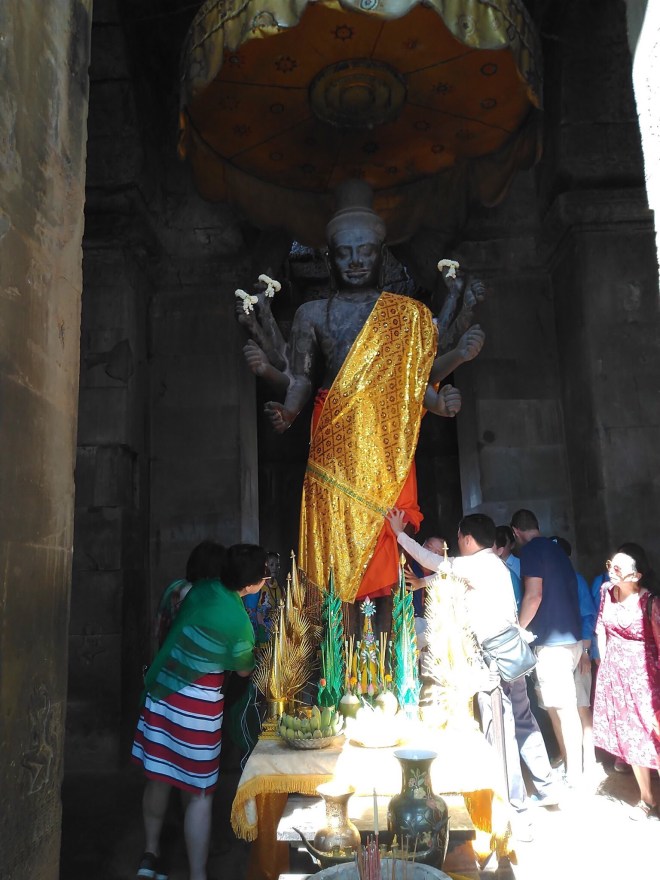
Though the temple has been converted to a Buddhist temple for sometime now, it was originally a Hindu temple. Above is the original statue of the Hindu god “Vishnu” to which the temple was originally built. It was the final thing we happened upon on our way back out.
On a final note, I forgot to mention it in the last blog, but Cambodia is the second country we’ve visited on this trip that uses USD as it’s main form of currency. It comes out of the ATMs and prices are written in USD, though “small change” (coins) are given back to you in local currency. Below is a bill we were given as change after our lunch in the temple complexes.

I don’t remember the last time I got a $2 bill as change!
The rest of our time in Siem Reap was spent doing a little souvenir shopping and laying at the pool. Because it was low season when we went, we got a fantastic deal on a room at a place called Villa Wat Damnak. Their staff is incredibly kind, the salt water pool is humongous, and a huge breakfast buffet was included with the room. Basically, we loved it enough that I want to remember the name of the hotel for the future, so it’s now written down for you too :). It’s one of the nicest places we’ve stayed our entire trip and we only paid $15 a night! I’m positive it’s much higher at other times in the year though!
Next blog: Thailand


I believe this one was my favorite…. you are an excellent writer!
LikeLiked by 1 person
I’m glad you enjoyed it! Thank you!!
LikeLike
I can’t remember the last time I received a two dollar bill as change. Maybe never. I can only remember receiving them as a gift from my dad, or getting one from a bank. We have one or two of them tucked away somewhere. The temple ruins are fascinating. And the trees look like something computer fabricated out of a movie for special effects props. We just watched the new Tomb Raider movie and rented it from Redbox. Can’t wait to see y’all. And it will be soon!
LikeLiked by 1 person