Ho Chi Minh City, formerly known as Saigon, was our final stop in Vietnam before heading into Cambodia. Prior to the Vietnam War, Saigon was the capital of south Vietnam. During the war it housed the headquarters of the U.S. Generals and at the end of the war it was the final place from where the South Vietnamese fighters saw U.S. helicopters fly away.
Today, Ho Chi Minh city is known more as a manufacturing capital in Vietnam. Plenty of US companies have large factories in the area and cheap, often well made knock-offs, as well as some of what are possibly stolen or second rate goods (bags that didn’t make the first cut and often end up sold in bulk to a buyer who then sells them in country) from the companies, can be purchased all throughout the city – NorthFace, Jack Wolfskin, Deuter – all kinds of camping clothes and bags can be found here.
18 years ago when Kirk was in Ho Chi Minh, he bought a large and small “Jack Wolfskin” bag – both of which are the bags he carried with him on this trip as well as throughout his 2 year Peace Corps service. However, right before we got to Vietnam, it’s as if Kirk’s bags knew they were coming home. Small holes began to form in them both that were gradually spreading and one zipper on the small bag quit functioning. They held out until we made it to Ho Chi Minh and have now been replaced. We’ll see if these last as long as those! You can test quality by looking at the seams, zippers, and buckles, but you never actually know what you bought 😬! We’re also hoping it’s one of the “seconds” – (that’s what we were told they are) that would be the most ethical of the options. Either way, Kirk got two bags for $55 – at home the single large bag runs around $200. His old bags fell apart at the right time!
Aside from cheap goods, a second thing Ho Chi Minh City is known for is painters. Much like the tailors in Hoi an, Ho Chi Minh is home to a large amount of painters who can replicate or create master pieces in about 24 hours. Give them a picture, they’ll paint it. Want 2 photos combined? They can do that too. Want your own Mona Lisa? They can replicate it so exactly that your average person couldn’t see the differences.
Knowing this, Kirk and I decided that we wanted to have something made to remember our trip by. We thought it’d be pretty cool to have a picture from one part of our trip painted in a different part of our trip – it’s like two memories in one! We decided that our trek in Patagonia is where our most beautiful photos are from, but the problem was that we didn’t have any good ones of both of us with a beautiful scene behind us. We ended up picking a selfie we took our last day on the trail and brought several pictures of beautiful scenes with us in hope that they could be combined.
Our first night in Ho Chi Minh, we went out looking for dinner and along the way, spotted beautiful modern art pieces at a shop nearby. We’d seen plenty of art shops full of replicas, but this guy clearly displayed his own work. We went in and talked with him and were quite impressed by his kindness and humility. We spent the whole next day walking by shops to see if any others caught our eye, but it was easily clear we’d already found our artist. That evening we took him our pictures, told him a general idea of what we wanted, and in the end said, whatever you think is best. He got so excited and replied, “Yes, I am the artist, let me decide!” The celebration in his voice made me wonder if he often gets asked to paint things exactly as a person wants them, without any of his own flair. We left, unsure of how it would turn out, and when we came back the next day we could not have been more pleased.
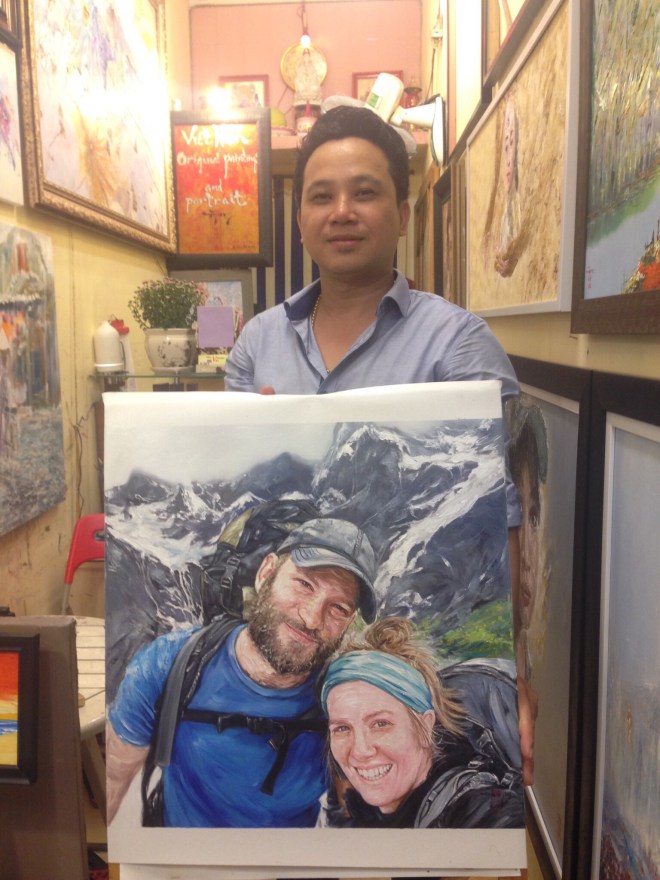
How talented is this guy? He chose the mountains from the Frances Valley on the W Trek and painted us in a modern style. Here are close ups of our faces:

—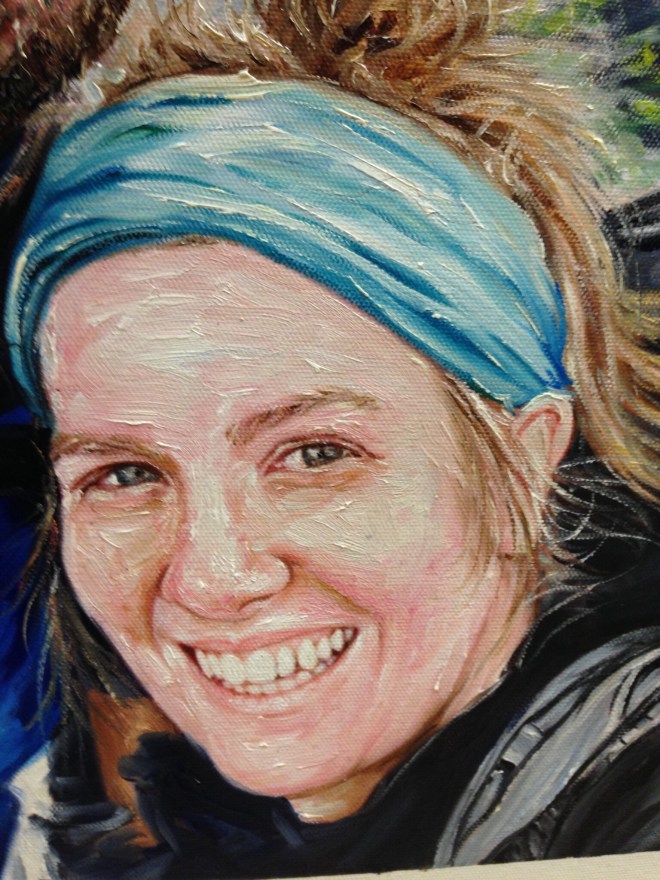
Y’all, he did that in 24 hours! We were also pretty excited that he left the backpacks in the picture. They were certainly apart of the journey! Our task when we return home will be framing… we are currently carrying it along with us rolled up in a tube!
As with the other cities we visited in Vietnam, Ho Chi Minh also had a food scene all it’s on. Below are some of our favorites.

Bun Cha Gio – rice noodles, herbs, lettuce, a few shredded veggies (carrots, cucumber) bean sprouts, spicy vinegar sauce, peanuts, and fried spring rolls.

We have no picture of the actual soups, but we found our favorite Pho place that also happened to serve a delicious “beef stew pho.” It was all the comforts of home mixed with an Asian flair and is actually a common meal here, not just a fusion dish. The picture above is of another one of our favorite herbs that they would bring with the soups, but we still have no idea what it is. It has a strong lemon flavor – anybody know?
Perhaps the most surprising delicious meal(s) we had in Ho Chi Minh were at a place called “Pizza 4Ps.” While on our tour in Ha Long Bay we met a Spaniard who raved about this place. Pizzas in countries that aren’t known for pizza rarely are good enough to even satisfy a pizza craving, but we decided to give this place a chance. We looked up the reviews on it and found that of 1000s of reviews on trip advisor, nearly all were 5 stars. Many called it the best pizza in the world. As it turns out, even with a mix of some interesting flavors, it actually is some of the best pizza in the world – or at least the parts we’ve been to. I wish we had this place back home!
Look up the menu online to see all the interesting combinations. There were so many we wanted to try that we were delighted to learn that we could get pizza made 1/2 one and 1/2 another. Ginger pork, fresh burrata Parma ham, salmon miso cream, salmon sashimi, 3-5 cheese pizza (all housemade cheeses), Camembert and ham mushroom sauce, and for dessert, raspberry and kiwi or apple cinnamon raisin both with vanilla ice cream. Don’t judge us, but that’s just the list of the ones we ended up trying 😬😍.
The pizzas are thin crust, 10-12 inches, and cook in a stone oven for 90 seconds before coming out perfectly speckled and crisp. My must haves if we go back again are the burrata, the salmon sashimi, and the Camembert and ham, though all the ones we had absolutely delicious. The burrata is like a fresh take on a pizza: a cold ball of heavy, mozzarella like cheese topping a cool, crisp salad (tomatoes, basil, leafy green) and fragrant ham on a warm crust – I love the mixing of the hot and cold! The salmon sashimi didn’t taste like pizza – more like an appetizer at a fancy event, but it was so yummy! Raw cold salmon on a warm, herbed, fresh creamy cheese, all a top a crispy speckled crust (you know it’s a good crust when it has speckles from the fire 😍). The Camembert ham is the one I would dub – possible best pizza in the world. It tastes more like a normal pizza at home, but with significantly higher quality ingredients. It’s hard to describe how much it tasted like a normal pizza, while remaining far outside the realm of normal pizza. If you were only getting one pizza, I’d get half the burrata half Camembert ham.
Kirk’s favorites were the Camembert ham and the four cheese. The 4 cheese came with a hint of blu cheese and a side of honey to drizzle on each slice. That honey made it extra special!
Anyway, I’ll stop describing pizza and just say, they now have multiple locations around Vietnam, so if you find yourself in the country, look for them.

Salmon sashimi and ginger pork – the salmon comes out on a separate iced plate for food safety – also, look at that crust!

The only other pizza I remembered to take a picture of before digging in, salmon miso and Camembert ham. Those “dry” looking squares of cheese on the ham melt in your mouth!
Another food we (finally) had in Ho Chi Minh was a hot pot. Hot pots are all around Vietnam (and various parts of Asia) and come with a variety of ingredients. They are basically a soup served with noodles or rice on the side and are large enough to be shared family style. 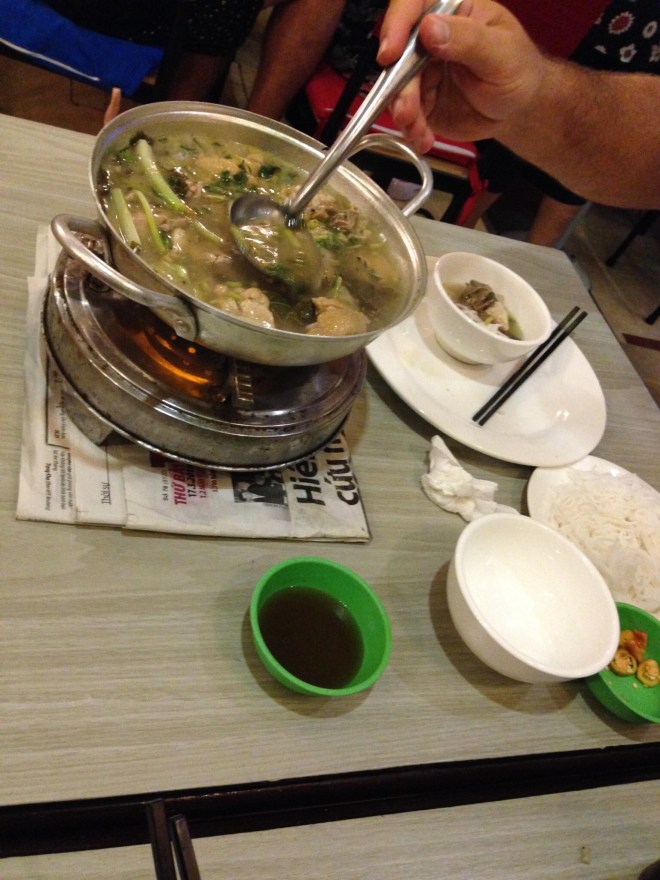
This one was a “sour” chicken soup (think sweet and sour, but less sweet). I was skeptical, but it turned out super tasty!
Onto a few pictures from around the city. First, here is a picture of an example of one of the many electric poles throughout the country..

😬 How crazy is that?
Next, a view of traffic…

Also pretty crazy! There are SO many motorbikes! It’s the main mode of transportation and it’s amazing how much they can carry/fit on those things! On more than one occasion we saw five people on one bike!
A few important/historical places:

City Hall

Directly in front of city hall – a monument and statue of Ho Chi Minh facing out towards the river.
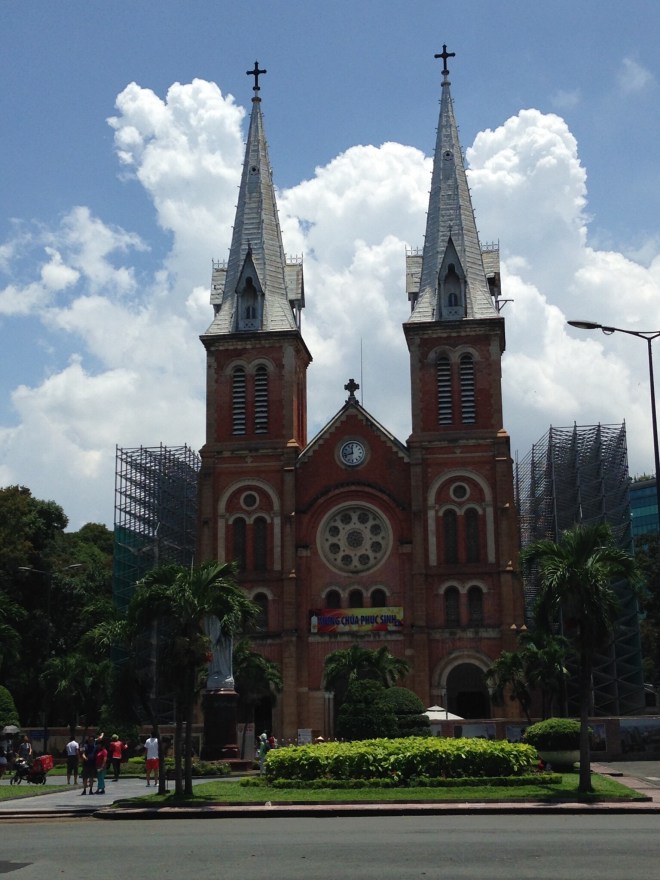
An old church
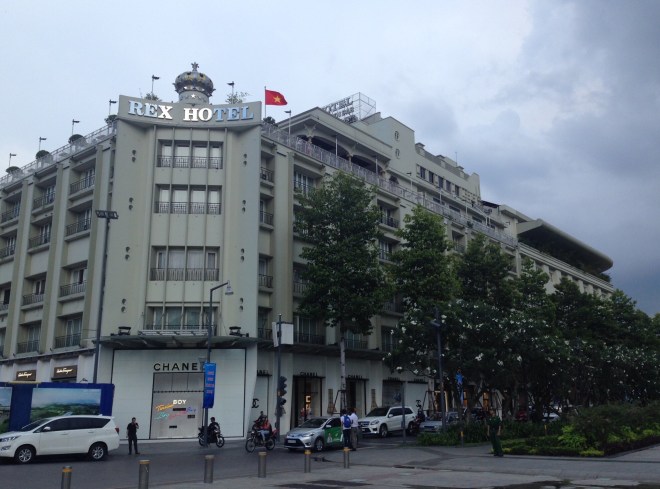
Rex Hotel, where the U.S. Generals were stationed during the Vietnam War.
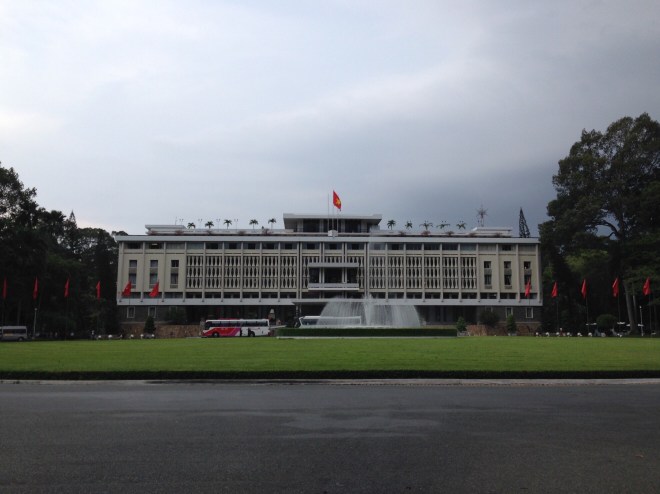
Reunification Palace – home of the President of South Vietnam during the Vietnam war. On April 30, 1975 tanks from the North crashed through the gate of this complex, signifying the end of the war.
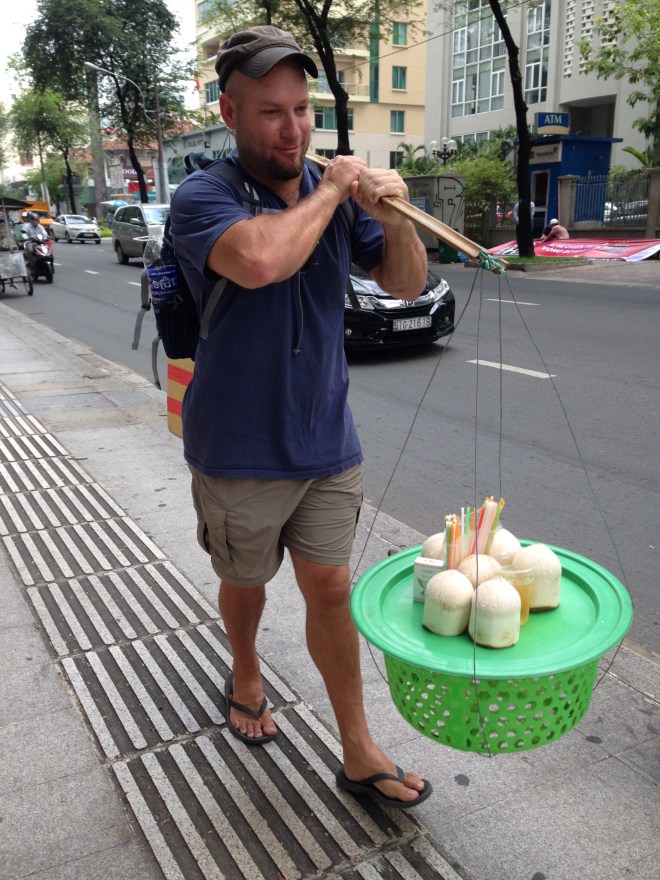
I post this picture because it’s a good example of how many people carry things around Vietnam – it’s a balancing act! This picture doesn’t show it well, but there is a second basket/dish/cooler on the back side balancing the front. I mentioned how there are many “sidewalk restaurants” where people will carry their kitchen with them and set up their stands on the street. This is how many carry their kitchens – you often see a grill with a pot on top of it on one side and serving dishes/additional ingredients on the back side. Pretty efficient! I tried taking one step with it and couldn’t keep balanced!
The real story to this picture is that the owner of this carrier was pretty tricky! He saw we were trying to look up directions on the phone and offered help. After some friendly banter he put his “balancer” on Kirk as a joke, told us to take a picture, and once we started walking, grabbed one of the coconuts, cut it open and gave it to us to drink. We thought it was pretty kind (while holding an air of suspicion) – then he asked for money (insisting we give him over double what we’d paid at other places…). It was frustrating, but part of me appreciates the hustle. We often feel exhausted by the amount that we’ve felt taken advantage of on this trip (y’all, it’s a daily battle), but for most of the people we’ve felt cornered by – that’s how they are barely getting by. It creates a lot of mixed emotions.
On the topic of heavy thoughts – I saved our final glimpses into the Vietnam war for last. While in Ho Chi Minh we signed up for a day tour of the Cu-Chi tunnels. During their war against the French, the Vietnamese began digging out a system of tunnels in which to transport goods and hide. Over a period of 25 years (in which they were fighting various people) these tunnels became a very extensive 155 mile long system that they lived in and traveled through – eventually right underneath US and south Vietnamese soldiers. It was really dangerous being under ground – aside from the obvious chance of the tunnels caving in, from what I’ve read, most of the men were ill due to poor ventilation, poisonous insects, and mosquito borne disease, but staying in the tunnels by day and counter attacking at night were some of the villagers best defense against peoples with far greater weapon defenses. The Vietnamese definitely weren’t completely defenseless though. Their creative strategies are pretty fascinating.
It was raining the day we went, which in some ways added to the experience (it really makes you wonder how they survived underground in rainy season!), but it made for some pretty terrible pictures!
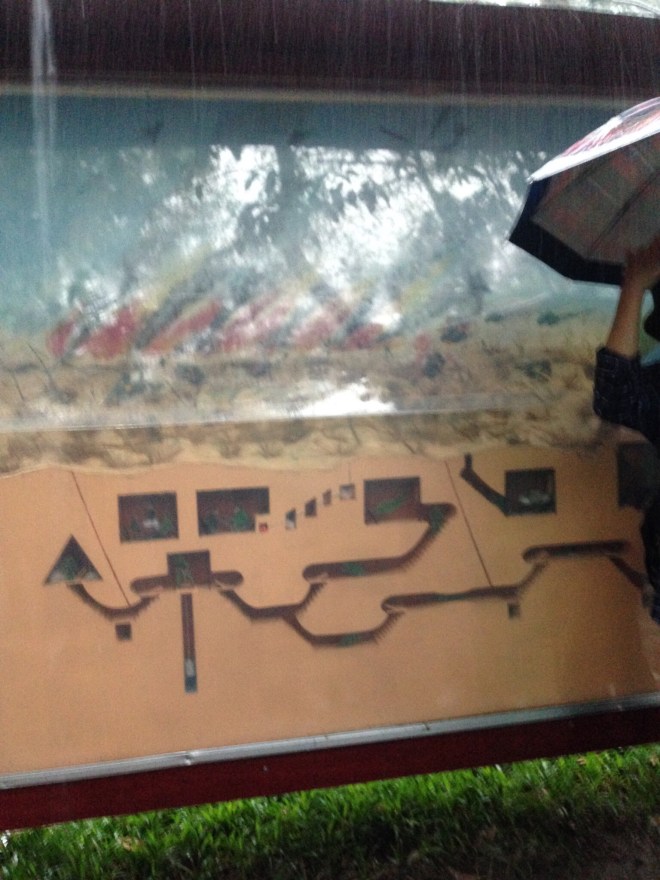
This is a model of some of the tunnels – they were crazy extensive! They hid their ventilation holes by having them come out under bushes. They had wells dug in their tunnels both for water to drink and to drain water when it rained. They also had a system for cooking (because they cooked by fire) by having multiple small rooms for the smoke to rise through before it reached above ground. This made the actual stream of smoke coming out above ground so thin that it wasn’t easily noticeable. They were also incredibly good at hiding their entrances and also protected themselves by creating traps, like the one below.

Clearly this isn’t exactly what they did (it’s covered in Astro turf 😂), but it is an example of the types of traps they set up throughout the jungle. They created many different styles of traps that were hidden until you stepped on them. In case it’s hard to see, those are large spikes in the bottom. The door would revolve when you stepped on it, sending you down into a pit full of spikes. Last time Kirk visited Cu Chi they told him that they often covered the spikes with human feces in hopes of causing infection to those who fell in. Interestingly enough, this time when we visited the area had been made significantly more touristy (it was basically still a jungle filled with holes and traps when Kirk came before). Now the area is set up more like an outdoor museum and they told us that these traps were used only to arrest people, never to kill…
I don’t know why the government has decided that’s the message that needs to be spread, but it’s fascinating to be a witness to. They proudly claim kills in certain areas of the war, but hide others.
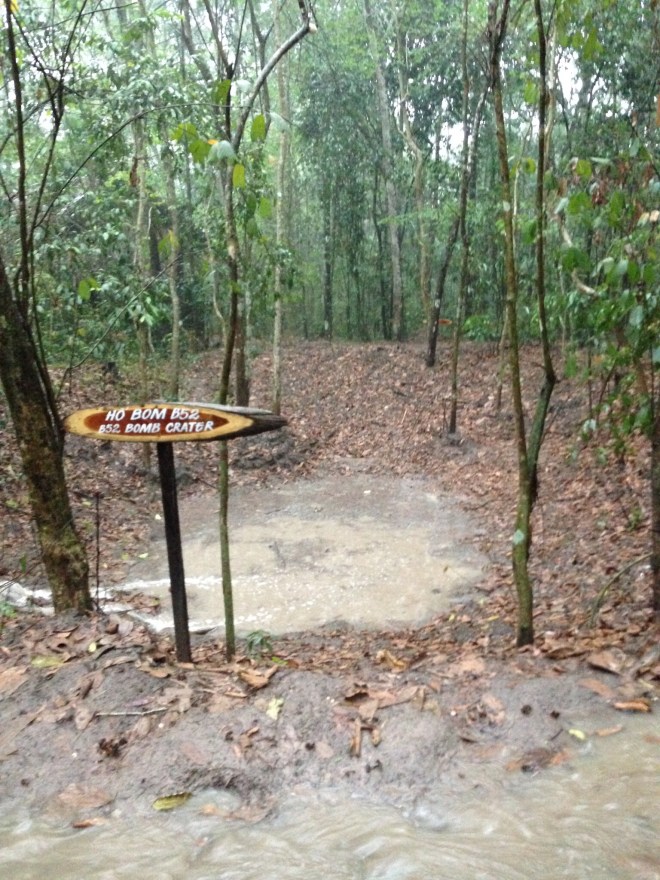
This is one of the many craters made by a US bomb. It’s significantly larger than this picture makes it appear. Towards the end of the war the US bombed the area in hopes of caving in some of the tunnels.

This is an example of an “entrance” into the tunnels. One small guy in our tour group volunteered to demonstrate.

Our tour guide to the left, telling us how they covered the top of the door with leaves prior to closing it.
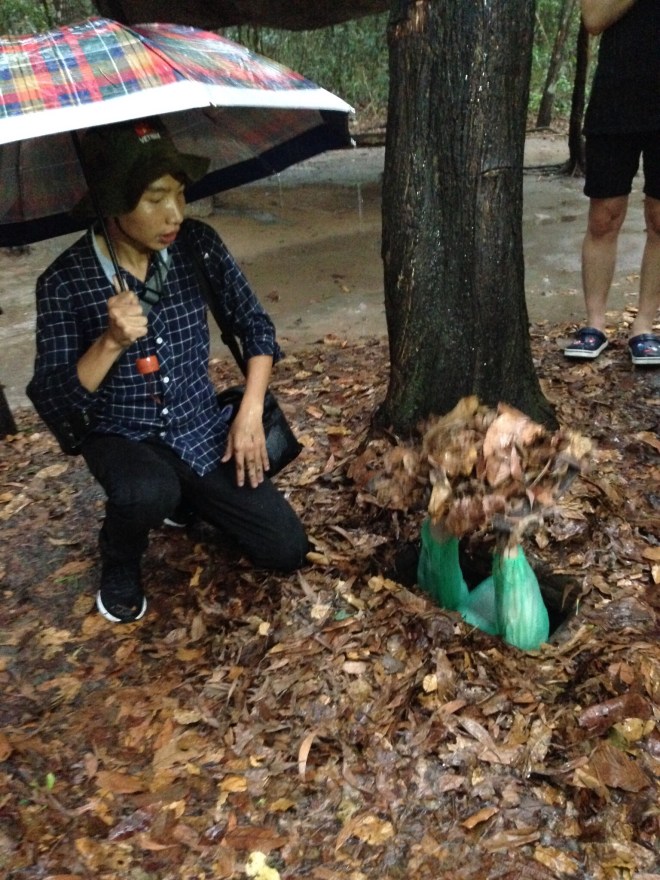
Down…
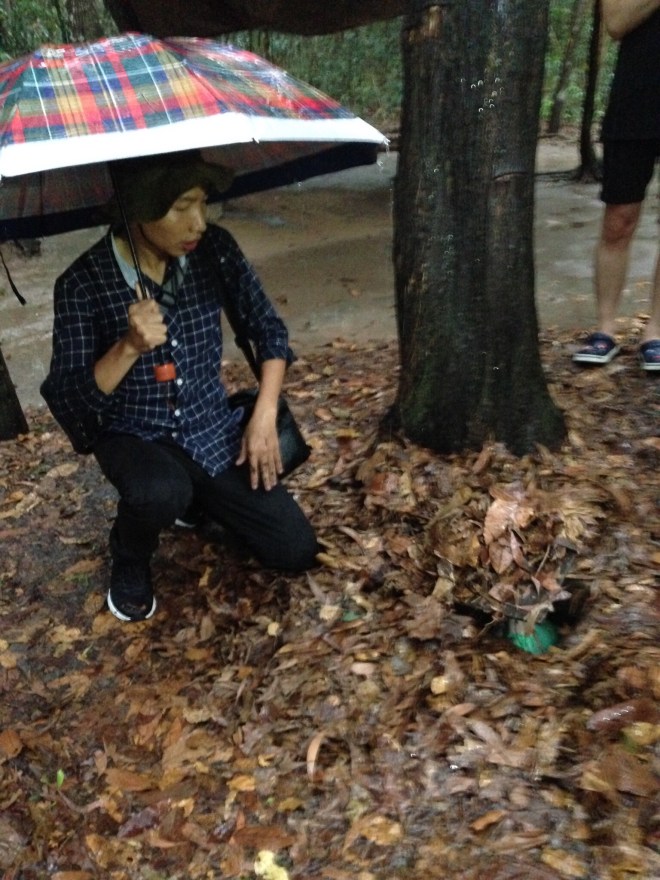
Down…

And he’s in – Seriously, I’d have no way of finding this door unless I knew exactly where it is. It’s not like anyone would want to scrape around looking for these doors – especially with traps set up everywhere too. It was a pretty brilliant strategy.
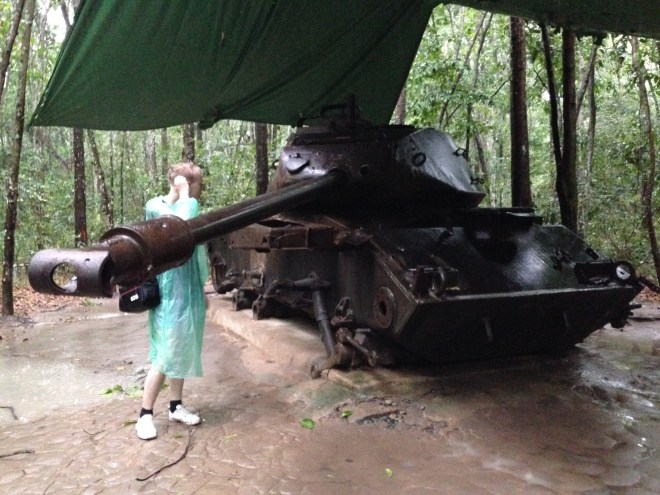
A US tank that had the tracks blown off. Kirk said last time he was here this was just sitting in the middle of the jungle. They’ve since built a platform for it and put a covering up.
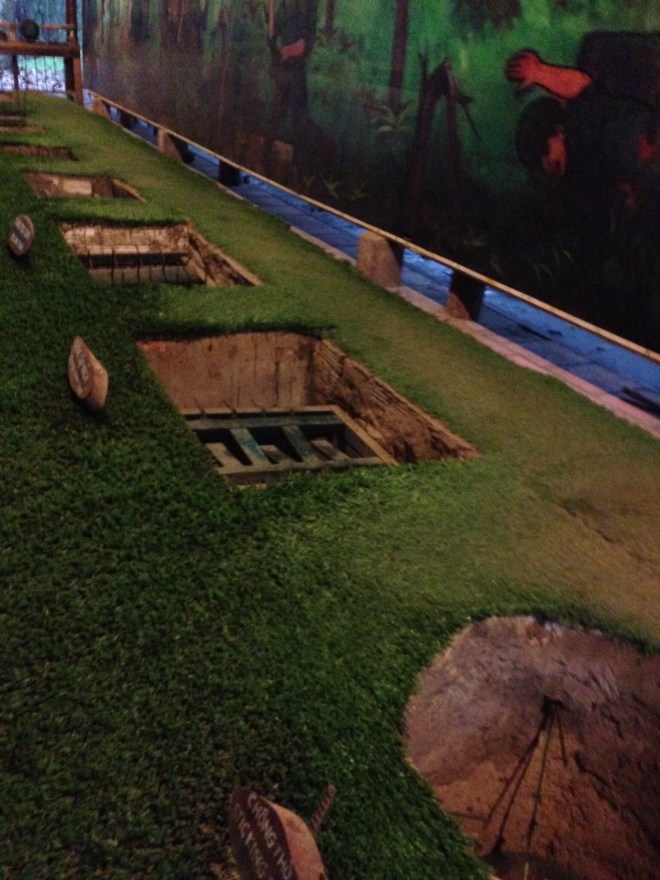
More examples of traps, all with different types of spikes to fall into.
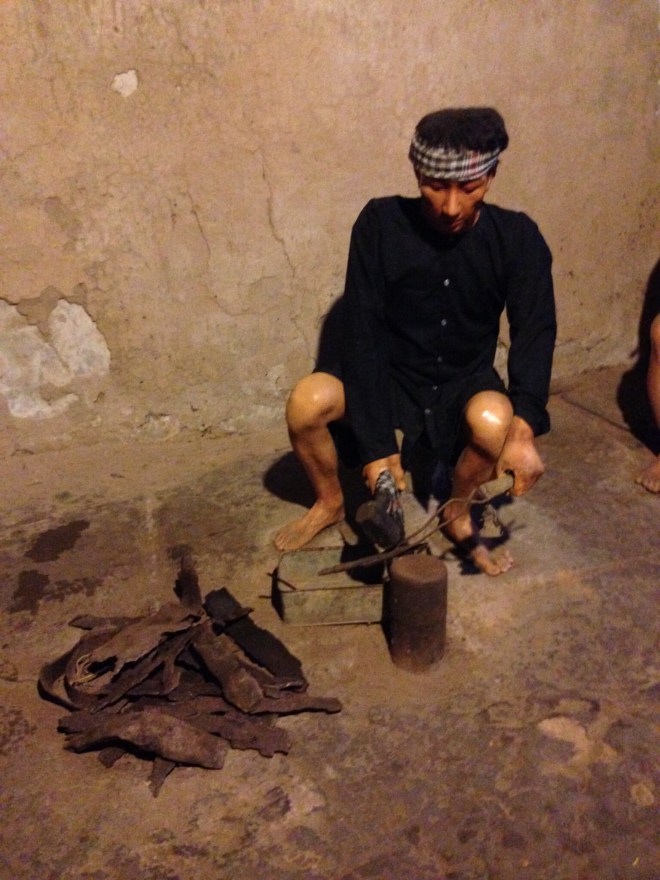
To the left are actual shards from a bomb that exploded. They would gather pieces of bombs and form them into new weapons. They would also gather bombs that didn’t explode and mine them for the gun powder to create their own land mines. They were exceptionally good at using the resources they had available.
As a side note, I never realized how many bombs don’t explode in war. It’s tons. Literal tons, and many are still being dug up. It’s crazy.
This is also crazy…
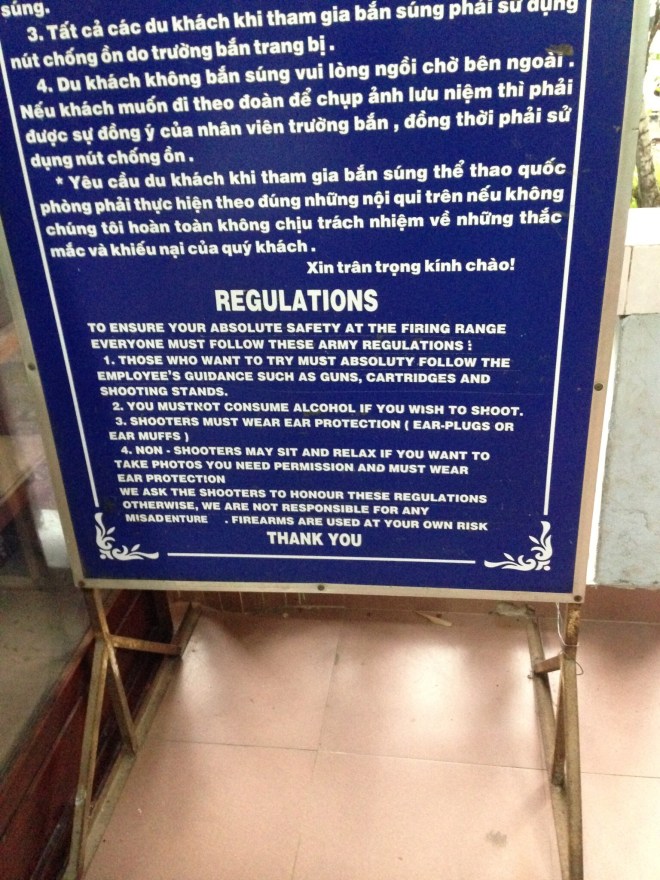
You can pay to shoot an AK 47 or M30 at this site. It costs per bullet and there is a shooting range, but y’all. I am baffled by how this idea ever came about. I actually just finished reading the blog of someone who was siked to go to Vietnam and visit the Cu Chi tunnels because this was their only opportunity to shoot these guns legally – which, fair enough – their government is allowing it and if that’s your dream, a shooting range is your best option, but man. I couldn’t stop thinking – how many people died in this area I’m walking through? For how many people were these guns a thing to fear, not something fun to try? How many people used an AK 47 here because they were fearing for their own lives? Really just, how does a former war zone turn into a shooting range?
I mean, just imagine, if you were Vietnamese, and someone in your family had died in that area by being shot (of which many many people did), would you want there to be a possibility of citizens of the country who killed your family coming and shooting guns there for fun? There would be an outrage in the States.
But the truth is that I probably only have those opinions because I grew up in a free and developed country. There are still many thoughts and ideas that people in communists countries aren’t allowed to question, and honestly, when you are in great need of money, you come up with solutions to fill that need – including setting up a shooting range at, what seems to me, an unconventional space. It’s amazing how much of our thinking is dictated by our location of upbringing
Back to the Cu Chi tunnels.
After passing through the shooting range you have an opportunity to go down in some of the safely replicated tunnels. They’ve made them a little larger for tourists (you can squat as you walk instead of crawling) and they’ve been reinforced so they won’t cave in on you. It’s still pretty crazy to realize that people lived in these!
Having crawled through the tunnels before, Kirk didn’t want that experience again, so he stayed behind while I went through with a few from the group. 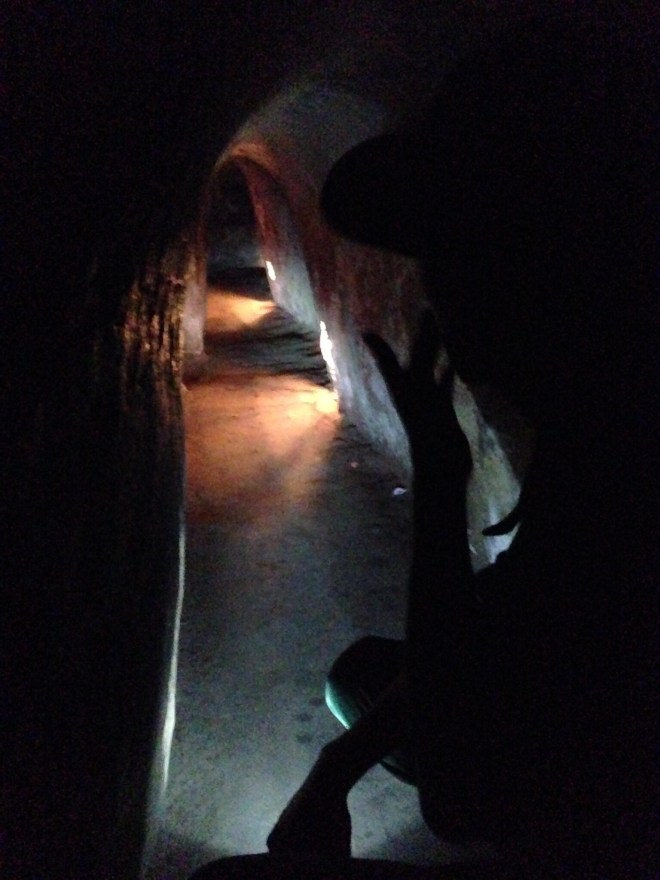
The path ahead of me in the tunnel

The path (and man) behind me in the tunnel. This probably gives a better idea of the height of the tunnel, though, again, these were much larger than the ones they actually used!
A few days after visiting the Cu Chi Tunnels, we went to our final museum for the trip, the War Remnants Museum. It was maddening and heartbreaking. Incredibly biased while also telling a truthful terrible story.
The first 3/4 of the museum is the story of the war, as written by the Vietnamese government. Some of it is truthful, some if it is simply pictures labeled in such a way to tell the story they want to. The final story of the building is currently an exhibit put together by photographers of the war from around the world – these photos are captioned by the photographers who took them and tell a completely different story than many of the other stories of the building. It’s still heartbreaking – we (America) did a lot of terrible things, but not all the things we were accused of in the lower stories of the building (and alongside that, the lower half of the building also didn’t mention any of the atrocities committed by the north Vietnamese.)
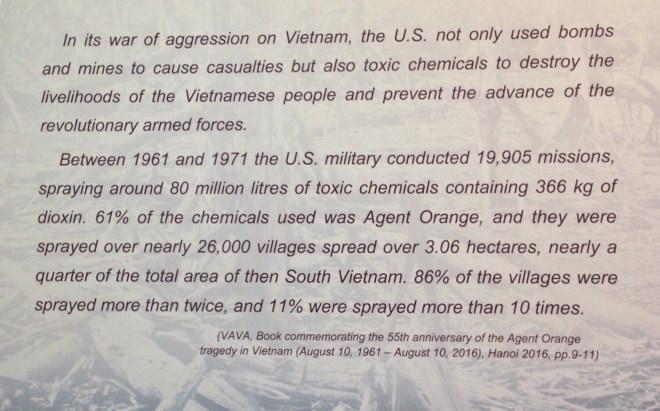
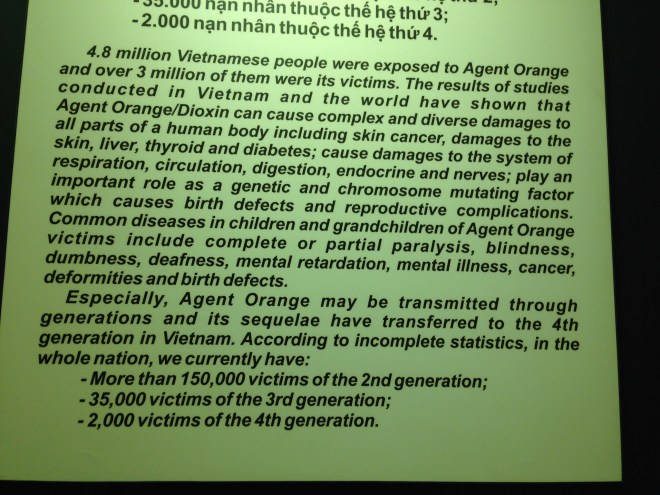
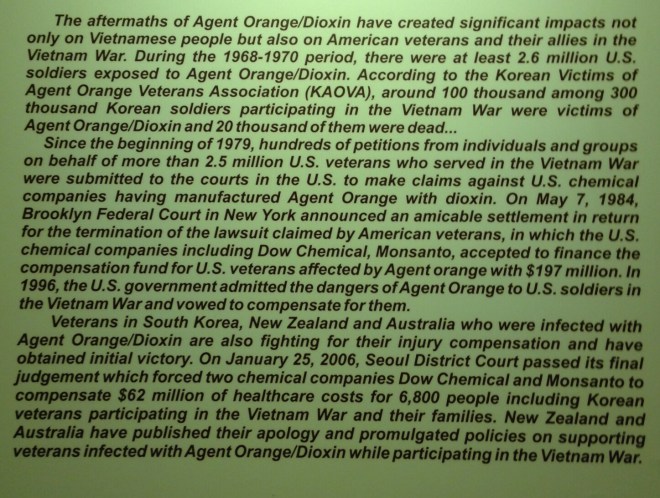
Perhaps the hardest thing for me to learn about on this trip was the US’s use of Agent Orange in the war. If you haven’t heard of it, it’s worth looking up. A brief explanation is that Agent Orange was a chemical sprayed by the US all over various parts of Vietnam to kill crops and forest cover of the enemy. It apparently wasn’t throughly tested before it was used though, and it’s caused a tons of health problems for both Vietnamese people and US veterans. Vietnam is now on their fourth generation of babies since the war and large amounts of children are still being born with extreme deformities. The museum has a whole room dedicated to photos and stories of people affected by the agent orange and those are definitely not fabricated. It’s heart breaking and not enough aid has been given. There are plenty of veterans back home unable to afford the medical help they need after being exposed to this chemical and very few resources are available to people here affected by it.
On many street corners around the cities in Vietnam, you find individuals affected by agent orange trying their hardest to survive by begging or doing the only work they are able. We’ve encountered numerous individuals who are unable to walk or see who keep a small box of something called “tiger balm” (an essential oil infused balm that is used throughout Asia for healing various ailments) in their laps as they scream out “tiger balm” every few seconds in hopes that someone will buy some. They can’t see who they are selling to or chase someone if they were to be robbed, but they’ve learned to count money by the feel of it and faithfully sit on those corners daily. They shouldn’t have to do that, but it’s amazing that they do.
I wasn’t willing to take pictures of the individuals pictured at the museum, but below are some of the plaques they had posted about agent orange. I haven’t looked up the accuracy of these, but the effects of this chemical are visible without me needing to know the exact amount sprayed or the exact number of people affected. It was a lot, it is a lot. The same phrase keeps running through my brain – War just shouldn’t last this long. Not for our veterans, not for Vietnamese children – not for anyone.
—
—
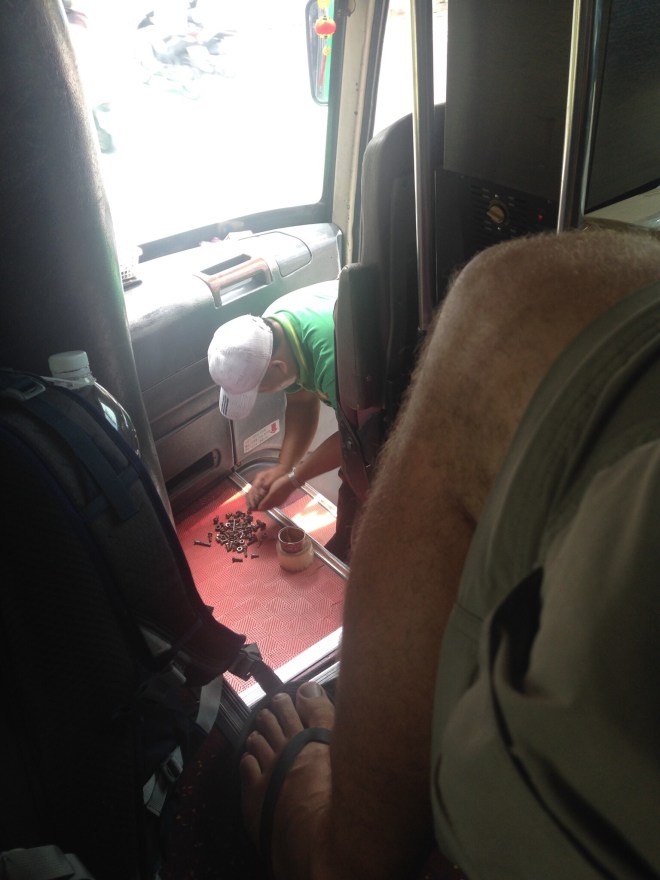
Our final memory in Vietnam was on a bus we caught from Ho Chi Minh into Penom Penh. Driving out of the city we heard loud clunk. Our driver stopped the bus, crawled underneath to check, came back in, and dumped out these nuts and bolts in the floor. He found the size he needed, went back out and reattached whatever it was. We were back on the road in five minutes 😂. Who knows? It’s always an adventure!
Next blog, Cambodia:)!

 The Yonderers
LOVE your stories!!! And love you both!! Thank you so much for sharing!
LikeLiked by 1 person