Hue was our next stop in our Vietnam travels.
Hue is home of the old Imperial City, the national capital of Vietnam under the Nguyen Dynasty from 1802-1945. We visited Hue to tour what remains of this stone city, which is actually quite a large area to tour. Totaling nearly 90 acres, this remaining large, walled complex, surrounded by multiple moats, was once the heart of the city, home to the emperors and center of political affairs. Though large parts of the city were destroyed in the French and American Wars, they’ve gradually been restoring it to it’s original grandiosity. It’s pretty cool to be able to see the remains of what once was next to the reconstructed buildings – it gives a glimpse into what was alongside a view of what time and war have left.
The Imperial City is a humongous complex to explore, and most of the pictures I took were of things I thought were beautiful – it got too hard to keep up with what structure was used for which purpose during our hours of wandering through the complex. Below are some of those pictures labeled with parts I was able to keep up with 🙂
This is a photo of the outer city wall/gate/moat that encompass a significantly larger area than the inner moat surrounding the palace. This moat and gate are right in the middle of the current city of Hue, surrounded by modern structures on the inside and out. To pass through this gate is free – and no, that water is not reflecting green, it is green.

Rules for visiting the inner palace. The wording of #4 was our favorite. You see so many misspelled and grammatically incorrect English signs while traveling that you quit taking note after a while, but once and again you find a new one that stands out :). Something about this one sounds so southern!
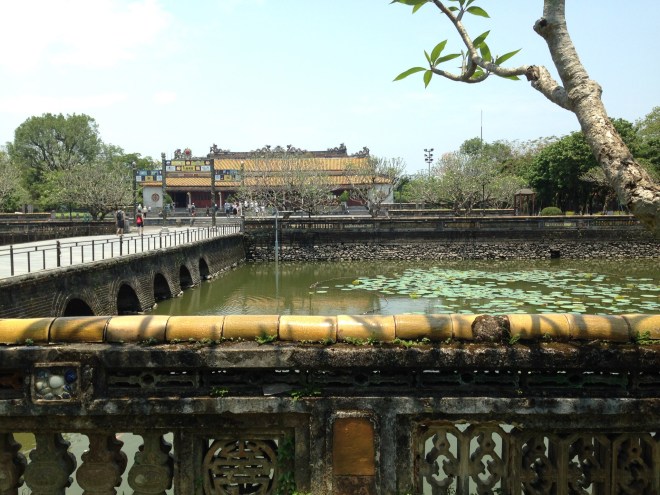
The last inner moat before entering the imperial city, though several of the buildings inside have moats around them as well. This would not have been an easy place to invade on foot!
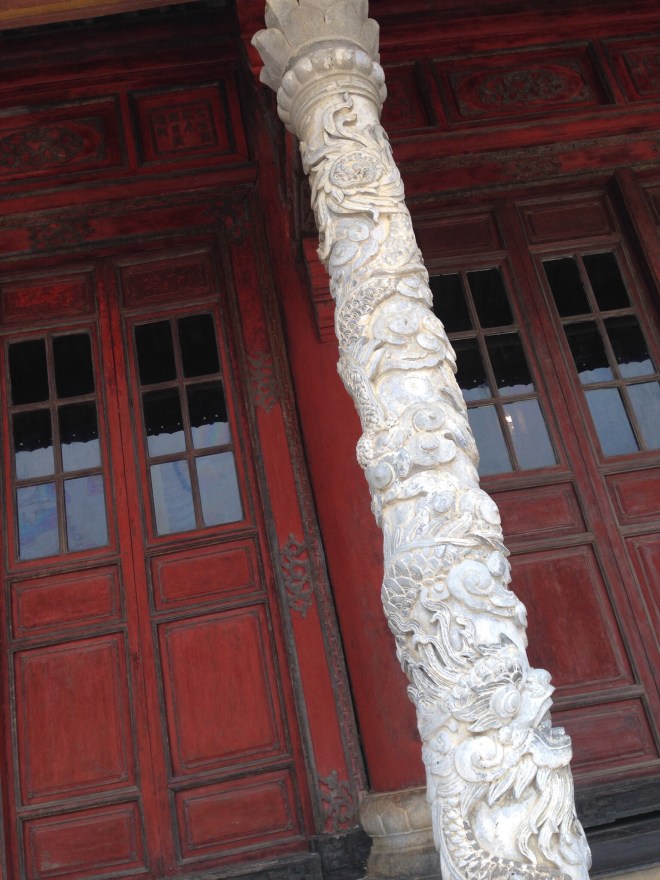
The outside of what I believe was the throne room – you weren’t allowed to take pictures inside, but I loved how decorative the columns outside were!
 Window
The replicated throne in a separate building that you could pay to take a picture on.
 I loved the ceilings and lights in so many of the buildings! So much detail!

Intricate doors leading to one of the courtyard areas
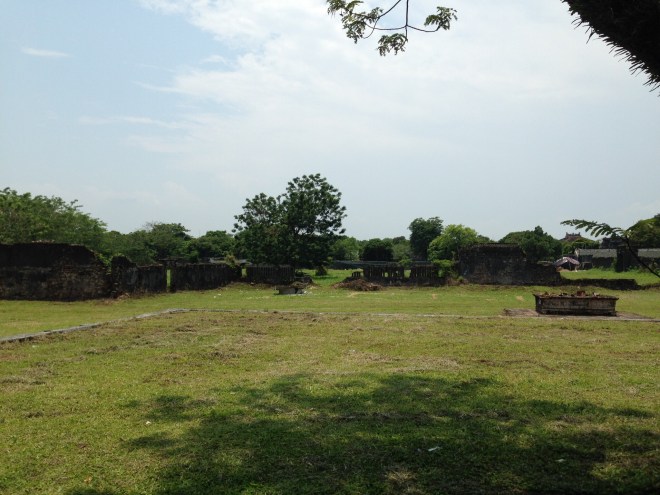
Part of the city that hasn’t been restored yet.

One of the buildings with a moat of it’s own.

A view of one of the larger reconstructed gates through one of the original unrestored gates. Not only did the city itself have walls and gates, but most of the invividual housing sections had them as well.
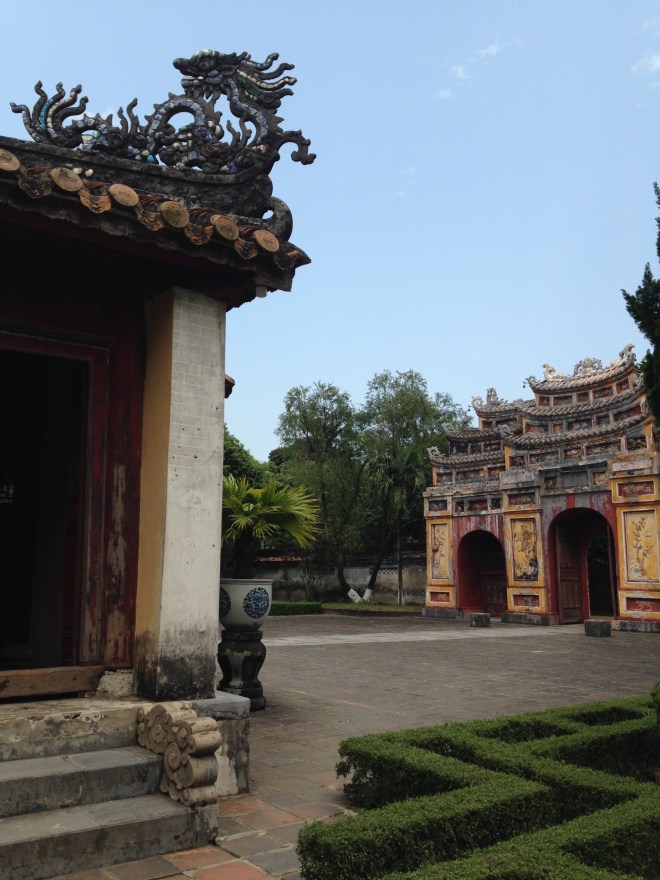
I love the details of the roofs – this dragon was one of my favorites we saw – with the colored stones lining his details.
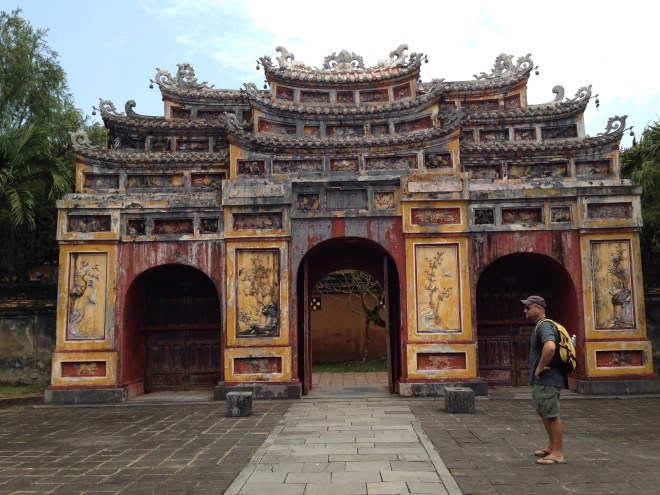
I’m unsure if this gate was partly restored or not, but it was beautiful and Kirk kind of matched it ;).
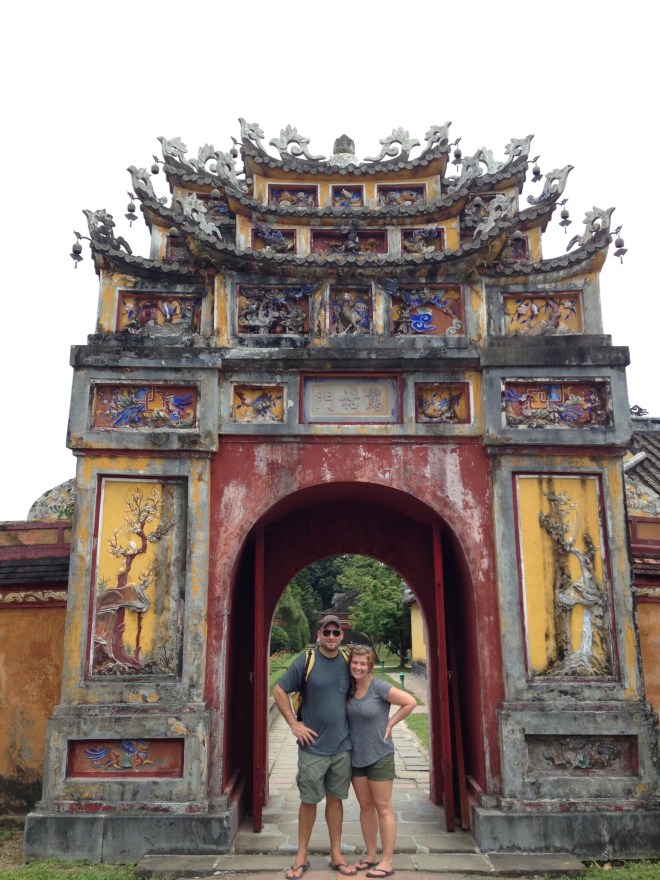
This day Kirk and I accidentally ended up matching 😂

Gate
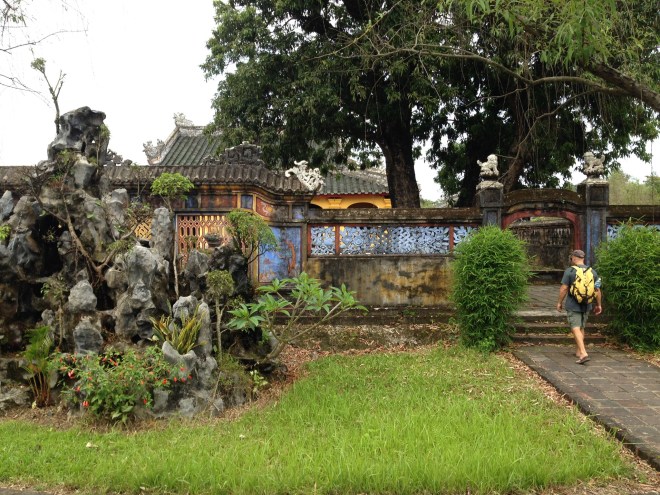
The final section we visited that was surrounded by the moat below.
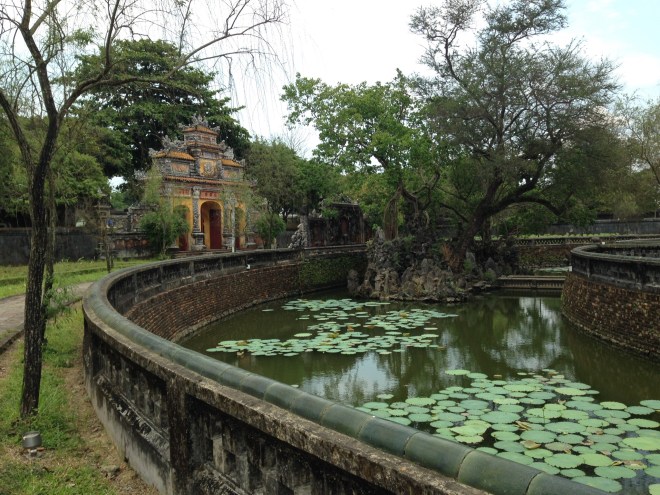
Seriously, they certainly protected themselves well!
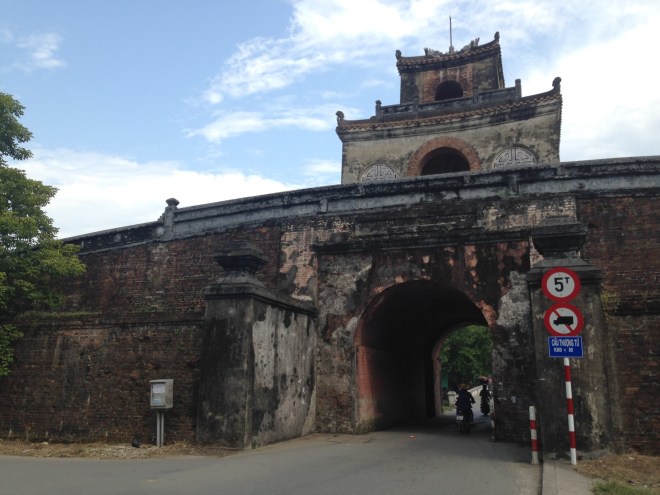
A view of the outer city gate we exited – look at how thick those walls are!
We spent the rest of our time in Hue eating and exploring. If you are looking for a cheap place to travel, Vietnam has it all. I mentioned food prices in our last post, but it’s also worth mentioning that in Hue, our guesthouse cost $8 a night and the cost to rent a motor bike ran $4-5 per day!
On two days we rented a motorbike from the guesthouse in which we were staying to see some of the surrounding views. Being home of the Imperial city, there are plenty of other ruins around, including older temples and entertainment venues, and within about an hour and a half, there is a nice beach on which to lounge.

On the motorbike day one! Driving in Vietnam is crazy! I’m not sure that there is a single law that is always (or even usually) followed. It’s more like, “every man for himself.” People run red lights, pass people who are passing people who are passing people, drive on whatever side of the road they want, pull out into traffic without looking to see if someone is coming… On several occasions we saw tourists covered in bandages, who had clearly wiped out on motorbikes. I definitely couldn’t have done it on my own, but Kirk has great instincts and kept us safe!

Phuoc Duyen Tower at the Pagoda of the Celestial Lady – originally built in 1601, though the tower seen here was added on in 1844. Seven stories high and octagonal in shape, it’s the most iconic image of the Pagoda.

A view from the side
After visiting the pagoda we set off looking for an arena that Kirk read about on a blog. We’d read that this arena in particular was used by the Nguyen dynasty to fight tigers and elephants against each other. It initially sounded like the emperors were putting on a show for their subjects, but as it turns out, it was more like political propaganda. In this dynasty, elephants represented the monarchy, so to ensure that the “monarchy” always won, they would injure the tigers prior to a fight.
We set off expecting to find a mostly dilapidated arena, but were surprised to drive up on a small coliseum in the process of being restored. The construction workers wouldn’t allow us inside, but we did get to sneak a peak.
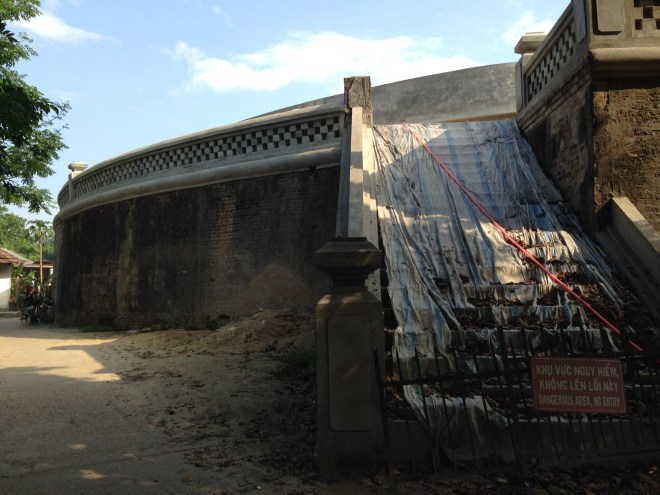
The outside. It looks as if the bottom bricks are all original, they’ve just rebuilt some of the stairs and fixed the concrete “standing” area on top.
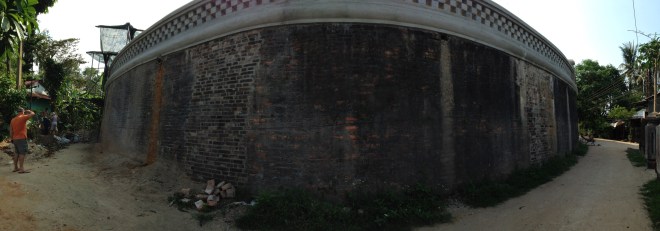
Having visited the coliseum in Rome, this place was pretty small, and not even close to as intricate, but impressive none the less! It’s always cool to happen upon something before it’s become the touristy thing to do – we were really lucky to find the blogger who had discovered it in his travels. This thing is located in the middle of a working village just outside the city- an old piece of history just sitting there while everyone lives their lives around it. You’d currently never happen upon it without already knowing about it, but with the restorations in progress, I have a feeling that is about to change. 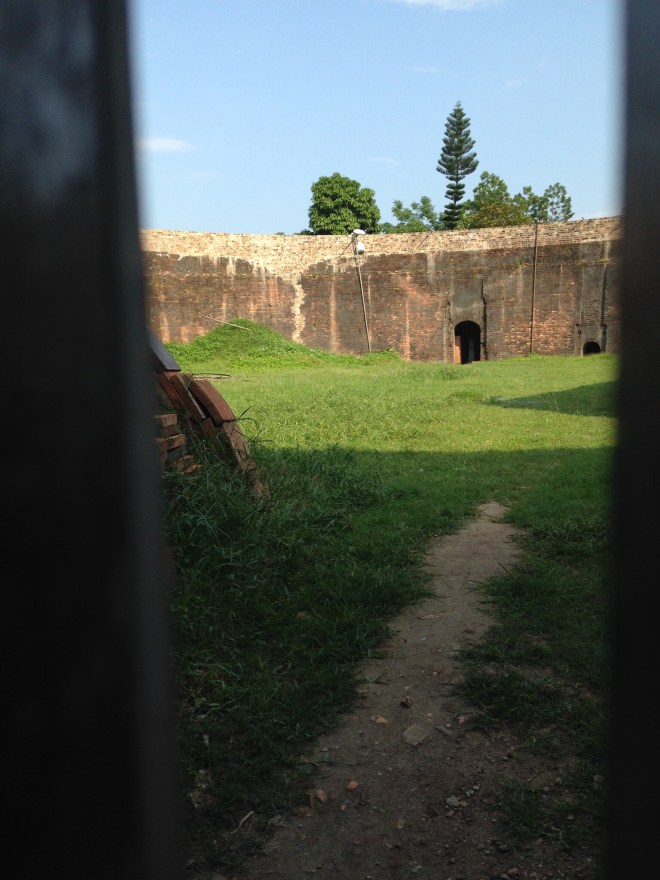
A peek between the doors blocking the entrance through which the elephants used to be brought in. Directly across is the tiger entrance, and the top is from where onlookers watched the fights.
Having found the arena, we were also on the lookout for an elephant graveyard that we heard was nearby. Since the elephants represented the monarchy, they were buried with care. We drove around the village aimlessly until a man, without prompting, pointed down a road. We turned and soon saw graves at the end of it. We followed the road, got off the bike, and began wandering around, unsure of what exactly we were looking for. We noticed some huge graves mixed in with smaller graves (that were for sure for people), but we saw no markings indicating that anything might have been an ancient elephant grave. Before long a village man appeared from the nearby buildings and began walking towards us. I feared that we might be about to get in trouble and braced myself for what he might say – after all, we still weren’t entirely sure where we were or if we were supposed to be there.
This older man, who had a little trouble walking, approached us slowly and stopped right in front of us. We told him we were looking for elephants, but he didn’t speak any English. We turned instead to the universal language of interruptive body movements, making our arms into trunks to show that we were looking for elephants. He nodded and waved his arm for us to follow as he walked past us. He took us to one of the huge graves nearby and nodded towards it. We still saw no markings indicating that elephants lay beneath us, but assumed this must be it. We snapped a few pictures before he indicated for us to follow him again.

The first grave at which we stopped.
We followed him down the path, taking in our surroundings. The graves looked so different than home. There was a lot of trash scared throughout the graveyard and animals grazed all around. Many graves looked more like pods, small circles that a person would have to be in the fetal position in which to fit. It made me wonder about their burial practices, so I later looked them up – I tell you about those in a little bit though :).
We continued down the path and eventually stopped at another large grave, but this time the man pointed to the grave and then brought his hands to his chest. Kirk pointed at him and said “Your family?” The man nodded. He motioned for us to follow, and we did as he gradually led us around the many tombs, pausing at each one that was family of his. Eventually he led us to a road at the back of the cemetery and motioned to give us directions. Using google maps, we later realized that what he had told us was a shortcut back to the city. We eventually followed that road home, processing our time with him as we passed by his family’s graves. What a lovely interaction with a complete stranger which was, for the most part, via silence.

Following the man down the path, passing one of the grazing cows along the trail.

Some of the other graves we saw.

A picture of the “pod” type graves we saw.
What I later learned about burial practices in Vietnam is that the location of the grave is more important than the up keep of the grave. They base where they bury family on religious practices that indicate where a family member might be happily buried. Customarily this was in the middle of a field of the family, though new laws now prevent people from being buried amongst crops.
Alongside that, they also have a common practice of burying a person in a regular casket, leaving them in the ground for 3 years, then exhuming the body (which, by then, are bones). They then have a specialist in this practice clean the bones, and later, rebury the bones in a much smaller coffin. I never found it written explicitly, but I assume that’s what these circle mounds are. Whether the mound is large and intricate (like the first pictures), a concrete pod (like above), or a mound of dirt with a stone (like below) depends upon the wealth of your family. 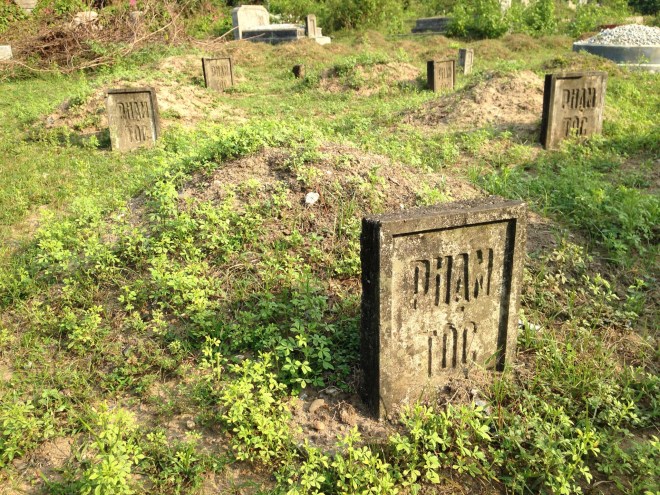
You may not be able to tell from the picture, but even these mounds of dirt were small circles, not full body length mounds.
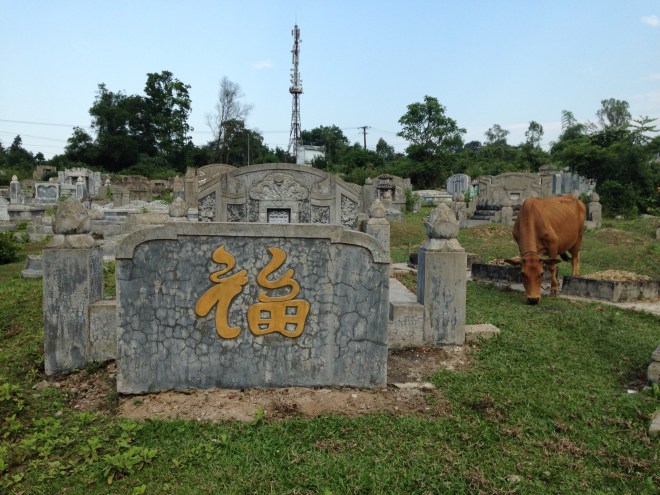
Another picture of some of the larger graves with one of the cows grazing next to it.
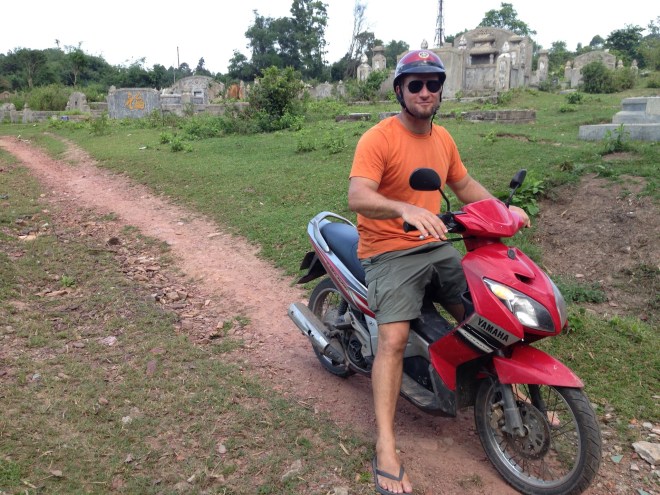
Preparing to leave
Once we realized that what the man had shown us was likely all family graves, we decided to take one more try at finding the elephant graveyard. As it turns out, luck was on our side.
Driving around in the village we came to a place where a lake was on one side of the road and a very old looking entrance was on the other. It looked just old enough to cause us to stop. We walked up the stairs to the gate…
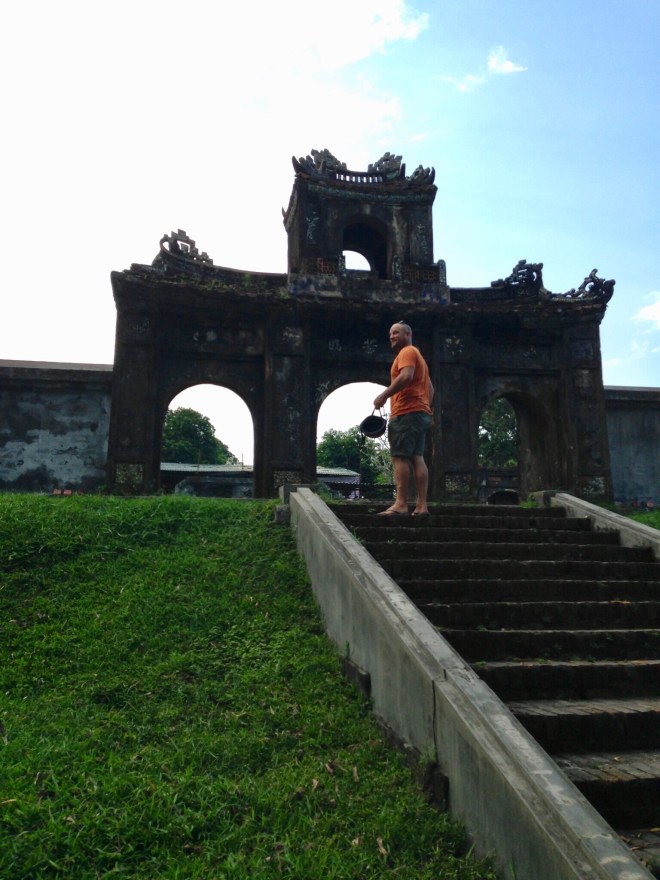
The concrete siding is new, but those brick stairs are not!
…and were greeted by an old script (Vietnam has since switched from characters to alphabet, so when you see the old characters on something, you know it’s older.)
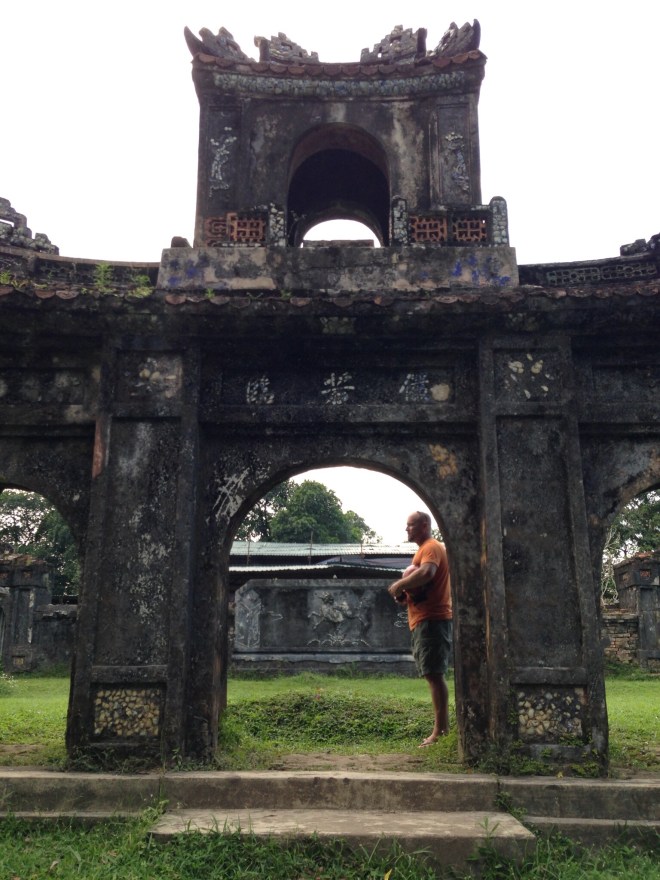
The characters are on the top of the gate.
We walked through the gate…
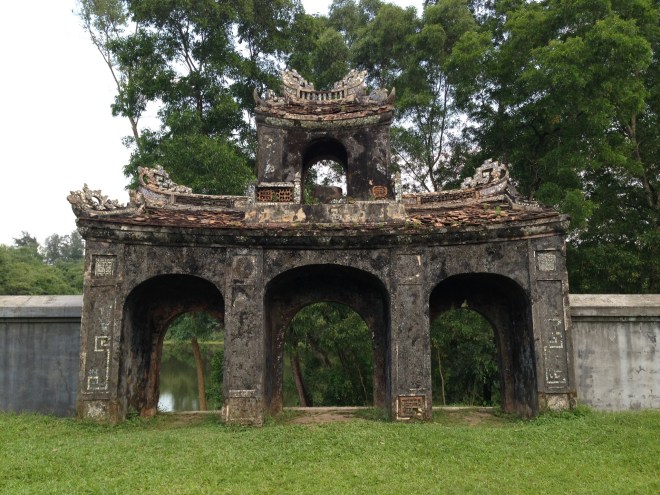
A photo of the back side of the gate, looking out into the lake below.
…and had a look around. We noticed that half of the area was restored and half wasn’t, but no graves were in site.
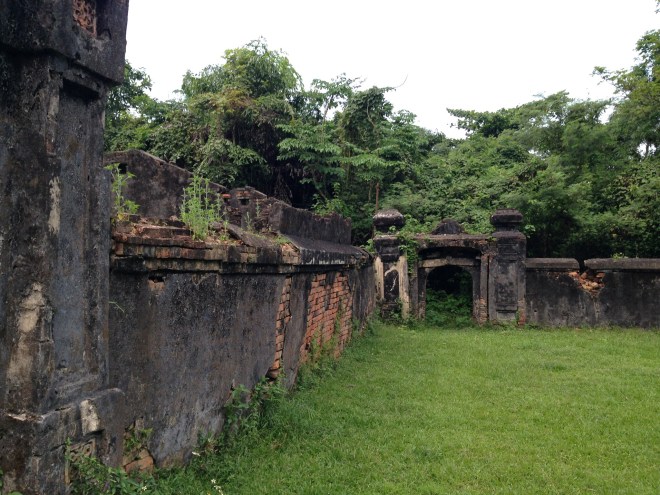
The unrestored half.
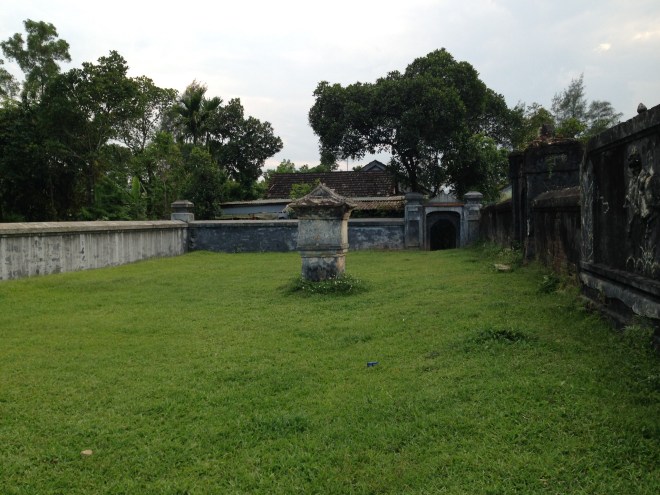
The restored half.
It was then that Kirk had the idea to peek over the fence – it was clear even from afar that some type of construction was happening on the other side. As it turns out, they were working on restoring the grave site itself 🙂

It’s hard to see in the picture, but the smaller doghouse looking monument has a large elephant statue inside. There were two of these, marking where the elephants lay.
I think it’s the inner child in me hearing the voice of Simba, “An elephant what? Whoa!” That made this place extra interesting. It turned out to be nothing like the elephant graveyard in “The Lion King,” but it was certainly an adventure finding it!
We later learned that the lake in front of the entrance is where they used to let the elephants cool off. It’s kind of crazy to think about how many generations before us have used the same water and water sources we use today!

Before we left I took a picture under the side gate – like so many other places we’ve been, everything here is “Tiffany sized” 😂🤗. Not only do I not have to duck to get under the ancient doorways, but for the first time in my life, my feet have reached the floor in every chair I’ve sat in! Kirk’s knees are often to his chest 😂.
As we left the elephant graveyard we traveled towards our final destination for the day – Vong Canh Hill.
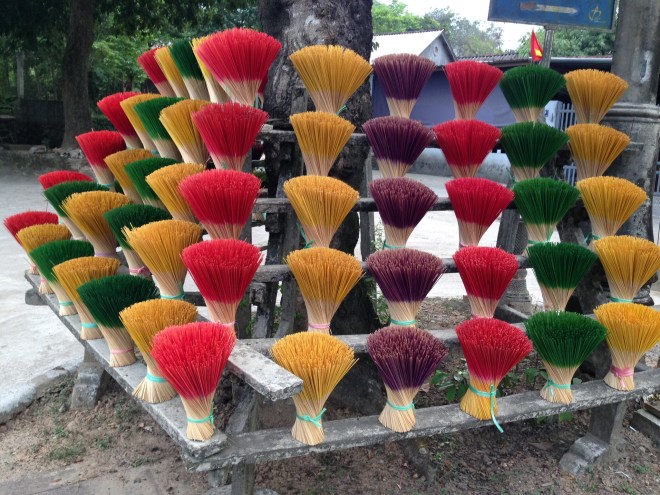
Some beautiful bunches of incense we passed on the way to the hill.
Vong Canh Hill is known for it’s magnificent view of the Perfume River. This hill, located right outside the main city is both where Kings used to come for rest and relaxation and where war bunkers were set up by either the French or US while fighting in Vietnam. Kirk and I arrived on the hill right before sunset, so it was quite a site.
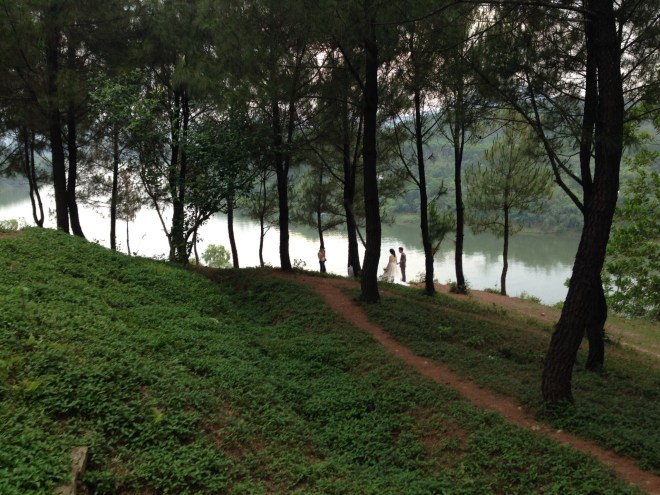
One of our first sights was a couple getting wedding pictures taken 🙂

Cameras never show exactly what your eyes see – it was quite a lookout with the mountains peeking out from behind the river!
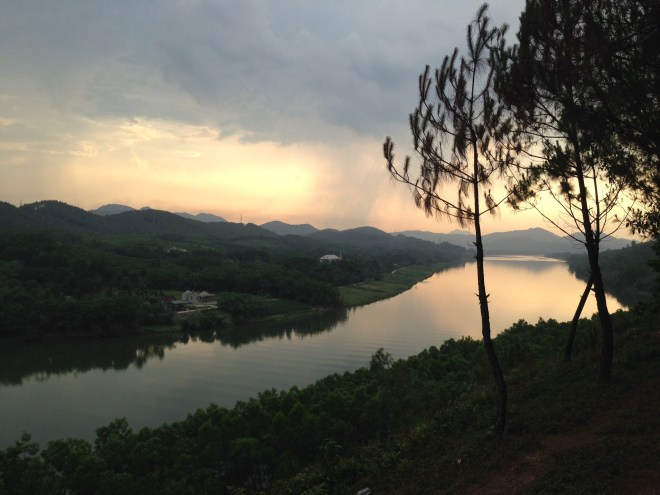
The view in the other direction

The whole bend in the river
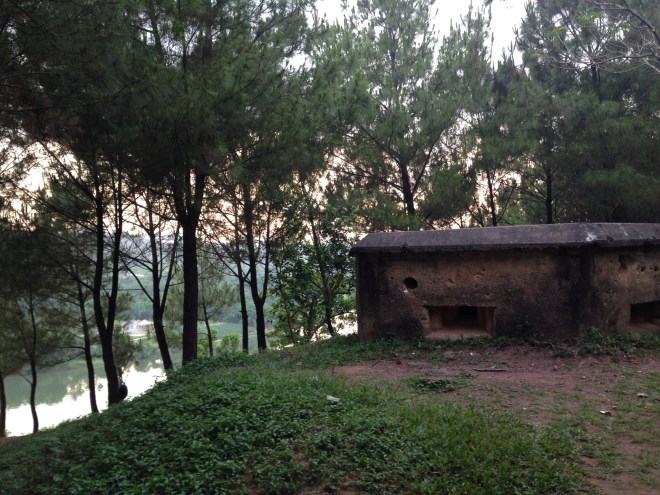
One of the old bunkers with the river behind

Another bunker
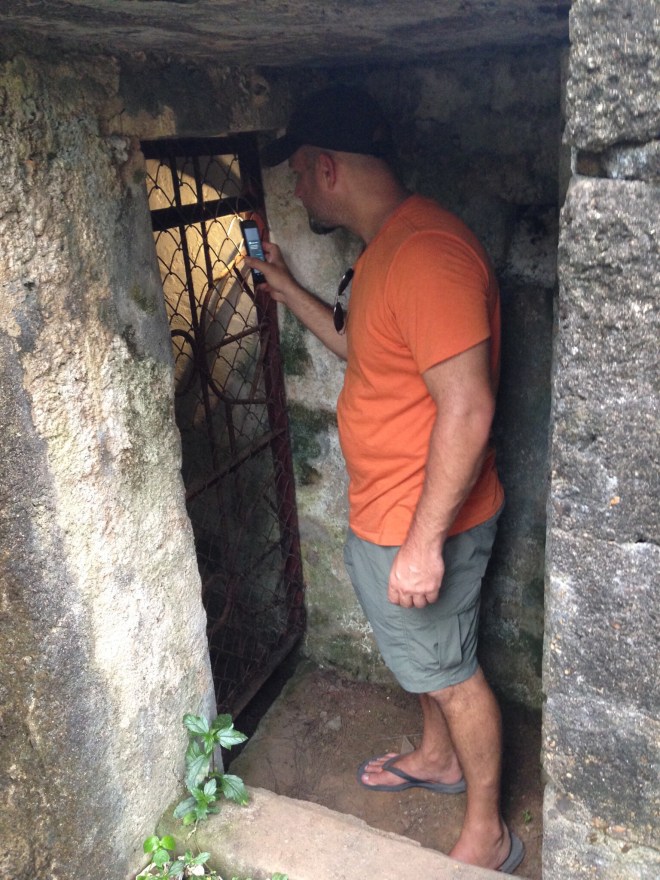
The bunkers were locked up, but we took a peek inside

They were pretty empty. We did find one with an open door, but the amount of spider webs in the entrance were more than enough to keep anyone out 😬!
The bunkers ended our first day on the bikes. The second day we rented a motor bike, we went to the beach. Google maps suggested a route to us that was supposed to take that hour and a half I mentioned earlier. Being the adventurers we are, we decided to ignore google and take a route that followed alongside the river in hopes of catching some beautiful views on the way. We figured it would only take about a half hour more – boy were we wrong. We started on a journey that ended up running alongside a river just out of our view – through small villages, along bumpy roads – and four hours later we arrived at the beach 😂. It was a nice day anyway. Below are some of the views we saw along the way as well as a few beach pictures.

I mentioned in the first Vietnam blog that the country as a whole is a green, water filled land – here is an example of that. Water filled rice field.
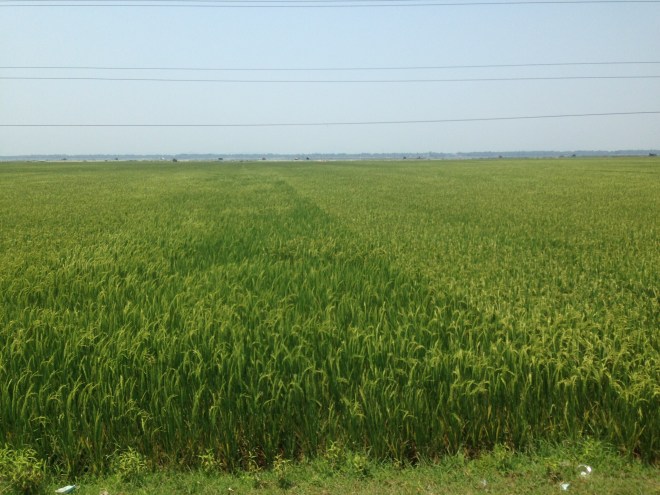
Rice field

Water buffalo next to a rice field :). We saw tons of these!

The beach!
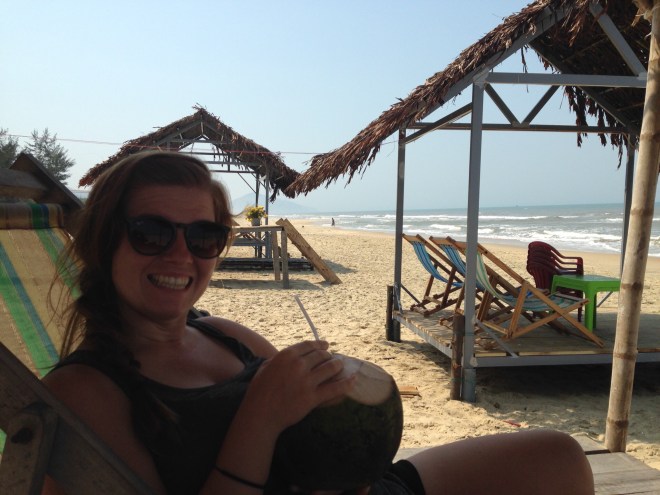
Coconut water on the beach :). The coconuts here are much larger than the ones we had in Vanuatu!
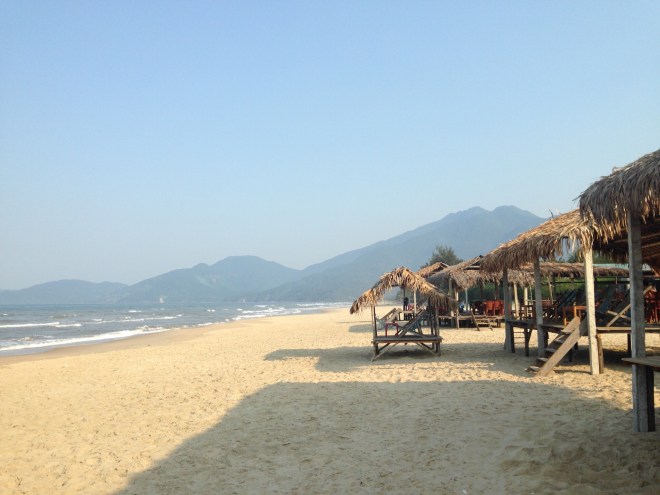
The view on the other side of our beach seats. Mountains beside the ocean!
That’s it for our adventures in Hue. I leave you with a few of the local dishes there that we enjoyed :).
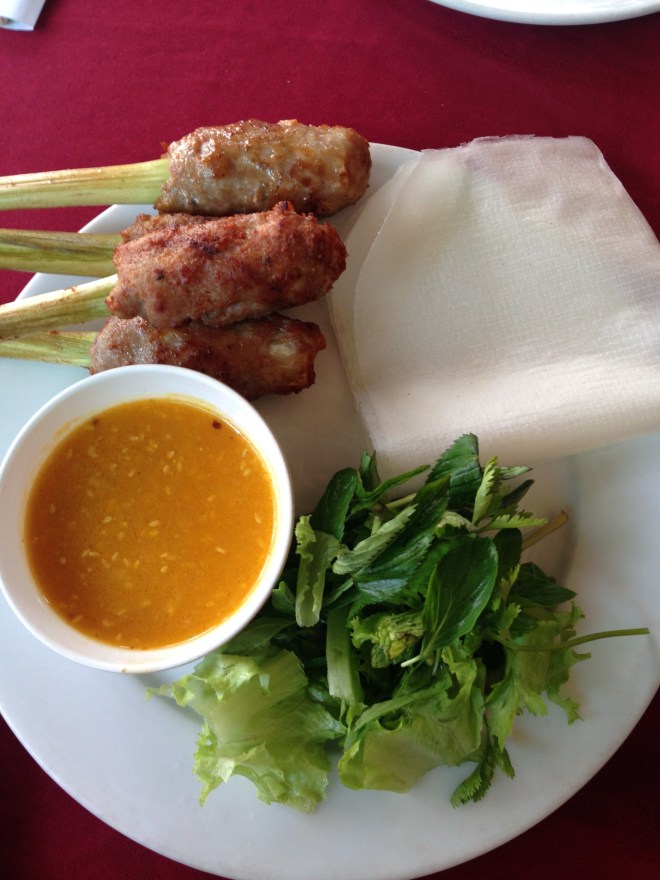
Nem Lui Hue – Ground pork (sometimes beef) grilled on lemongrass stalks. To eat it, you pull the meat off the lemongrass skewer and wrap it in rice paper with fresh herbs. The dipping sauce is flavored with peanuts :).
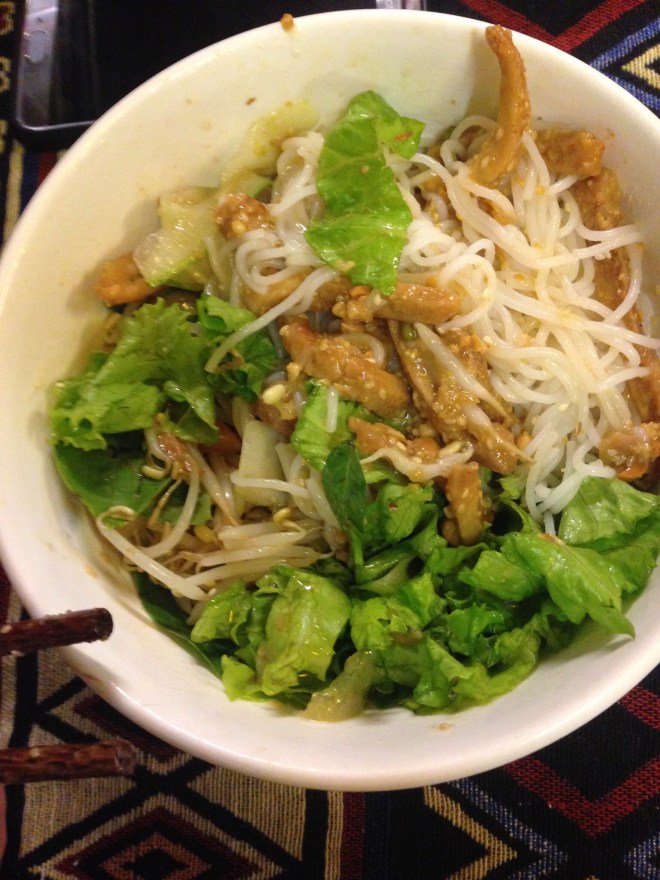
Bun Thit Nuong- Grilled pork noodle salad with a lemongrass and peanut sauce.

Bun Bo Hue – beef noodle soup with served with fresh herbs. Often spicy with a heavy lemongrass flavor. It also often comes with what I can only describe as crab “meatballs” – interesting texture, but tasty.
Tomorrow Kirk and I leave Cambodia and head to Thailand. Hopefully I’ll have some time to catch up on the blog on the bus/train because once we hit Thailand, we’ll be off the map for a bit doing a silent retreat :). More to come!

 The Yonderers
Wow!!! So informative and do interesting!! Love the photos…and I am so happy Hue ‘fits’ you perfectly!😊
LikeLike
Wow!!! So informative and so interesting!! Love the photos…and I am so happy Hue ‘fits’ you perfectly!😊
LikeLike