Today’s blog is about Tanna. Though our actual journey in Vanuatu was Port Vila, Santo, Ambae, Santo, Tanna, Port Vila – I’m going to save Santo to talk about in the final blog alongside our final week in Vila. There is far too much to ponder from our time in Tanna for it to be combined with anything else!
During our time in Tanna, I think I experienced just about every emotion possible. Happiness, anger, fear, sadness, overwhelmed, confusion, awe – we hit the whole spectrum. I’m not completely sure where to start with our story from there, but I do think I should put a disclaimer here that part of this post is not very suitable for a young audience, and while no one was physically harmed, it has the potential to be a trigger for someone who has sexual trauma in their past. If any of that is a concern for you, there are some pictures of an active volcano and beaches toward the bottom if you want to just read this next paragraph and then skip to the first picture you find :).
Tanna is home to the most accessible active volcano in the world. If you can walk up hill for 5-10 minutes, (equivalent to 4-5 flights of stairs), you can see this volcano in all it’s glory. For this reason Tanna is the most known outer island in Vanuatu and is visited by many tourists. It’s created an interesting atmosphere there. Tourists are fully seen as “other” and charged prices that, while mostly reasonable for tourists, are astronomical compared to local prices. It’s created a strange dichotomy on the island though, because while tourists are often charged rates at least 10 times of that of locals ($50 for a car ride instead of $5 – even though you are sharing the same vehicle), in some villages, tourists are still expected to follow local customs. For example, when we arrived in the village we were staying in, I was informed that I was not to walk by the Nakamal (meeting area) when men were present and in fact, I was to keep my head down as I walked the “woman’s path,” as a woman is not allowed to look at the Nakamal when men are present. I’m normally very okay with adhering to other’s customs, as I am the one visiting their land, but it was frustrating to feel somewhat taken advantage while also being oppressed because of my sex. That feeling is how we began our time in Tanna, and sets the stage for the next part of the story.
Our first full day in Tanna we decided to go to the beach that is located right next to the village we were in. We set out down the short path, taking the detour on the “women’s path” as to avoid the Nakamal. We arrived at the beach and walked a ways down as to not be too close to the village. We feared a tourist swimming might draw attention, even though this village is no stranger the occasional foreigner. About an hour into our swim, Kirk, who was a little further out in the reef looked up and pointed. At first I didn’t understand, but he then came close and let me know that he had just seen a man sneak behind a tree located directly behind the place we’d been sitting earlier. My eyes scanned the horizon several times, but I never found him. If Kirk wouldn’t have happened to look up when he did, we’d have had no idea the man had come.
I thought – there is no reason to sneak unless you are up to something. Anger welled up inside my chest as the frustrating emotions I was already feeling swirled around. I’m not allowed to look at your Nakamal, but you have the gall to come watch us swim?
Kirk got out of the water and addressed the man as Kirk walked towards the small straw shade covering our belongings were under. Though he really just wanted the man to know we knew he was there, what he asked was “Is this your cover? We can move if you want it back.” The man replied no and after a couple of minutes, left, me still having never seen him. We sat drying for a while, discussing why he might have been there and how creepy the whole thing had been, and then gathered our belongings to head back to the village.
We walked down the beach and onto the path, but as we turned off the “woman’s path,” I noticed movement in the bushes behind us. I glanced back just as a man emerged from a bush carrying a machete in his right hand. “Kirk, is that him? There is a man behind us. Is he following us?” After a ways Kirk glanced back and confirmed it was him. He seemed to lurk behind us, careful to maintain a certain distance, slowly veering off as we entered the village and continued on to our hut.
I felt concerned, but really torn. Kirk stood about ten feet away chatting with our host as I sat outside our door, my thoughts running wild, “Who is this man? What if he’s important and we tell someone and they get angry with us? Women don’t seem to be very valued here – will anyone care that he came to watch? Are we just paranoid or was he actually following us? Where is he now?”
In that moment I glanced up to take in my surroundings. To the right, Kirk stood talking with our host, directly in front of me three woman sat chatting as their children played on the ground beside them, to the left – my heart jumped. There he was. About 30 yards away, stationed between two houses in a place where he was hidden from everyone’s view but mine. His eyes were wide in a dead stare, set right on me. A nervousness came over me and I glanced away. Hoping my initial gaze had made him quit looking I glanced back to a shocking realization. His gaze was still deadlocked, his pants down, and he was pleasuring himself as as he stared.
Vulnerability. Fear. I’ve never felt so alone and targeted while being surrounded by people. We still didn’t know who this man was, but I could no longer not say anything. “Kirk. Kirk..” I got up and quickly made my way over to where he was, quietly explaining what was happening. Kirk told our host what I had said and our host looked relatively unsurprised.
“Oh, him, he does that all the time. He’s smoked too much marijuana. Everytime he does that we yell or swing at him and he runs away. He’s harmless.”
Marijuana? (That word is the same in Bislama and English) That’s not a common reaction to that drug.
The women nearby joined in on the conversation, recalling times he’d done it to them and telling about the previous tourist who was targeted as well. Kirk took in the stories to tell me later as we looked at one another suspiciously. The man’s appearance was a bit disheveled. He wore long pants and a coat that had not been washed in some time. That doesn’t sound like drugs, it sounds like mental illness.
Kirk began to ask questions:
– Does he ever sit and talk to himself? “Oh yes, he sits and talks and laughs to himself all the time.
– Did this start later in life maybe in his 20’s? “Yes, yes, he used to be a very bright kid. He worked at Iririki (one of the nicest resorts in the capital) but one day he jumped in the pool with all his clothes on and he’s never been the same since. When he first came back to the village he was really violent.”
– Has anyone else in family ever been…different? “Oh, yes. He is one of eight children – six boys and two girls. One of his brothers used to act similar to him and one night he walked into the ocean and drown himself. He has another brother who doesn’t act right either. There is also another brother who he is scared of. That brother beat him with a big piece of wood last time he was caught looking at a woman. He ran away and we didn’t see him for a while.”
All my emotions were on overload from the parts I had understood. I felt such great sadness for this man who had been beaten for something that wasn’t his fault – for him living in a village with people unknowingly blaming him for this incredibly difficult thing he is facing. I imagined how alone he must feel while also acknowledging how scared the people in the village must feel facing this unknown thing. At the same I still felt fear myself. I still hadn’t recovered from feeling targeted and the image of him with a machete and the thought “he used to be really violent” kept replying in my head (the image of out bamboo hut with no locking door playing alongside it).
Kirk then began to tell them that we knew people back home who acted similar to this. He told them that part of my job as a social worker has been to counsel people facing similar situations. Most importantly, he told them – “It wasn’t drugs that did this to him, in fact, it’s not his fault at all. It’s a type of illness, an illness in his head. There is nothing he did to cause nor could he have prevented this, and you should know that sometimes illnesses like this follow down the family line.” Kirk also explained that just because he was once violent and it stopped, doesn’t mean that it could never happen again.
They listened intently, never having heard of such a thing, but because Kirk’s initial questions were so dead on, they were very interested. Our host explained that when the man first started acting like this, they took kava away from him also as punishment for his bad behavior.
A little info on the side for you guys before I continue on – the most popular substance of choice on the islands in Vanuatu is something called Kava. It’s a type of tea, made from the roots of the kava plant and while it’s just catching on in the states, islanders have been drinking it for ages – in particular, the men. Drinking kava is what they are doing when women aren’t allowed to look at them in the Nakamal. It’s so greatly a part of the culture for men that you are unlikely to find a man who doesn’t drink kava unless they’ve opted out due to religious beliefs (and not all religious groups are opposed to it, somewhat like alcohol in the States). The effects are calming. It reduces anxiety, but when drank in small amounts, it doesn’t greatly affect cognitive function. In other words, people on the islands still drive after using it. Many people say that it isn’t addictive, although I suppose that’s yet to be seen. Research in the states is actually currently being done to test kava as an anti anxiety medication, and prices for kava are soaring as drug companies from the States buy up crops in the area. I just found this article if anyone is interested in knowing a little more about it. Though there are potential side effects, there is nothing conclusive yet.
After asking how the man had previously responded to kava and them replying that it calmed him, Kirk thought, and then told them in Bislama – “I’m no doctor, but I would think that since it calmed him before, it could calm him again.” Kirk and our host talked a while longer and the host ended up bringing it up to the man’s family.
Ni-Vans (people from Vanuatu) are known for being slow decision makers, so the next morning when our host came to us and said they had decided to allow the man to have kava again, we were surprised. In fact, they had given it to him that very evening, including him in the community of men as they partook. They noted that he ended up being calmer than they had seen him in some time and felt good about him continuing to participate with them. I don’t know what this means long term for this village or this man, and I think the road ahead is very long, but I can tell you that on the ride home, the man from the village in the front seat turned to Kirk and said, “I just realized today that it’s not his fault that he acts this way.
After all the fear and crazy emotions, that’s a lovely thing to hear. Education is so important, and even when the best decision isn’t always clear and resources are lacking, recognizing the humanity of a person is always a beautiful thing. Mental illness can be scary – I felt the fear first hand as his eyes were deadlocked with mine, but he is still a human being, worthy of being treated as one.
I don’t know where all your mind travels after reading this story, but I know for me, I have a million unanswered questions, while also sorting out all the emotions I faced in that brief time. How can mental illness be better addressed in a place that lacks resources? When Kirk was in training for the Peace Corps, one book they gave him to read was entitled “Where There is No Doctor, “ because for the majority of people in Vanuatu (including volunteers), there is no access to doctors. Most islands have health clinics run by local volunteers, but those clinics have few resources other than bandaids, Panadol, and if you are lucky, an anti malaria medication. For most islanders, there are no prescriptions, no counselors to send people to, not any type of asylum (there was once one in Port Vila, but it shut down due to lack of funding.) There are police in some places if something goes terribly wrong, but culturally, they are under utilized. Communities tend to handle problems on their own, as they have culturally always done.
Considering all this, my brain wandered to questions of ethics. Do ethics take on a different face in a place with few resources? Though Kirk was the one doing all the talking and relying it to me in English later, I wondered if I would have said the same thing about kava to the community had I spoken the language. As I stood alongside Kirk, working to decipher the Bislama, I had thought to myself, “Could kava be a resource to this man in someway? It’s so immensely apart of their culture.” The thought made me feel a little crazy though, because it would never cross my mind to mention something like that in the States. There are so many other resources that we know more about – evidence based practices and professionals – that we can utilize, but in an area with so few resources, what does “doing the least harm” look like? I’m interested in thoughts you might have. That’s ultimately why I wanted to share this story. Traveling presents a lot of gray areas, and it seemed like a good thinking opportunity for us all.
The final question I’ll raise for now that’s been on my mind – how do we get education out – not only to communities lacking in resources, but also in places with abundant resources? There are tons of organizations around the world working to better educate people about topics such as this, but so much is still unknown. Even in the States mental illness is often misunderstood. People who have been diagnosed with something are often looked at as “other” when in all reality, I’d be shocked to find a person who hasn’t been touched by mental illness in some way in their lives. There is still much work to be done in education, and I think this was an important reminder of that.
I suppose that’s enough thinking and heavy stories for today, but if you have any thoughts, please send them along. For now, I’ll move in to some pictures. Though our time in Tanna was filled with plenty of heavy mental lifting and sorting emotions, it was also filled with great natural beauty and awe.
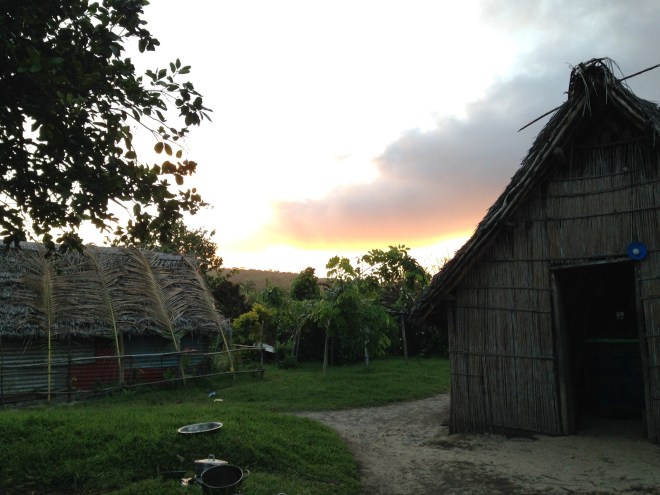
This is a picture of a traditional hut in the village in which we stayed. The house on the left has coconut tree branches on top of it. During cyclone season many people place those on top of the house to help weigh down the roof. I was actually trying to get a picture of the color in the clouds I when I was taking this. The small amount of red you see is lava reflecting off the clouds from the volcano below.
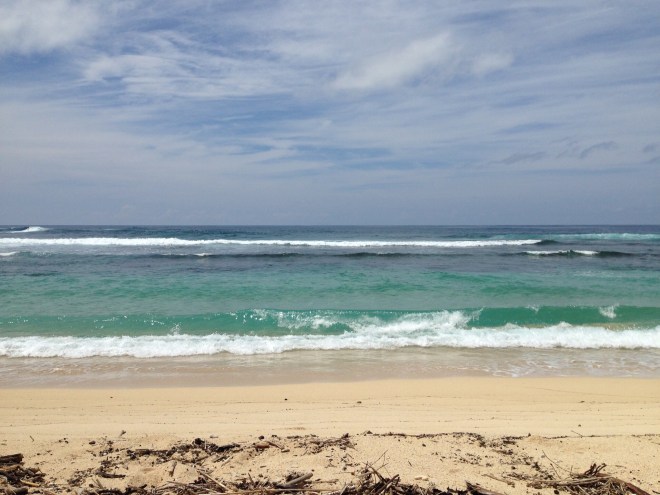
This is a picture of the beach right next to the village in which we stayed. This is one of my favorite beaches we’ve been to. It’s practically untouched, with colorful reefs growing close to shore. The water is shockingly clear and the perfect temperature for swimming. The sand is white with speckles of colored coral, and it’s just coarse enough that it’s soft to walk in, but brushes off easily.
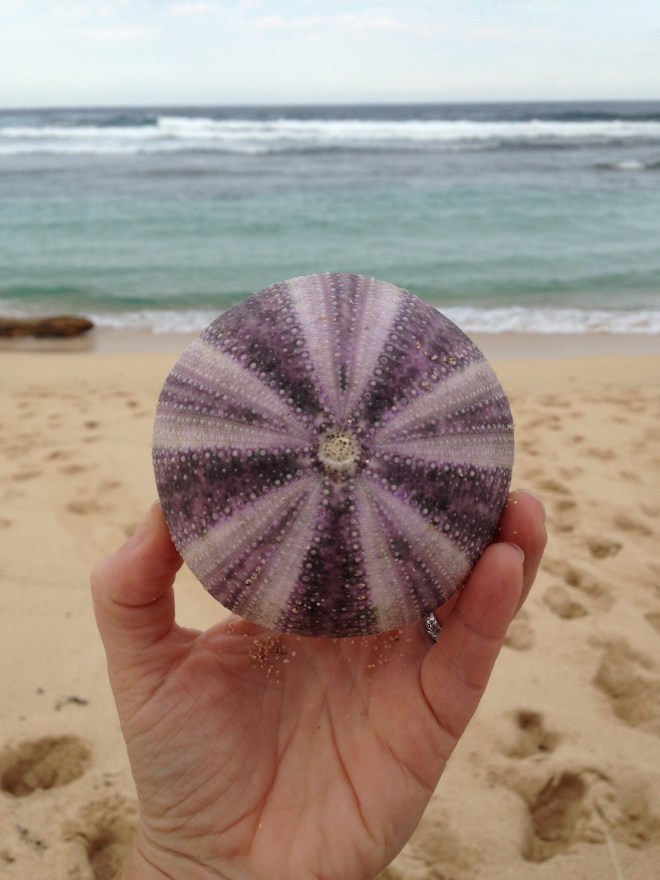
Once, when we were near the shoreline, I looked down and saw this being tossed back and forth by the waves. This is the most beautiful shell I’ve ever found on a beach. The bottom was already broken and it was too fragile for us to consider keeping it, but we did walk it up to the village and gave it our host. That purple!
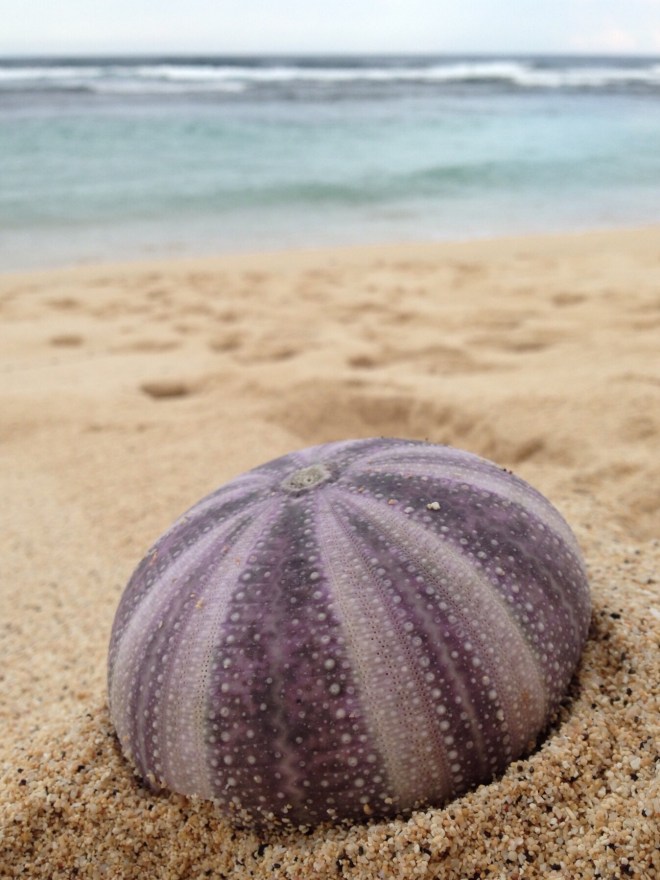
The last picture was to show size, but here’s a close up showing the coarse sand as well.
One day our host took us for a walk around the village, showing us two other beautiful beach areas.
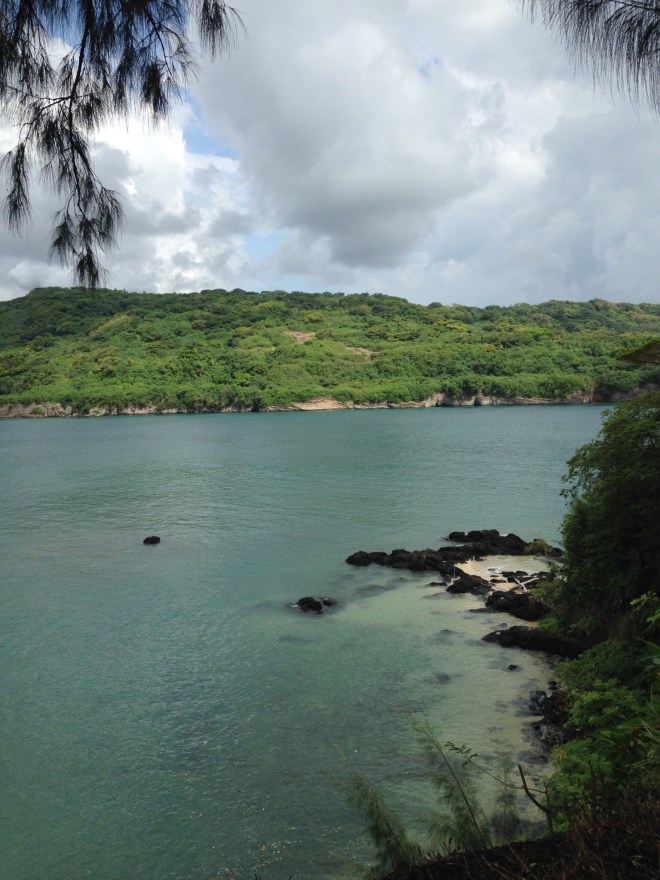
This area is near a yacht club that has been built nearby. Isn’t the water beautiful?
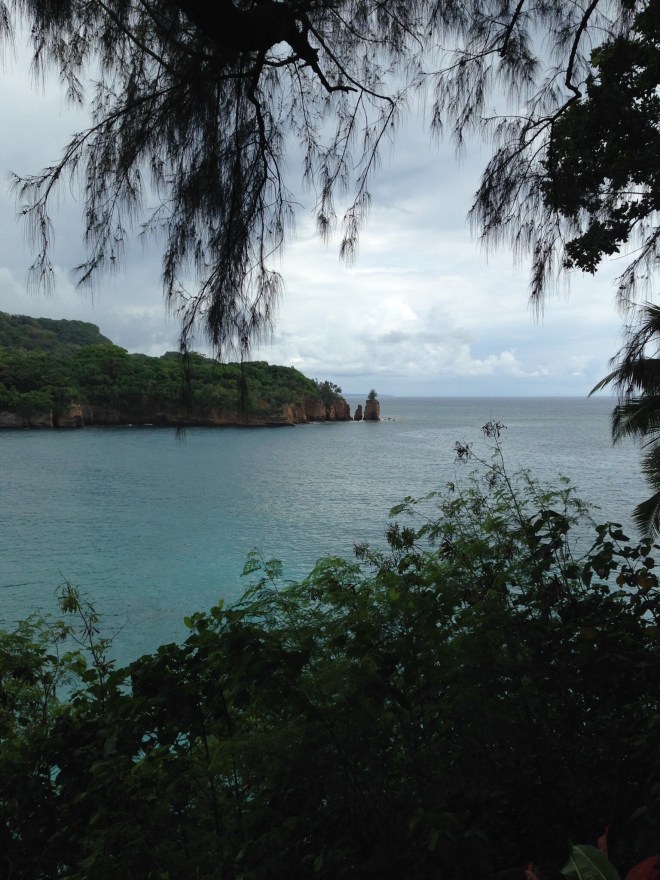
The view from the other side of the yacht club
Next we went to a beach filled with waves. We sat under a thatch covering as kirk chatted with our host and I listened to the waves crashing over the rocks.
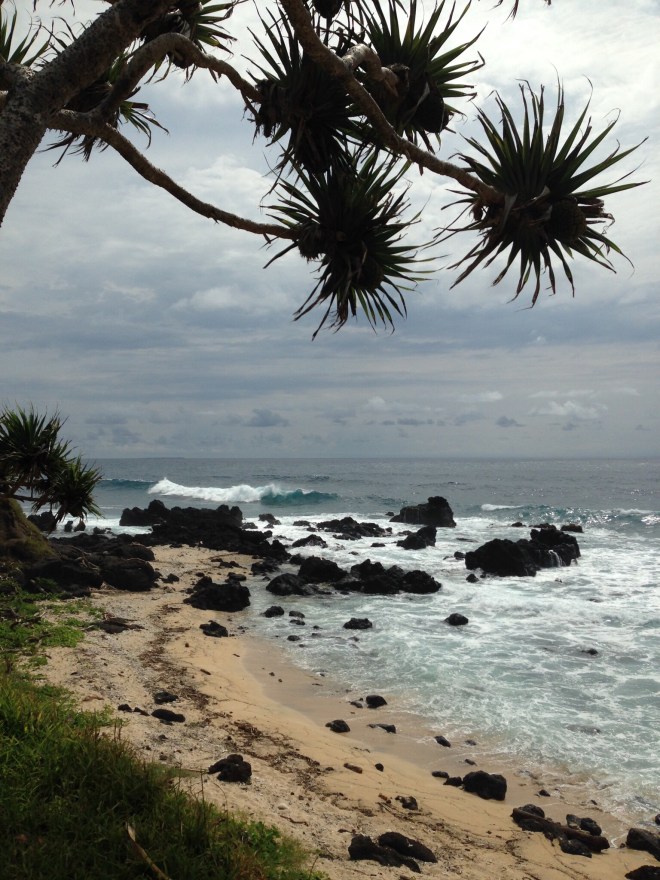
The view to the left
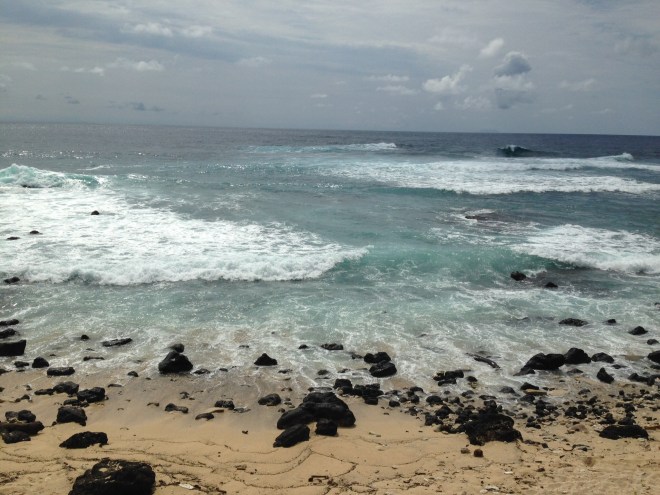
View to the front

View to the right
And now the main attraction…

This was our first up close view of the volcano. We drove right by it on the way to the village our first day on the island.
It’s getting more and more expensive to climb up the volcano, but the company that does it is gradually making it into more of a tourist experience. They had our group sit and watch a local tribe do a “volcano dance” prior to going up the volcano. I thought it was going to be hokey, but I was actually really impressed. When they collectively stomped or jumped, the whole ground beneath us shook. It was quite impressive.
Here is a short clip:
After the show they gave us bottle of water and we loaded onto trucks to head up the volcano. It’s about a 20 minute truck ride up, followed by a 5-10 minute climb to the top. Seriously, this is THE most accessible active volcano in the world. There are others you can climb and watch, but this is the easiest. If you missed the Facebook post that explained this, this volcano in particular has been continuously erupting for hundreds of years. When it is at a level two (which it usually is), you can safely climb up to the second rim of the crater and watch and feel as the volcano throws rocks and lava into the air every couple of minutes. Some booms are bigger than others, and occasionally a shock wave will lightly push you back from the pressure.
The following pictures don’t do it justice. Most pieces you see flying in the air are larger than a human, and the height they are reaching is hundreds of feet up. The camera catches it as a concise picture, but the actual view is nothing like that.
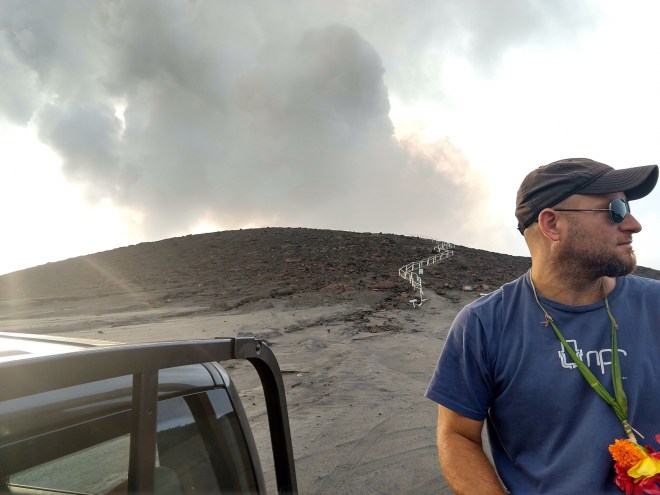
I snapped a picture of Kirk as we pulled up to the walking part of the trail. It has rails to hold onto, and what you see is the whole thing, the equivalent of 4-5 flight of stairs.
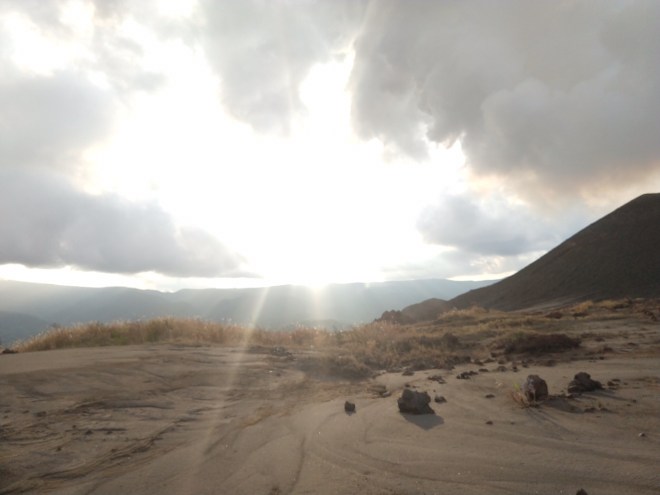
The sunset nearing the top
We were able to view the volcano from two points. The first allowed us to get some beautiful sites of the crater with the sunset, while also getting our first views of the eruptions. There are different times of the day you can go, but if you ever go, we suggest evening for sure. You get to see the volcano in the light, watch the sunset, and then see the hot lava glow as it erupts in the dark.

The crater at sunset
Below is a short clip of the first major eruption we saw. My recording it was a happy accident!
All those flying pieces are what glow bright red in the dark!
We hiked up to the second viewing spot and could see farther down into the volcano.
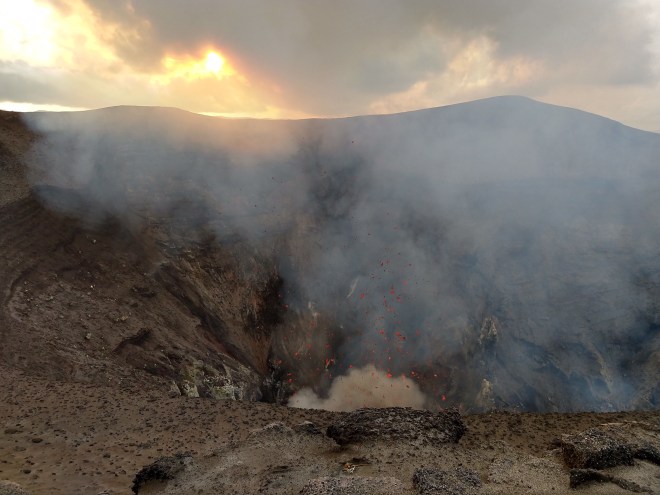
The red glow was starting to show!
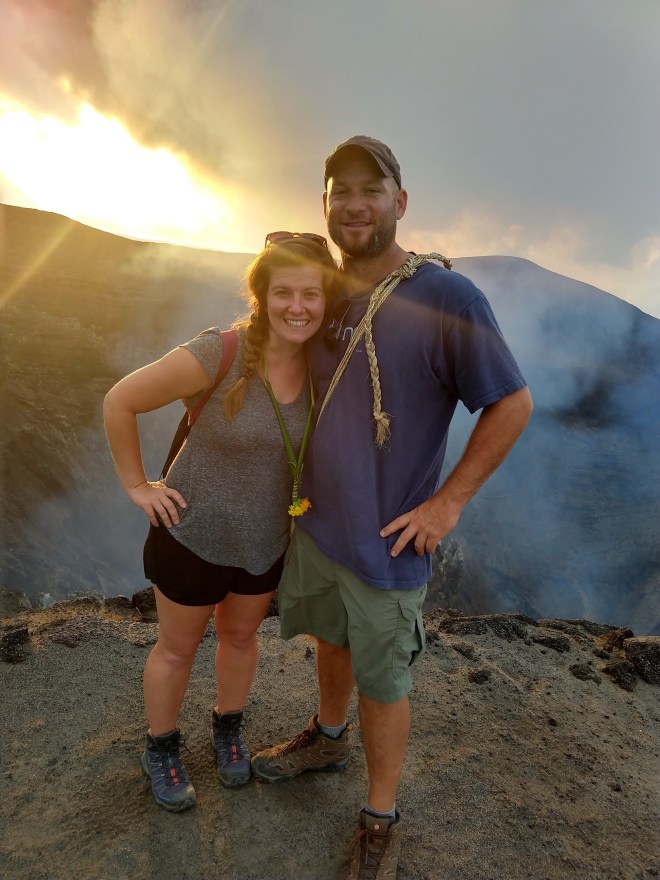
Our tour guide asked if we wanted a picture and we said yes.
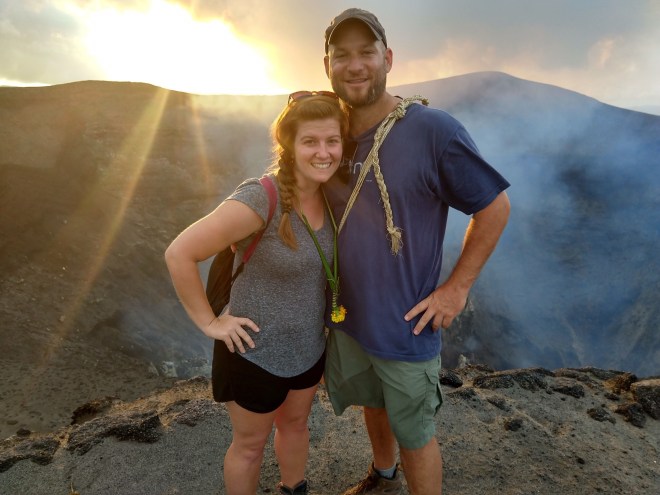
I think these are our best photos taken by a stranger at this point in the trip, so I’m posting both :).
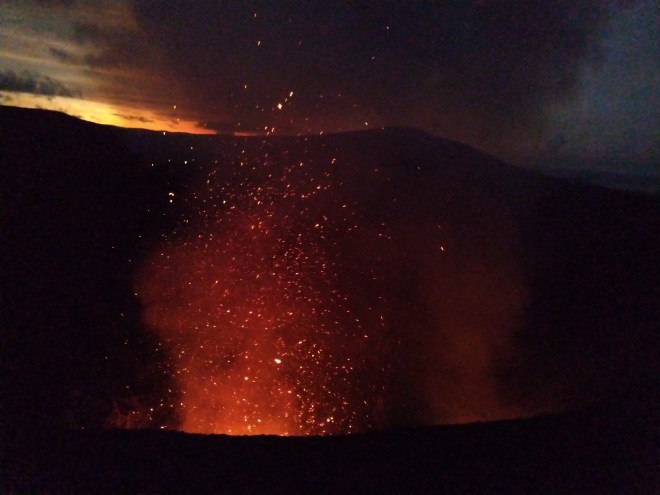
After that we sat for about an hour watching the sunset and the volcano continuously erupted. It was quite a sight as the colors shown behind the fiery bursts.

—
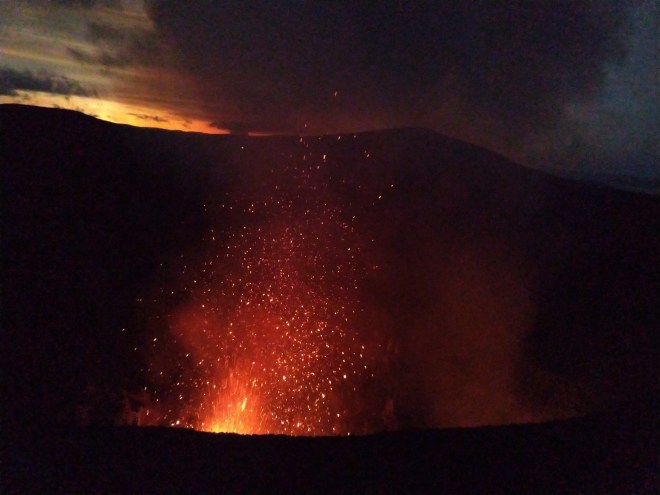
I love all the colors in these!
Here’s a nighttime clip as well:
Before we descended back to the trucks I took a couple of final pictures of the fiery glow reflecting on the ash clouds.

—

It’s truly unbelievable!
Reflecting on our time in Tanna, the whole experience was truly unbelievable. It’s also pretty unbelievable that all of it, the good and bad, is everyday life for the people on the island. Traveling introduces you to different ways of life. It’s amazing all the things you can learn and be reminded of in the midst of that.

 The Yonderers
Interesting! I’ve seen a lot of people smoking marijuana, but I have never heard of anyone doing something as stupid as what you describe because of smoking marijuana. You’re right. Those are symptoms of some form of mental illness. Kava, now there is another subject. When I was at Seminary I used to drink Kava coffee. Kava was the brand name, not the ingredient. It was made from coffee, but differed from other instant coffees in that the “acidity” had been chemically neutralized or removed. It was supposed to be easier on one’s stomach, and I believe it was. I haven’t had a cup in a long long time. – Just a thought. It isn’t impossible that in your journeys you could run into people who are actually demon possessed. There are some things that even psychiatry can’t explain in my opinion. Over the course of my lifetime, I have encountered a couple of two or three people who seemed to be even beyond the realm of mental illness. Myron was one. He did automatic handwriting, (I’ve forgotten the technical name for it.) Autogramaton? He also try to kill himself and failed. Oh well, enough of that! I’m going outside to work on the Trellis. Bye, Love y’all.
LikeLike