As I begin typing this we are on the plane, leaving one of the most anticipated locations of our trip, Vanuatu. For those of you who don’t know, Vanuatu is where Kirk spent two years as a Peace Corps Volunteer. It’s been twelve years since he served there, so going back was no small deal. He was excited to see the community that brought him in as family, and I was excited to meet everyone and see where he once lived. The last three weeks have been pretty amazing, and it’s going to take a few blogs to describe the craziness and wonder that occurred in our time there.
Before I fully get into some of our stories I’ll tell you some of the things that I’ve found interesting about this place that Kirk once called home. First, the language.
Bislama is the official language and common tongue in Vanuatu. There are over 100 local languages spoken and school is taught in either French or English, but Bislama is the one language that pretty much the entire country speaks fluently. It’s considered a pigeon language, a mix between English, French, and local words. As I would listen to people speak, I found that it was easy to figure out the main idea of the conversation as so many of the words have English roots. I have to admit though, when I first saw the language written, I couldn’t help but think of the game “Mad Gab.” Like the game, there are a lot of phrases and words in Bislama that look completely foreign upon first glance, but if you read them out loud, suddenly it starts to have meaning. It’s an incredibly phonetic language, being pronounced just as it looks, so for you teachers who are used to deciphering phonetically misspelled English words, learning parts of Bislama would not be so different. For example, I saw this written in an advertisement:
“Gud wota gud lief” (Good water, good life)
Another said, “Tuff Tomas” (“So strong” – or as I like to think of it – “too much tough”)
Here are a few without the answers right next to it in case you are in for a bit of fun :):
1) Buk blong mi
2) Hemi woman blong saiens
3) Nambawan
4) Tankyu Tomas
5) Nem blong mi
6) Olsem wanem
Don’t get me wrong, there are plenty of phrases and words that have no resemblance to English, but it got easier to decipher some of those as well by the end of our time there. Below are the answers:
1) That book belongs to me 2) She is a woman of science – “hem /hemi” is the word for him, her, he, she, and it. 3) This phrase is used the way we would use “the best,” but it definitely sounds like “number 1” 4) Thank you very much 5) My name is 6) This one was a trick :). It’s a greeting that means “How are you?” Or “What’s up?”
I’ll also note, even having not spoken it for 12 years, Kirk’s Bislama is unbelievable. I’ve been impressed with Kirk’s Spanish, but his Bislama far surpasses his Spanish. He never has to search for words and the locals were shocked by his accent everywhere we went. I eventually heard some other white men speaking Bislama, and I finally understood why the locals were all so impressed with Kirk! This guy has a knack for accents in language. It’s true of Spanish too – I forgot to write it in the blog, but every time we met a person in South America they would comment on Kirk’s accent. One taxi driver we had in Argentina even asked Kirk if he was from Mexico!
Moving on from language – the country itself is made up of 83 islands located in the South Pacific. All of the islands have beautiful beaches, some sand beaches, some coral, some volcanic rock – some white, some multicolored, some black. There are also plenty of reefs to snorkel on with an assortment of “Finding Nemo” fish, brightly colored corals, and beautiful untouched shells. Vanuatu is also located on the “Ring of fire,” so there are plenty of volcanos to climb and soil rich with nutrients.
Each island in Vanuatu is home to multiple tribes, with some of their territories being quite small. I remember walking down a road in Ambae where Kirk stopped me and said “That house behind us is the end of that territory. The house in front of us speaks a completely different local language.” Isn’t that crazy? People have speculated that the previous prevalent practice of cannibalism contributed to the distinct territorial lines of language that still exist, as it was not safe to go to the neighbor in the next village to borrow some sugar. In fact, the practice of cannibalism was only stopped in recent history with the arrival of western missionaries. The first missionary was actually eaten, and the last men known to have eaten someone are still alive.
With the presence of these many different tribes and customs, each island is completely different. Most tribes have held on to their roots in some way and all tribes still speak their local tongue. Some tribes still wear their traditional outfits (like Nambas – covering only the male genitalia). Other tribes have switched to a more modern type of dress, but hold on to traditional dances, ceremonies, or chiefs. People in the cities that host many tourists live a more modern life.
For example, the capital, Port Vila, is a large city that caters to the many tourists that visit from Australia and New Zealand. Cruise ships port here, prices are significantly higher in this area, and electricity and running water are widespread.
The island of Santo (where Kirk often went for groceries during his time in Vanuatu) has a modern city right alongside traditional tribes. You can sometimes see a person walking around the grocery store in a loincloth and parts of the island have sewage systems and electricity.
Kirk lived on the island Ambae, and it’s somewhat of a mix. It’s still very much life, as they say, “in the bush,” but they dress similar to people back home, and though they have chiefs, their role in the community has changed immensely from their role historically. There are French and English schools on the island, but no power grid and no sewage system. Some houses have solar panels to charge phones (there is a tower there that also runs on solar power) and stores on Santo, the nearby island that I just mentioned, sell small solar panels connected to a single lightbulb for the equivalent of $8 USD. Although, 12 years ago, less of that was available. Houses vary, but there is a mix of cement block homes and bamboo/thatch houses around the island and all of them have a separate “bush” kitchen (wood fire kitchen), dry or pit toilet (usually a significant distance from the sleeping quarters), rain water cistern, and bucket shower stall.
I suppose that’s enough background from now, onto the beginning of our time on the islands 🙂
We arrived in the capital of Vanuatu intending to fly straight into Santo, then on to Ambae, but were delayed because a cyclone was passing through the northern islands when we arrived. We had to wait out the storm a few days in Port Vila, but thankfully one of Kirk’s closest friends from his time on the island was living in the capital and invited us in, housing us and feeding us. We spent a couple of days with him and his family, feasting on the island food Kirk had missed and “storian” (pronounced like story-ahn – there’s no direct translation for this, but it means telling stories and talking) as the rains poured outside. Here’s a picture of Brian, the friend, and his sons in front of their wood fire kitchen.
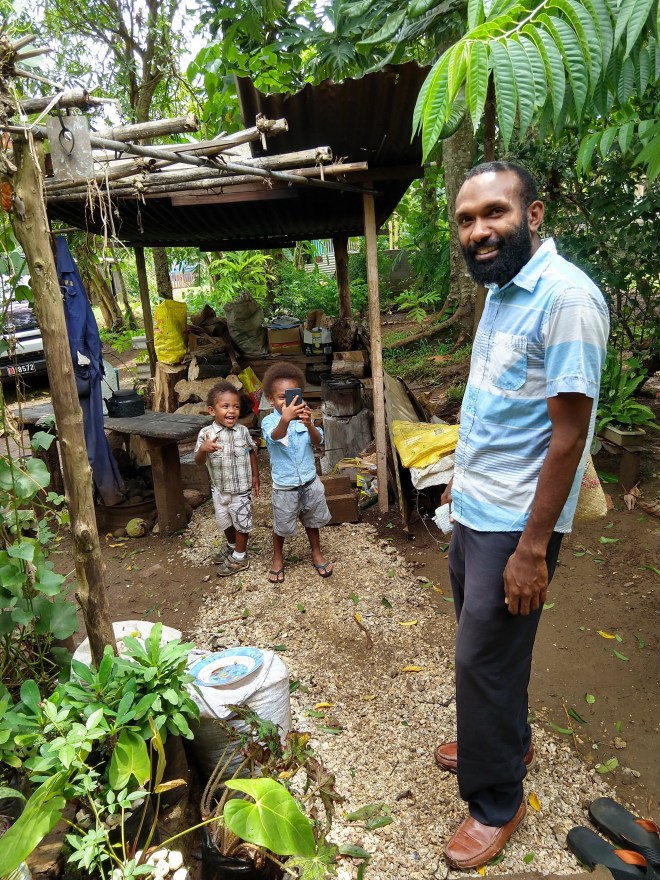
The kids were actually taking a picture of Kirk taking their picture 😂.
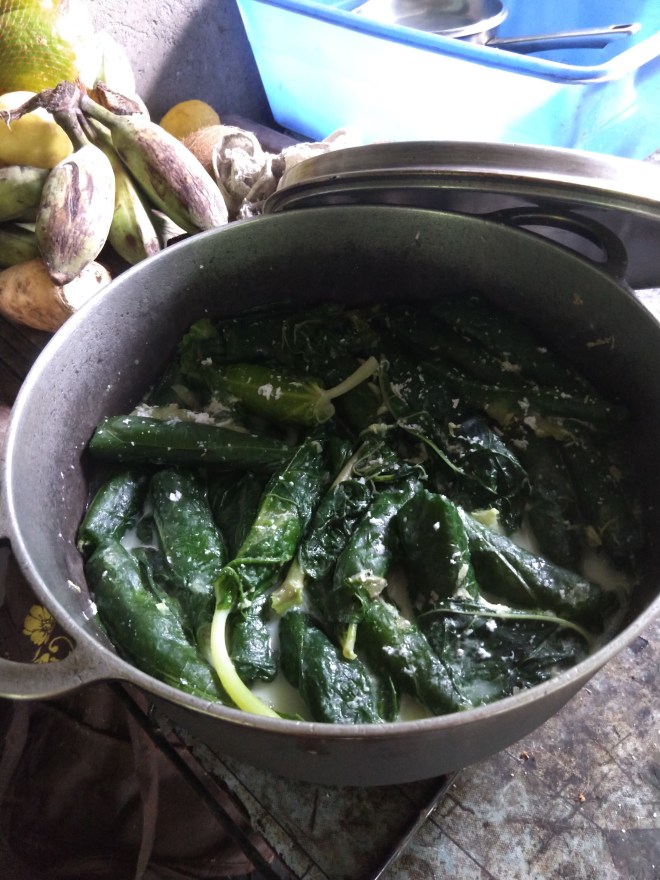
One “island food” called simboro. It’s a type of dumplings made of grated manioc rolled inside island cabbage and boiled in coconut milk. Y’all. I love island cabbage. The tastes falls somewhere in the middle of all the leafy greens at home, and texture is a mix of spinach and kale – soft and easy to chew, but durable enough to make dumplings. I now see why Kirk missed it so much!

Check out these plants on the way to the toilet. Tropical plants are so beautiful and they grow so easily here! That pink flower is of the ginger family, but you can’t eat this particular variety.

Nearly everyone in Vanuatu wear flip flops, and you leave them at the door of your house before entering. They are the most practical thing, especially during cyclone season!
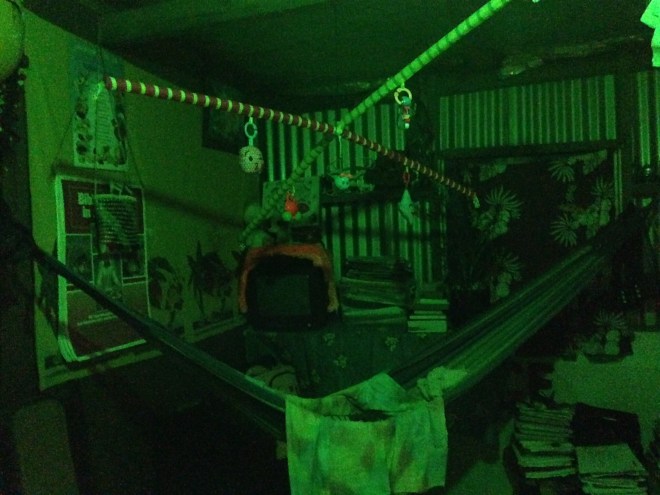
Brian, Kirk’s friend, had another son who was a month old. I was fascinated by this “baby hammock” he slept in. Before arriving in Vanuatu I was reading an article about new baby hammocks that can be put in cribs (so that the fall isn’t far, if they somehow get out). The article talked about how hammocks replicate the snug womb, helping the baby rest more easily while also ensuring that they are sleeping facing up, because hammocks are harder to roll over in or sleep tummy down in. I thought it was so interesting to have read that article and then seen this set up a few days later! I would definitely research it more before recommending it, but I thought it was interesting enough to mention 😊.
When the flights finally got going again, we flew into Santo for one night (I’ll talk more about Santo in a later post, as we spent more time there later), then on to Ambae. The flight into Ambae is the smallest plane in which I have a memory of flying. 20 seats and no stewardesses. We sat in seats 1b and 1c, directly behind the pilot, so we were able to watch out the front as we neared Ambae.
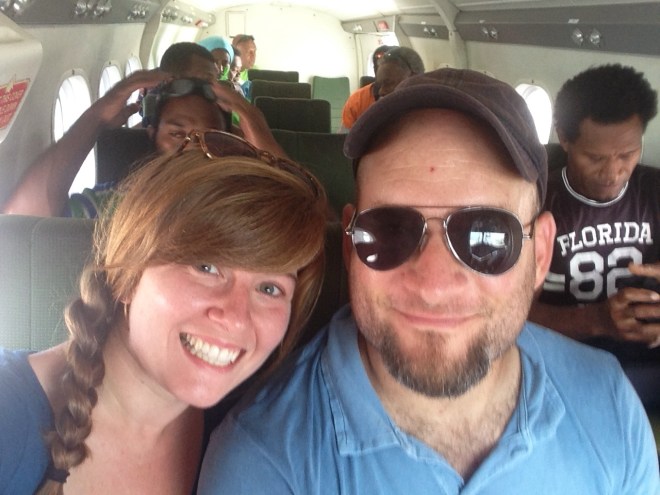
Us with the few rows behind us.

Our view out the front
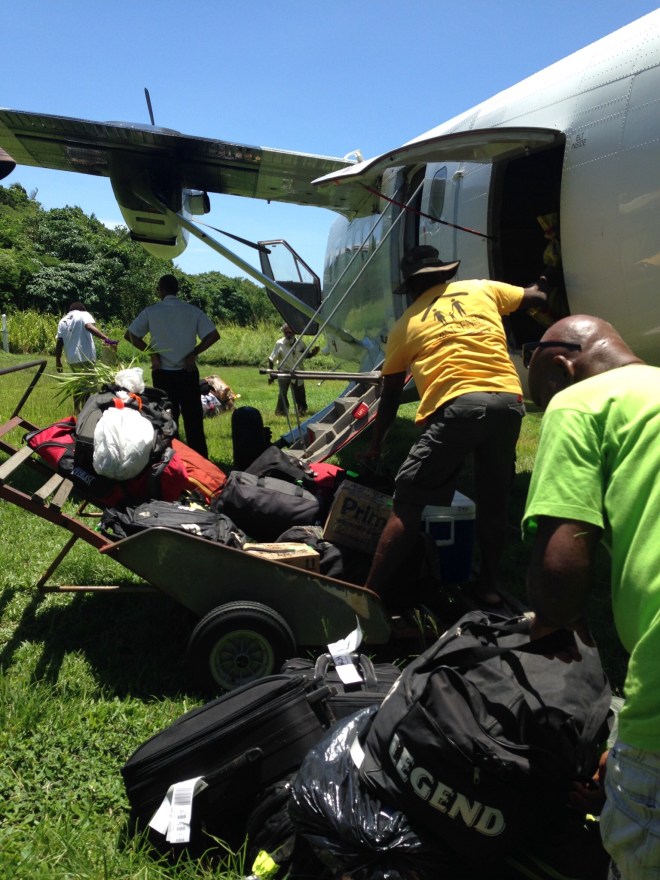
Getting our luggage
The landing strip on Ambae is interesting. It’s a long strip of grass that starts near the beach and goes straight up. If you are standing at the “airport” (a tiny building with a check in desk), waiting for a plane to arrive, you will see the plane in the sky before it drops down and disappears, not to be seen again until it’s already slowed and pulling up by the loading zone.
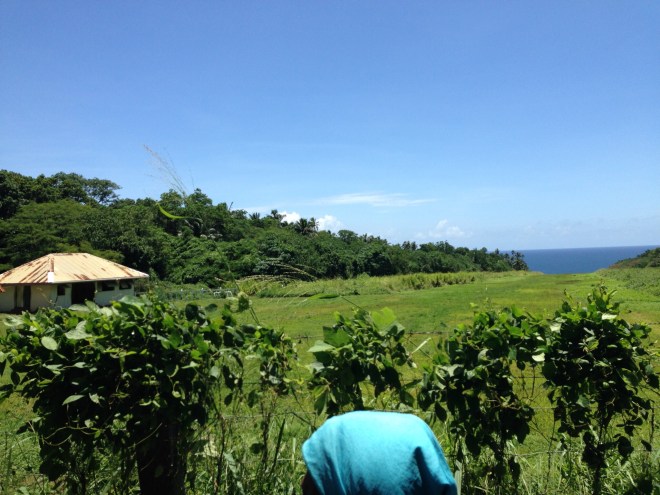
This is a picture of the very top of the landing strip with the airport to the left
It makes sense that the landing strip is so steep. The entire island of Ambae is essentially part of a volcano. It’s shaped like a football, all sides gradually going upwards towards a tall cone in the middle. Though the volcano is only around 5,000 feet above sea level at it’s tallest point, the base of it continues down beneath the ocean for another 8,000 ft.
Our seven days and six nights in Ambae were filled with greetings and smiles. We stayed with the same host family whose land Kirk lived on during his peace corps years. Though the house he stayed in previously is no longer suitable to live in, we were welcomed in and given a room inside the family home. This was the first place in our journeys that I feel like we were truly immersed in culture, and that’s only because Kirk knew the culture so well from before. I was fascinated by island life and found myself comparing it to my previous experiences in traveling.
Ambae is unlike any place I’ve ever been. In some ways what they call “island life” is not so different than “village life” that I’ve experienced in different parts of Africa. In both places there is a vibrant joy spread throughout the community in spite of circumstances. Modern conveniences are lacking, but the love and willingness to share and give is abundant. Uganda is the first place I remember experiencing a joy like that, but you might be interested to know that this joy is not just seen in Vanuatu, but also calculated. Vanuatu is consistently rated among the top five happiest countries in the world. We actually met a German girl in the Amazon who was ecstatic that Kirk had lived in Vanuatu, as she had been studying the happiness index there in hopes of finding a way to spread the joy around.
What’s strikingly different about Vanuatu from other places I’ve been is the food situation. Many of the people in the villages in Uganda (and other parts of Africa I’ve visited) face an everyday battle with food. I remember driving through Mali and watching individuals dig through the landfill for scraps. During a meal, nothing was wasted. Bones were picked clean, all innards were eaten, food dropped on the ground was washed off and consumed, no part of a plant was wasted. Even during my time in Peru we watched families rise early in the morning and spend sunrise to sundown in the fields – bent over, walking the rows, tending to their crops to ensure they have food, growing extra to stock up for winter.
Vanuatu is different. The volcanic soil on the islands is so fertile that food just grows, and much of it does year round. There are even several foods that can be grown by breaking a piece off of a another plant and sticking it in the ground – then you just wait – little to no tending needed. There are also foods that grow in the wild. Some people plant papaya or mango trees in their yards, but there are also trees just growing out in the bush. If you are walking down the road and pass a papaya tree with ripe papaya that isn’t next to someone’s house, you can just take it. Coconuts grow in abundance. When dinner time comes, you walk into the bush, pick up one of the 100’s of fallen coconuts, and boil up dinner in the milk. Peanuts, taro, manioc, sweet potatoes, bananas, island cabbage – there’s just so much that you can grow with relatively little effort, and since the islands are not overcrowded, there is more than enough for everyone, much of it for free.
That’s not to say that there isn’t hardship though. Kirk described their food situation as feast or famine. Either there is abundance and plenty to share, or a natural disaster has hit (cyclones or volcanic activity) and everything has been destroyed. We actually arrived as a time of famine was coming to an end. Plants were finally beginning to produce fruit again. It’s terrible though, because by the end of our week, famine was coming back in full swing.
If you’ve seen my facebook posts, you know that the volcano on Ambae has recently become more active. Over the last year it got active enough that they had to evacuate the entire island. Everyone unpinned their animals (so they could feed themselves) and deserted the island to head for safety. They were only gone for a short time before being sent back, but upon coming home, acid rain greeted them, killing all their food. Thankfully rice and canned fish were sent to the island so that everyone could eat, but they’ve been eating that a long time now. Canned meat and rice was still the main meal during our time on the island with a few occasional “island foods” from crops that had slowly returned. However, the day before we flew out of Ambae, the volcano spit out heavy amounts of ash. We watched as the sandy soot covered the water cisterns and greenery. All around you could hear and watch as surrounding food sources were crushed by the weight.
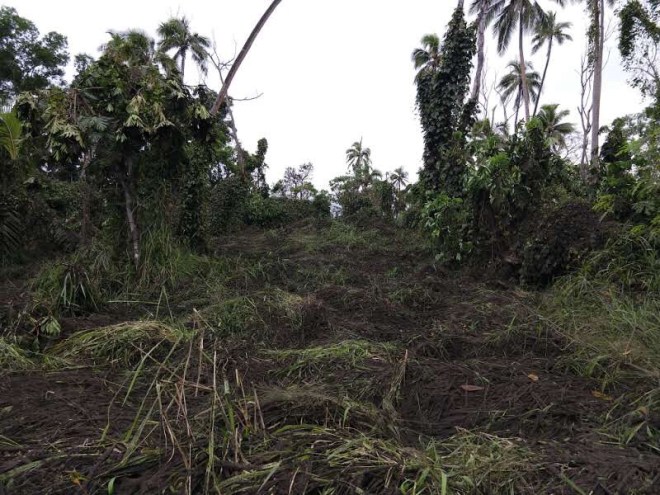
Tall grass, flattened by the ash
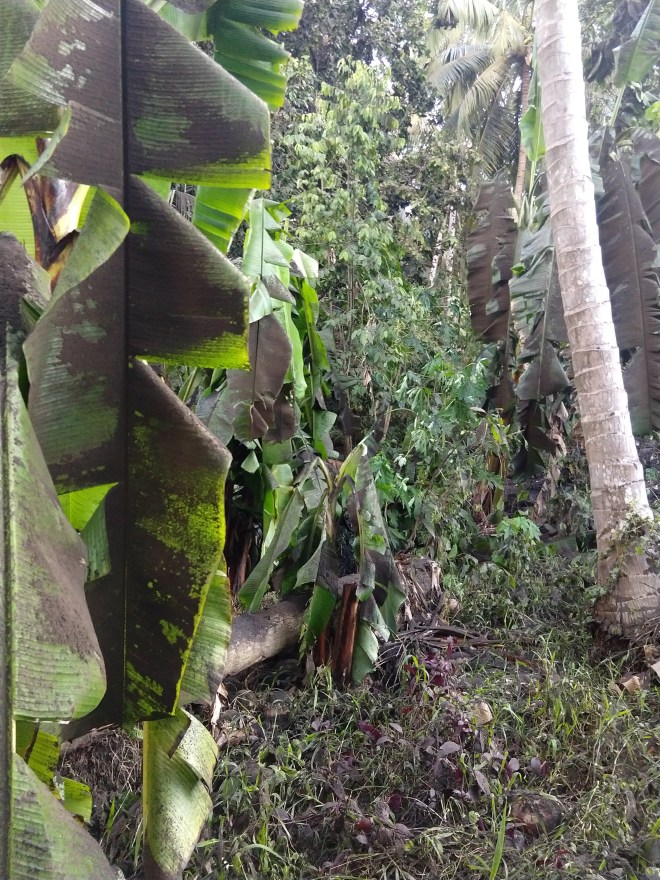
Banana trees, leaves snapped from the weight

The water cistern, covered in ash. Though little of ash got inside this time, other cisterns have been spoiled by the ash.

One of the tropical plants with a thick ash cover

This picture was taken a few days later, but once we arrived in Santo, we found that the ash fall had actually made the front page of the Vanuatu paper.
Though we could hear the rumble of the volcano from miles away throughout all of our days in Ambae, the winds only blew the ash our way twice. The rest of our time was filled visiting people, with a few beach visits in between.
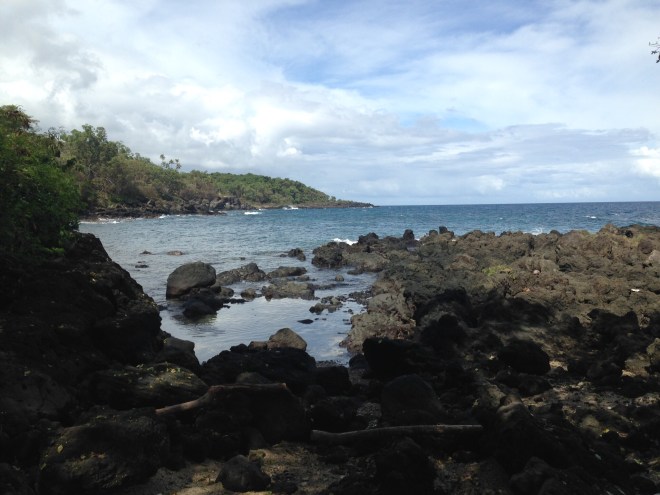
This is one of the beaches closest to the village Kirk stayed in, right next to the center of town. Years ago Kirk spent many a days spear fishing in these waters. While beautiful, the volcanic stones make this one of the less comfortable beaches on which to hang out.

One day we walked to an area called Devils Rock. It has some of the nicest beaches on the island made up of coarse multicolored sand and large pieces of coral. Some of the beaches in this area are considered taboo, haunted by spirits, so not many people visit. We ended up having the beach to ourselves!
It would have been a lovely day, but the volcano decided otherwise. We watched as grey clouds spewed from the volcano, seen looming over the beach in the picture above.

At one point we were sitting on the beach eating lunch when my arm started itching. I looked down and saw that I was covered in black specks. We spent the next several hours “hiding” in the water to keep the ash off. Though the ash that broke so many plants was more like sand and didn’t itch, this ash was light, irritated our skin, and dissipated upon contact with water. Eventually heavy rain came, washing all the ash down at once, and allowing us ash-free travel for the road home.
A third beach we visited was a talk of the island. Not long before our arrival, a village nearby woke up to find literal tons of sand had traveled from the top of the volcano, down the creek banks, covering their once rocky beaches. Somehow, none of the houses were affected, but the sand did sweep a car down with it.

This picture shows where the waves have washed away much of the sand, revealing the rocky shores the beach once had.
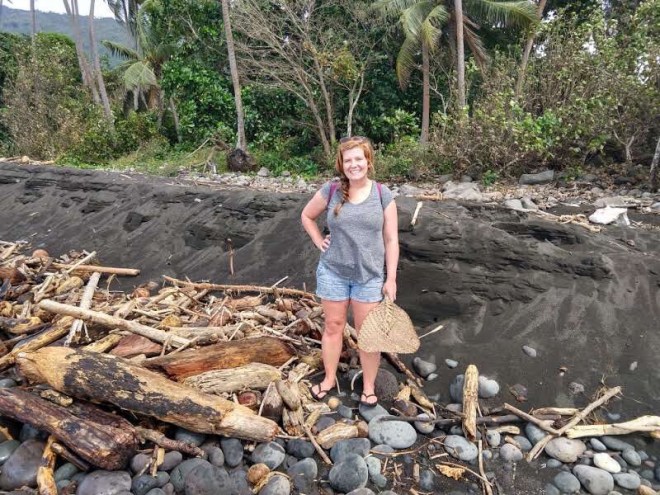
For reference, I’m 5’2″, and this sand goes a very long way down the shore.

This is Kirk standing where sand filled in the gaps between some of the large volcanic stones. It’s hard to see, but the frame of a car is buried back behind him too.
While we are on pictures, here are a few pictures of useful plants in the area that you may or may not recognize.
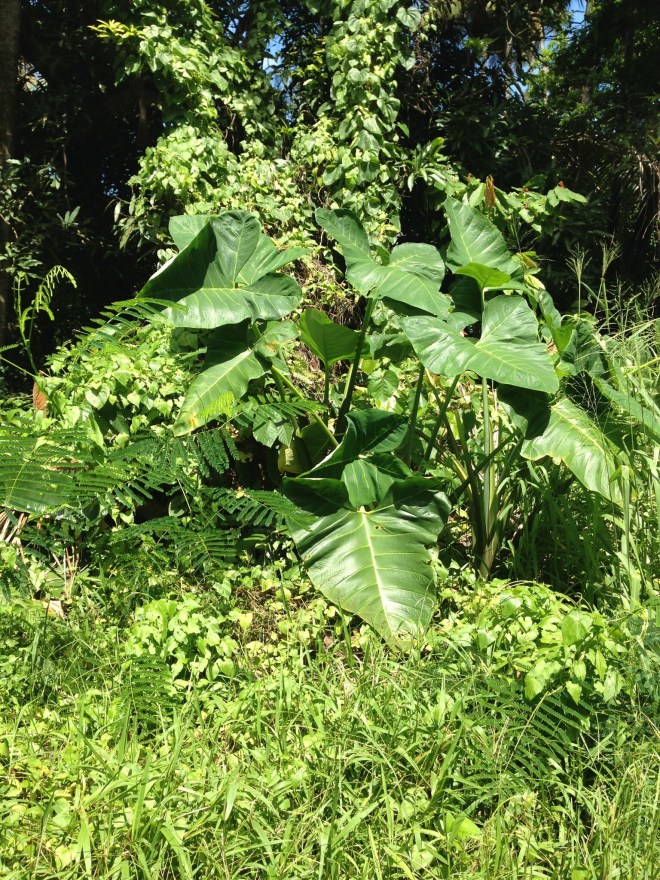
That “elephant ear” plant is called Taro. The roots are huge and taste similar to potatoes.
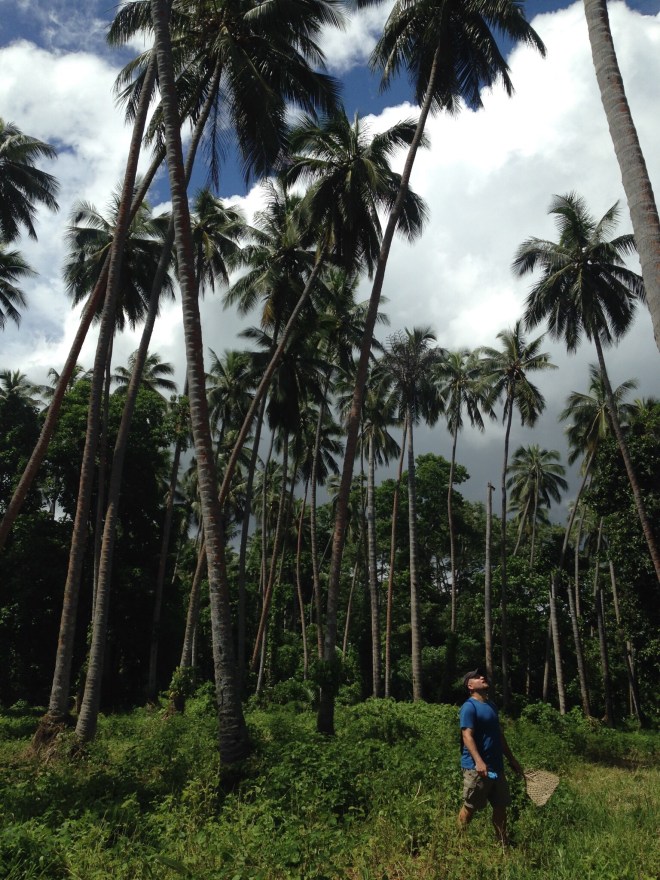
Us walking through some of the many coconut trees. Coconut water is drank from green coconuts on the trees. Coconut milk/fruit is used from ripe coconuts, that have often already fallen.
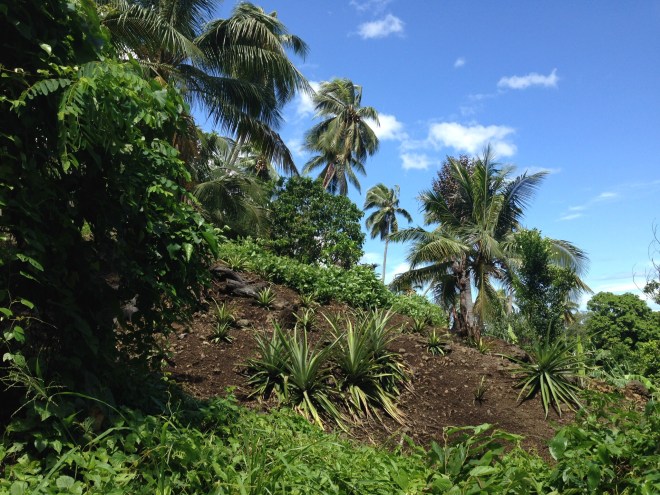
The plants in the middle of the dirt are pineapple plants. The grow best in rocky soil

The tall tree behind the banana leaf is a mahogany tree that Kirk planted 12 years ago. It’s around three stories tall now! They aren’t indigenous to this island, but they grow well here!

A group of papaya trees. I thought I didn’t like papaya, but that’s only because I’d never had it straight off the tree! That stuff you find in the states isn’t close to ripe!

I don’t have any pictures of the plants, but leaves from many of the palm like trees here are used to make all kind of things. Walls, roofs, baskets, fans, temporary plates, mats, bags, purses – it’s shocking how useful and durable they are. The roofs made from thatch and bamboo last around 20 years, and (as Kirk experienced during his time in the peace corp) they are capable of keeping out level 2-3 hurricane/cyclone winds.
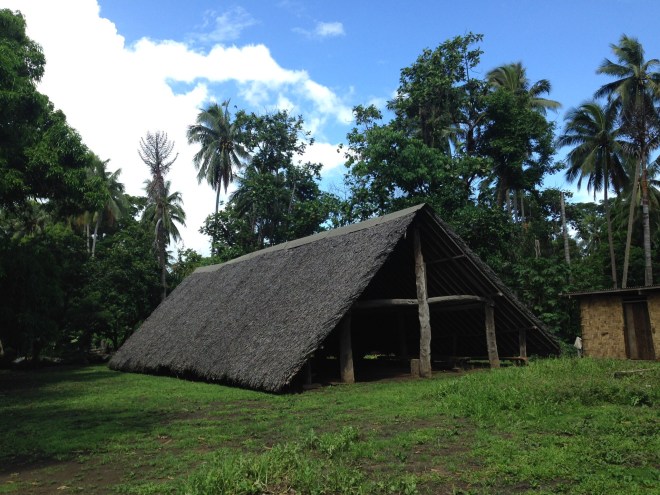
This is a traditional Nakamal, a gathering place for the community, with a thatch roof. Kirk was in one of these when cyclone Ivy came.
Banana and lap-lap leaves are also often used on the island for cooking or packaging food. They flavor the food and hold up well in heat. Fires are often used to heat stones, then packages of food wrapped in these leaves are placed under the stones and left to cook for hours. It’s so economical, and the leaves are often used as plates as well!
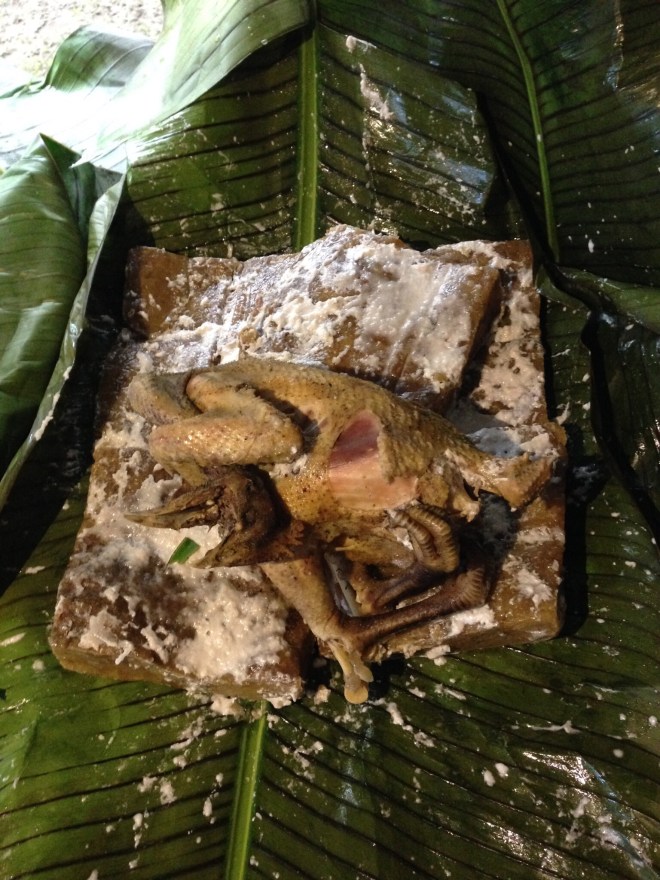
This is a very traditional dish made for celebrations also called lap lap. It’s made from any of the grated root crops or bananas mixed with coconut milk, and cooked in the leaves. This one was cooked with a whole chicken. The texture is pretty gummy, and the flavor changes depending on what crop was used. Kirk loves it. We received several of these as gifts, which was very kind of people!

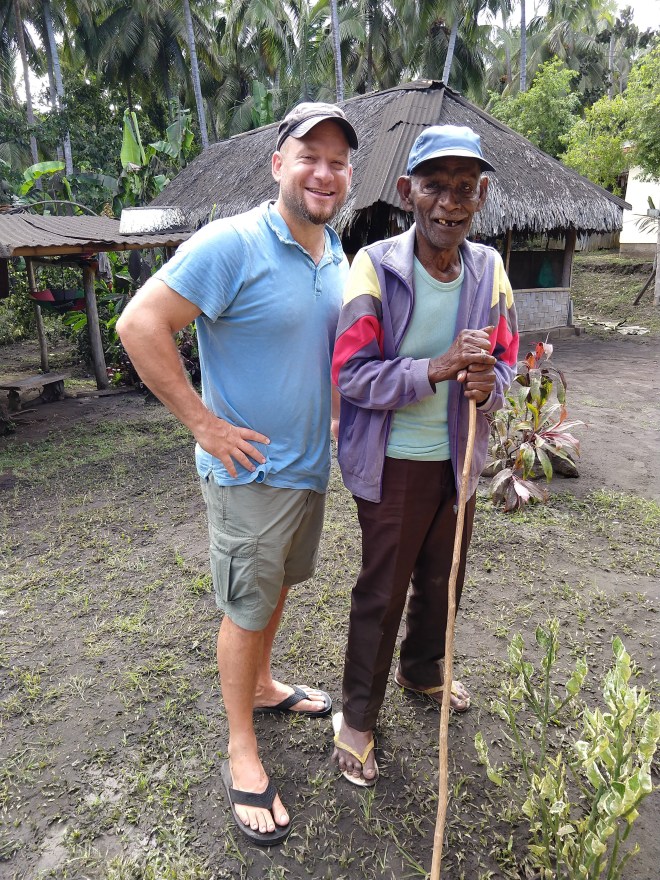
This is Kirk with an old friend, Pastor Titus. Lap lap is packaged in those lap lap leaves. Customarily, when this meal is gifted in this manner it’s considered a big sign of respect.

One day when we were in the town center, Kirk ran into Evelyn, a woman he knew during his time in the peace corps. She offered us a scone and they were delicious – perfectly moist and mildly sweet! She was so kind to give us the recipe, and I’m putting it here for safe keeping. It would be especially delicious with some fresh or dried cranberries mixed in with the sweet coconut milk! If you want to give it a go, SFR is self rising flour and you mix it together in the order listed. Dessert spoon is close to teaspoon and baking temp and time is up for discussion (probably around 350 for 15-20 minutes). honestly, I’m not sure canned coconut milk will have the same effect as fresh, but work with what you got!
Here are a few pictures of old friends.
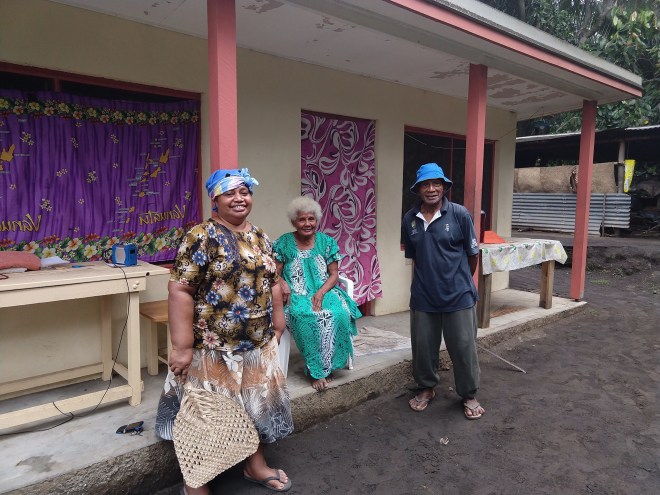
This is part Kirk’s family in Ambae. We missed out on getting a picture with our main host, Reynold, because we ended up being rushed leaving, but above is one of Reynold’s extended cousins alongside his mom and dad.
This is Kirk with Charlie, Reynold’s uncle. Charlie and Kirk storian-ed many a nights during Kirk’s time in the Corps, and it was fun to watch them interact again. Charlie has a great sense of humor!

This is pastor Adam and his wife. He ran a village store near Kirk’s house, and he and Kirk visited often when Kirk was living there.
There are so many people we ran out of time to get pictures with, and so many other who welcomed us with kindness and generosity. Upon leaving, Reynold and his family gifted us bags. Kirk received a straw bag, a traditional bag men wear here, and I received a large bag made by Reynold’s sister. During our time in Ambae, we were often asked about children – if we had them and when they were coming. When the family gifted me the bag, we all cracked up as they joked that it was a diaper bag for our future children 😂. This bag will definitely hold a few diapers!

We were quite lucky to fly out when we did. Right before boarding the plane we watched as the volcano shot out more ash into the sky.

Unfortunately, it’s continued to grow in activity since we left and talk of evacuating the island is going around again. Articles are saying fire can now be seen on the top of the volcano, reflecting in the clouds, and more landslides have occurred, some damaging homes. Keep Ambae in your thoughts and prayers. It’s going to be hard if they have to evacuate again, but even harder is the volcano fully erupts!
I think this has been my longest post, but now that you’ve been introduced to Vanuatu, stayed tuned for interesting story telling from our time on other islands there.
As I end this post, we are on our final day in Australia. Tomorrow we head to Hong Kong!

 The Yonderers
Oh, I loved reading every word of this! You describe everything so well, that I can envision being there with you! How exciting for Kirk to rekindle these friendships! I cannot wait to hear more stories! I will definitely be in prayer for the people of this island. Please keep us posted. Let me/us know if there is anything I/we can send to them to help, should they have to evacuate again. Love and hugs…
LikeLike