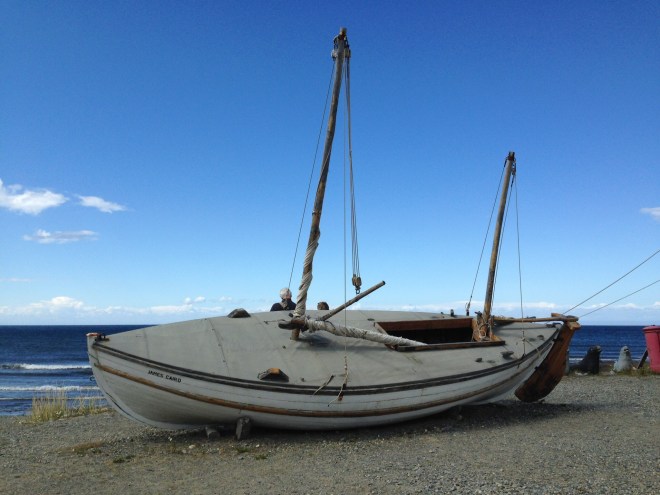
Hanoi, Vietnam

In total, our time in Vietnam was 30 days, six cities. While Kirk has visited Vietnam on several occasions in the past, this is my first time there. As I write this, we are on our way out of our last city in Vietnam, traveling towards Cambodia. Today’s post is about the city we flew into, my first introduction into Vietnam, Hanoi.

You likely won’t be surprised to hear that for the most part, I love it here. Though my stress level has been significantly higher here due to the unruly traffic and ridiculously loud and often used horns, the beautiful greenery and outstanding fresh food has won me over.

Vietnam is the world’s number one producer of rice, and riding through the Vietnamese countryside, this is very clear. While Hong Kong was filled with shiny buildings, fancy cars, and random green space in between the concrete, Vietnam as a whole is more of a vibrant green, water filled land, with jam packed, hard working, somewhat dingy cities in between. The main mode of transport here are motorbikes/scooters and the amount of people wearing face masks to protect from the fumes of the city number make up about 1/3 of the population. Even the naked faced individuals occasionally cover their faces with their clothes though – some of the truck fumes are pretty bad!

I’ve felt it would be too rude to ask to take a picture of someone with the mask on, but the kids wearing them are particularly cute – kids masks usually resemble some type of animal face :).

Like Hong Kong, the food here has left me wanting more. I was certain that by 4 weeks in I’d be tired of noodle bowls, but the crisp deliciousness inside them usually just leaves me wanting more. We’ve found that each city/region within Vietnam has their own special dish – although our favorite we discovered comes from this first city in which we found ourselves – the dish is called Bun Cha.

Bun Cha is essentially a pork noodle bowl that is served with fresh herbs and greens. Upon ordering the cook brings a small bowl filled with a hot, sweet and savory, sometimes garlic-y, vinegar broth with thin soaked slices of green papaya and carrot. Just before giving you the bowl they drop in a few strips of perfectly marinated, freshly grilled pork and a few small sweetly charred pork patties. On the side, you receive a plate of rice noodles and a bowl of lettuce and fresh herbs (mint, Vietnamese lemon mint, basil, sometimes cilantro, and some other types of herbs we haven’t yet figured out). There are also usually a set of “condiments” nearby – freshly chopped, quite hot peppers, a vinegary garlic sauce, soy sauce, fish sauce, sweet chili sauce. I usually just add the hot peppers and garlic 🙂

You eat the dish by gradually adding the noodles and greens to the broth, as the broth goes down. I wish I could send flavors! In the States I usually do not prefer vinegar based dishes and sauces (for example, I prefer sweet barbeque sauce to a vinegar one), but here, the mix of herbs and, well, probably the sugar they add, makes it taste more like a fresh salad – a fresh noodle salad. Since you eat the dish with chopsticks and a spoon, you usually end up eating the noodles/greens/meat first, and sipping the leftover broth at the end.

How they bring Bun Cha to you- everything separate.
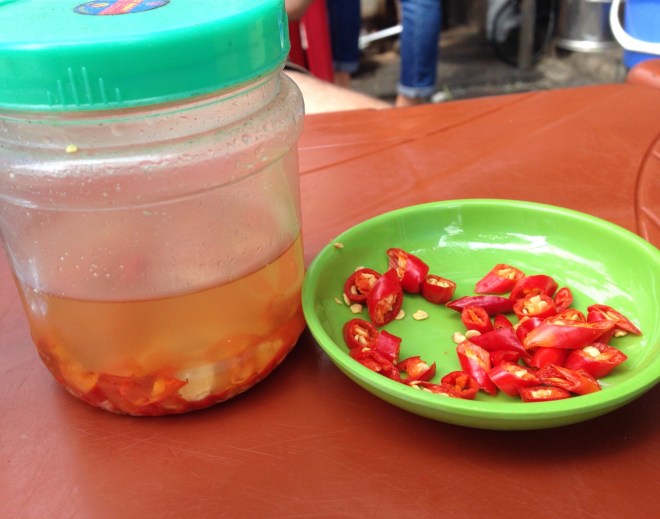
Hot peppers and a hot pepper garlic sauce
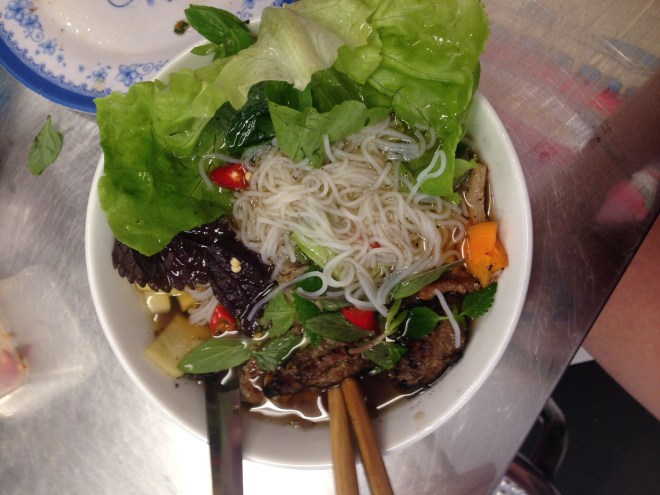
My Bun Cha bowl ready to eat :)!

Our favorite place for Bun Cha in Hanoi. We found it by accident, and never found any others that quite compared! Also – 30,000 dong is less than $1.50 US (around 23,000 dong per USD)

As for other foods we had in Hanoi…
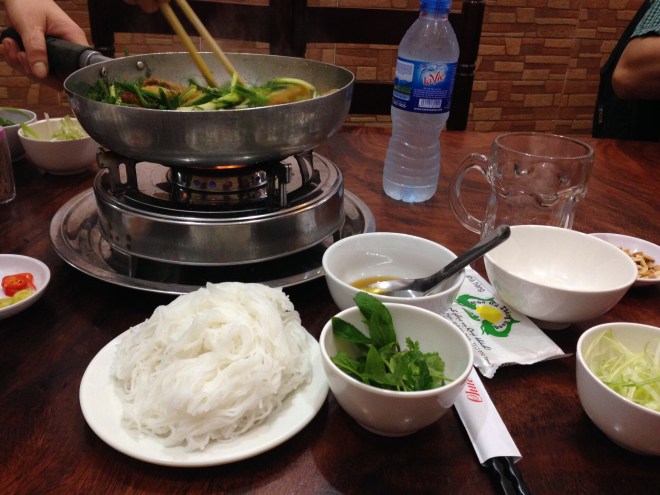
This is Cha Ca – Tumeric fish with fresh dill, lemon grass, and green onions that is served with rice noodles, fresh herbs, lime, and a light vinegary sauce. Strangely, the dill had very little flavor at the place we had it, but it was still pretty tasty.
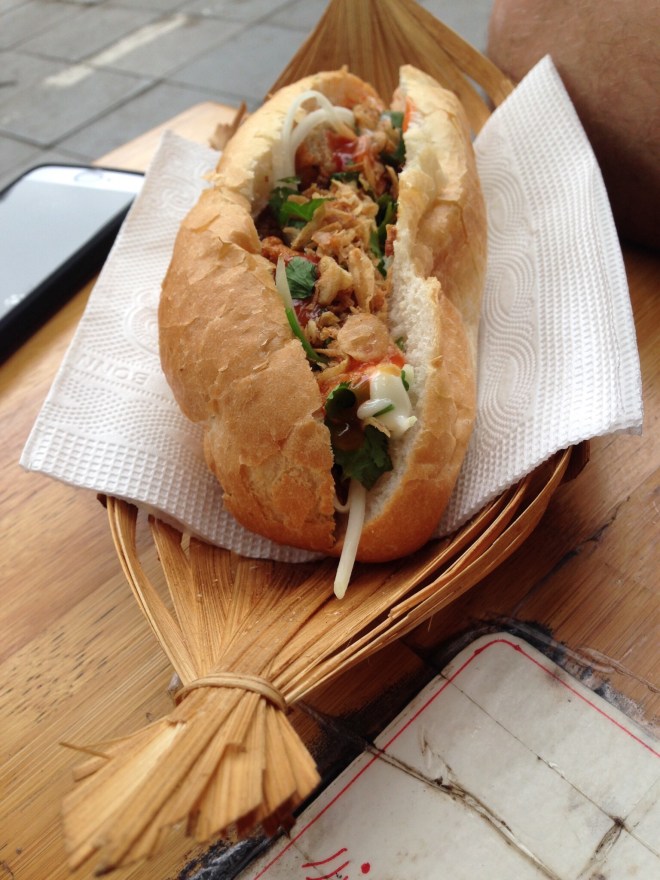
Banh Mi – Vietnamese Sandwich. It comes in a variety of meats and has a collection of different vegetables (often pickled) and herbs – they are more delicious than your average sandwich and cost around 15k ( .70 cents US)

Bun Bo Xao, a beef noodle salad with bean sprouts, peanuts, fried onions, greens, herbs, rice noodles, and a light sweet vinegar based sauce.
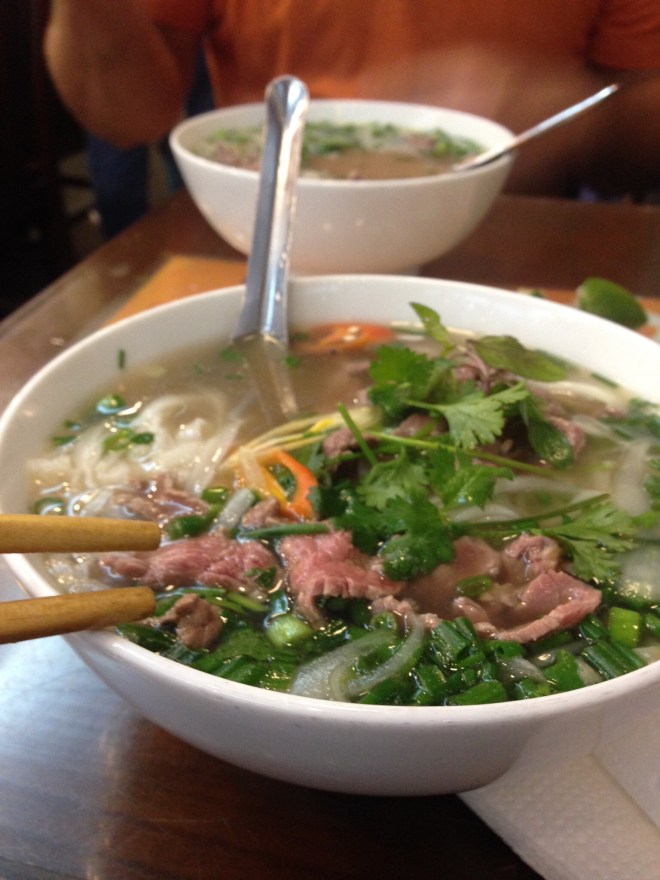
And the ever famous – Pho, in this case, Pho Bo, Beef Pho. All phos are not created equal and I’ve found my favorite ones either have a light mix of ginger, cloves, and cinnamon or a heavy onion taste to the broth. There is also a stir fried version of this, everything seen here fried up in a pan, minus the broth. That too is tasty!

If you ever find yourself in Hanoi, I also recommend hunting down “King Roti Coffee Buns” and getting the coffee bun filled with chocolate. My nose found this delicious pastry as we were on our way home one day and I couldn’t resist going back, though I never got a picture of it. It was somewhat like the pineapple bun in Hong Kong, texture wise, (soft with some kind of crumble on top) but it actually had a hint of coffee! Delicious!!

We also had our fill of spring rolls and fried wonton/dumpling type foods, but most of those aren’t too different that what you see back home.

Onto something other than food 🙂

Hanoi itself is the capital of Vietnam and the resting place of Ho Chi Minh, the communist leader who led Vietnam to independence. In the middle of the old city, is a large, beautiful lake called Hoan Kiem that is a center of activity for the city. In fact, on the weekend nights, all the streets around it become pedestrian only and street vendors and performers set up around the area to sell to and entertain the crowds. There are also plenty of Zumba type groups that come out – you can watch as groups of people dance shamelessly at various places around the lake.

The lake with one of its beautiful flowerbeds.
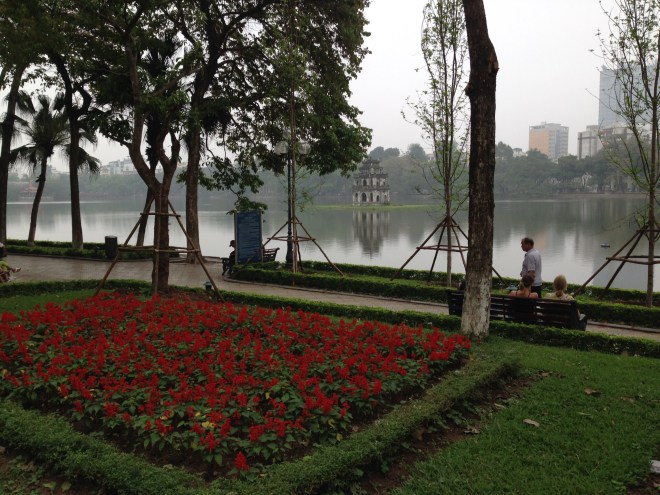
Another view of the lake with “Turtle Tower” seen in the middle.

An edge of the lake – this is not a lake for swimming!

There are also several notable sights around the lake.

This is the entrance to the “Temple of Jade Mountain,” a temple located on an island in the middle of the lake.
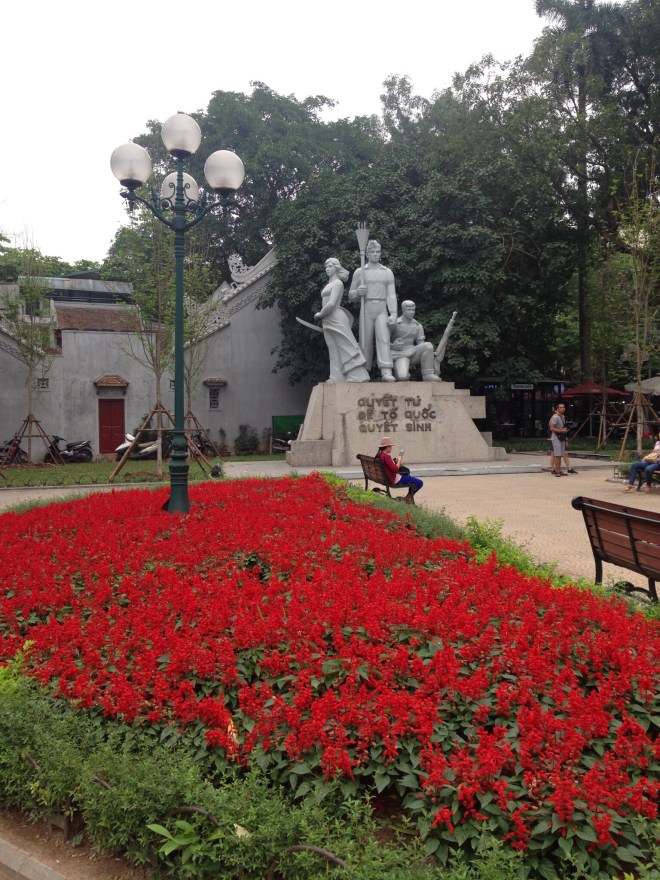
A war monument near the lake

A building with a large picture of Ho Chi Minh, located across the street from the lake.

I mentioned earlier that Hanoi is the resting place of this former Vietnamese leader. What you may not know is that Ho Chi Minh’s body is fully preserved and kept in a glass case in a large mausoleum within the city. Last time Kirk visited, he was able to see the body on display, but when we visited this time we were unable to go inside, but did take a look around the Presidential Palace grounds.

The front of the mausoleum
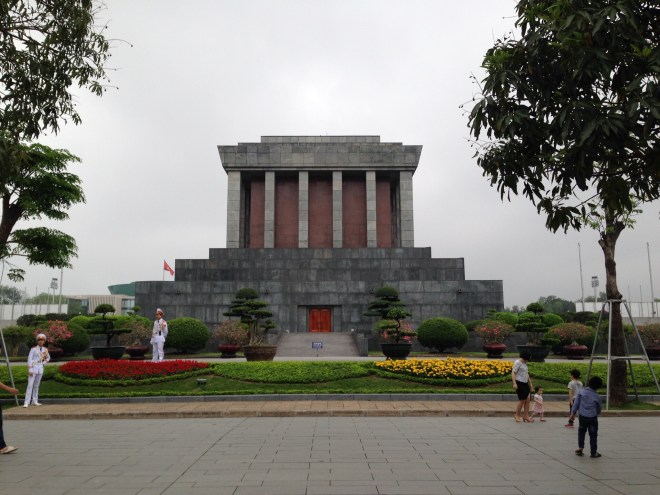
The back of the mausoleum

The Presidential Palace, built for the French Governor when France was still the ruling power. Though it’s the “Presidential” Palace, Ho Chi Minh refused to live here due to it’s grandiosity and had a much more modest residence built nearby.

According to what we read, Ho Chi Minh practiced what he preached, which seems to be part of the reason he was so loved. Below are a few pictures of his humble home.
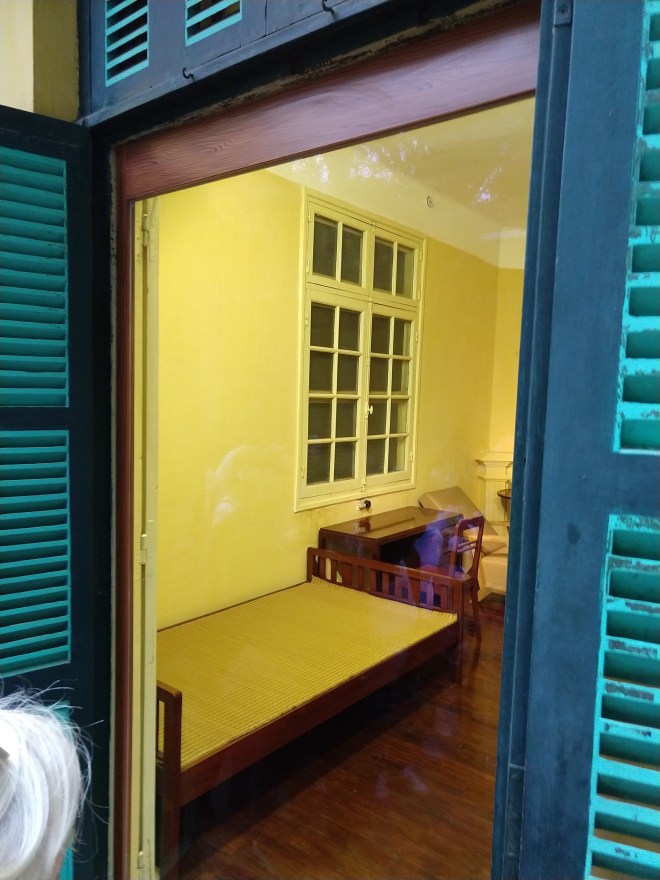
His bedroom
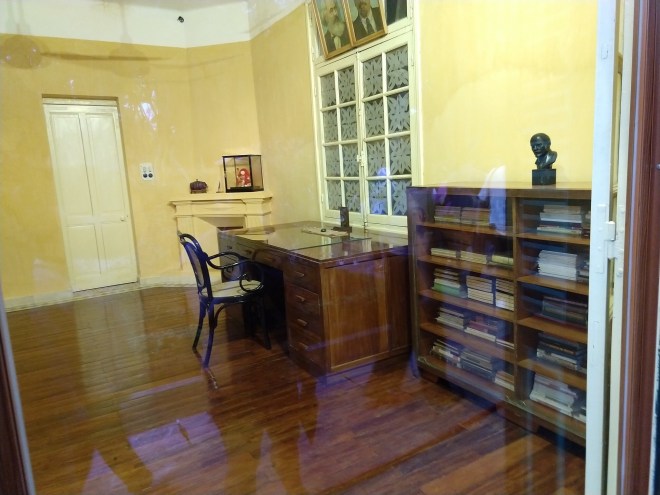
His office

His dining room

It was really fascinating to learn about the circumstances surrounding the Vietnam War while in Vietnam. Honestly, if I was taught about the Vietnam war in school, it must have only been a few sentences because I have no recollection of it. I knew the Vietnam war had something to do with communism and that a lot of people died, but I had never even put together the pieces that it’s a war we lost. I’m thankful that my traveling partner is a history buff, as he has been able to help fill in the missing pieces for me.

If you are as unaware as I was, I’ll take a brief moment to fill you in on my current understanding of what happened in the Vietnam War – though I’m pretty sure parts of this are still debated. Very long story short – the French conquered and colonized Vietnam in the 1800’s and ruled over them up until WWII. In WWII the Japanese came into Vietnam and ran the French out. Towards the end of the war the US worked alongside Vietnamese rebels as advisors to help overthrow the Japanese and at the end of WWII, and when the Japanese left, those Vietnamese rebels declared independence. As the leader of the movement for independence in Vietnam at this time, Ho Chi Minh wrote numerous letters to the US asking for our assistance in their independence (the Vietnamese Declaration of Independence is actually closely modeled on the US Declaration of Independence). The US turned him down to support the French instead, and in the end, Ho Chi Minh strengthened his relationships with Russia and China. It’s still debated whether Uncle Ho (as they call him here in Vietnam) would have fully turned to communism if the US hadn’t have turned him down in support of the restoration of the French colony, but Ho Chi Minh certainly had socialist tendencies prior to the US support for the French. I guess we’ll never truly know what could have happened if the US had offered help (nor do I think dwelling on the past is a good way to move forward, but it is an interesting aspect of the story that I previously didn’t know!).

After WWII, the French ended up coming back into Vietnam to reclaim their colony with great financial support from the US, but the newly declared independent Vietnamese were unwilling to be controlled again. After a nearly 8 year war, the French gave up their claims to Indochina. In the treaty to end the French war, Vietnam was divided into two countries with the communists controlling the North (Both North and South wanted independence, but the South didn’t want to be communist). By this time, US foreign policy was centered around stopping the spread of communism throughout the world, and the fear of communism had spread amongst the US people, so when the American government saw opportunity to support the South, we stepped in. It now seems that while both South Vietnam and the US saw this as a fight against communism, the north Vietnamese still saw this as a war for independence.

Ho Chi Minh is quoted to have said to the French, “You can kill ten of my men for every one I kill of yours, but even at those odds you will lose and I will win.”

In 1975, the US withdrew our last troops. The final numbers of lost lives turned out to be just under 60,000 US lives and well over 3 million Vietnamese lives (two million of those being civilians from both the north and the south).

Vietnam has been a communist country ever since, though there is still somewhat a divide in the country both between the north and south and, ironically, between the rich and poor. Some from the South still face the effects of having fought against the what the country’s history now deems as the “wrong side,” struggling to find work and feeling unable to speak out against government if they wanted to – though this lessens as more time passes. The divide between the rich and poor remains, making me wonder further about how much of the North’s fight was actually about communism to begin with. Having visited Vietnam Military History Museum in Hanoi, it seems as if this immense desire for independence was their true guiding light.

Here’s a little about the museum:

Before entering the museum there is a “graveyard” of old war equipment from centuries past set up next to a very old citadel. There’s everything from old canons to modern helicopters and each piece has a story beside it. Some machines were captured and later used by the Vietnamese, while others were shot down or left behind when the war was over. Some of the older canons were found hundreds of years later on old battle grounds.
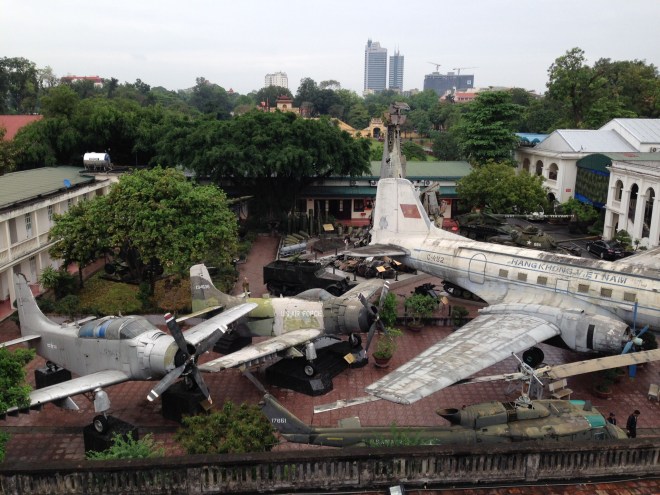
A picture of the “graveyard” from the top of the citadel.
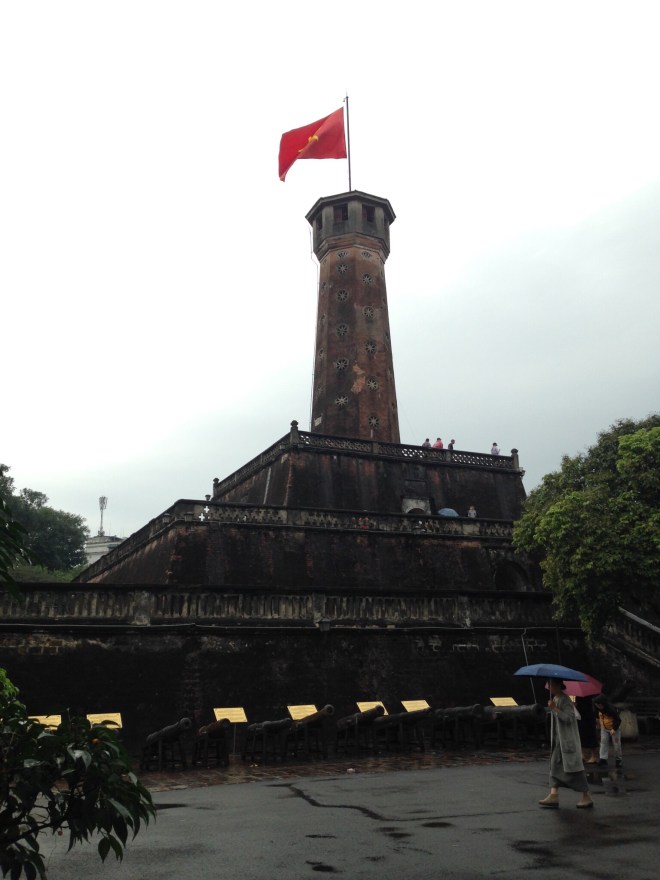
A picture of the citadel and canons. This citadel was built in 1812 and is one of the few pieces of the old city that survived the French invasion in the 1800’s.

Entering into the museum itself, you very quickly find yourself immersed in a story of oppression and resistance. A series of rooms in the museum goes through the history of 1000’s of years in which the Vietnamese were were taken over, but never stopped fighting. They describe themselves as a people who continue fighting, even if it’s behind the scenes while someone else is the ruling power.
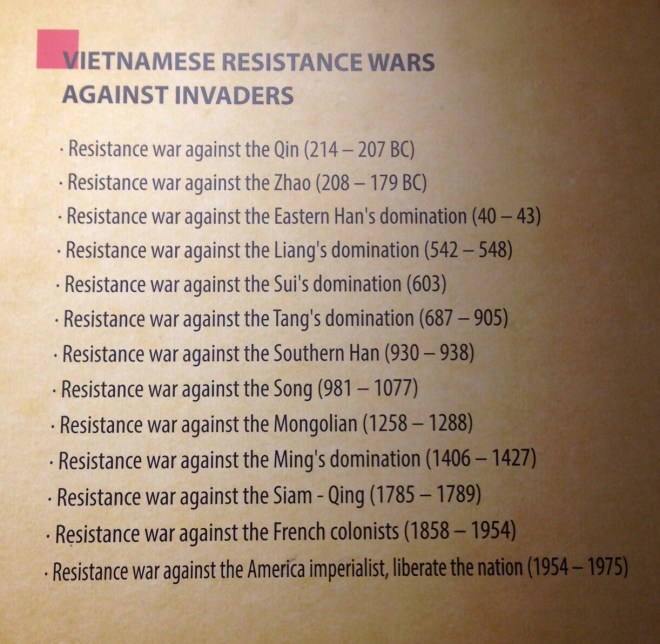
A list of wars talked about in the museum.

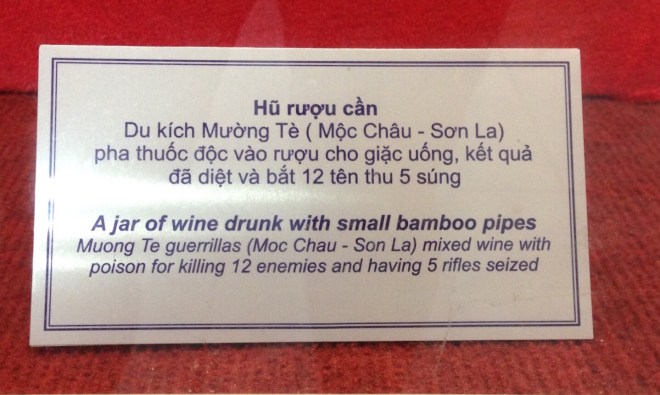
Through the storyline presented, you easily see the passion behind the need for liberation that they had reached by the end of WWII. The whole museum builds up to the final Battle – “The American War.” In this final section they describe their war tactics, displaying artifacts with a very exact description of each – this was a fascinating read. The descriptions read more like a history of a people passed down verbally, rather than a textbook type explanation (which says something of the culture itself). A sword, for example, might say – “This sword was owned by *name* who used it to kill 5 enemy soldiers in *city*, commandeering two enemy rifles in the process.” It’s very different than an experience you have in a US museum – it’s not as concise – but it’s kind of cool to see history told in such a personal way. Afterall, it’s not just leaders who are talked about in the museum, but the everyday man.

Here’s a picture of an example of that:

We learned a lot by visiting the Vietnam Military History Museum, but there was another museum that Kirk had visited previously that he wanted me to see – Hao Lo Prison Museum.

According to the museum, Hao Lo Prison was built by the French and used as a political prison for Vietnamese dissentors during the French reign. After the French had been run out, this was building was used for US prisoners of war during the Vietnam/American War – for example, John McCain was kept here. I would describe this museum as having possibly the strongest bias I’ve ever seen at a museum, but even a strong bias tells a story.
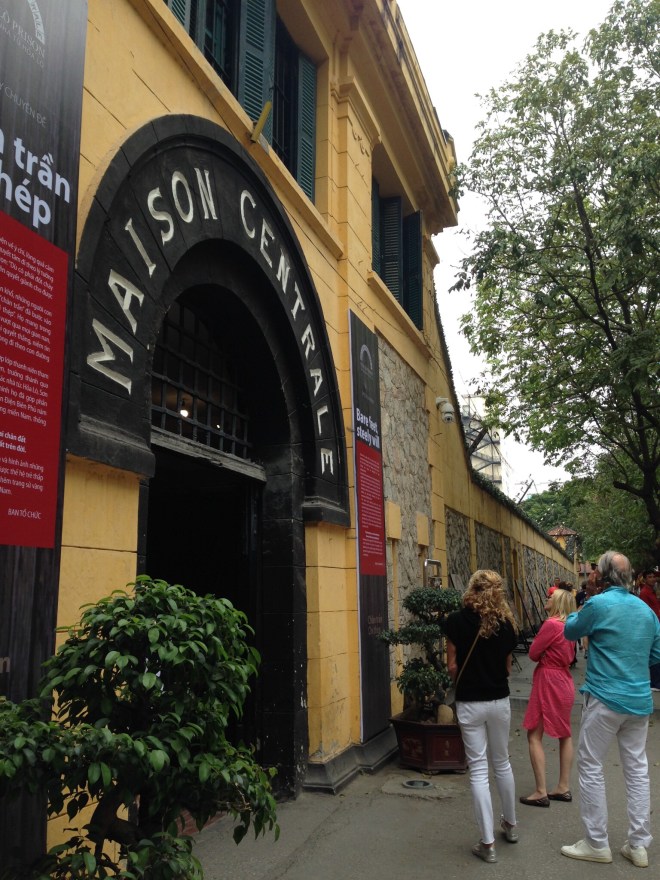
The outside of the prison/museum.

In brief, the first half of the museum is about how terribly the French treated the Vietnamese prisoners in this facility (alongside information about how the Vietnamese never quit fighting for freedom); the second half of the museum is about how nice the Vietnamese were to the American prisoners. Photos are below.
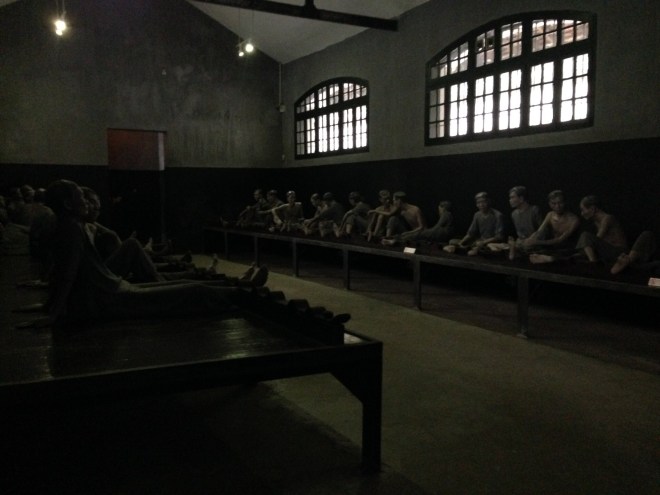
One of the rooms where Vietnamese prisoners were kept, feet shackled.
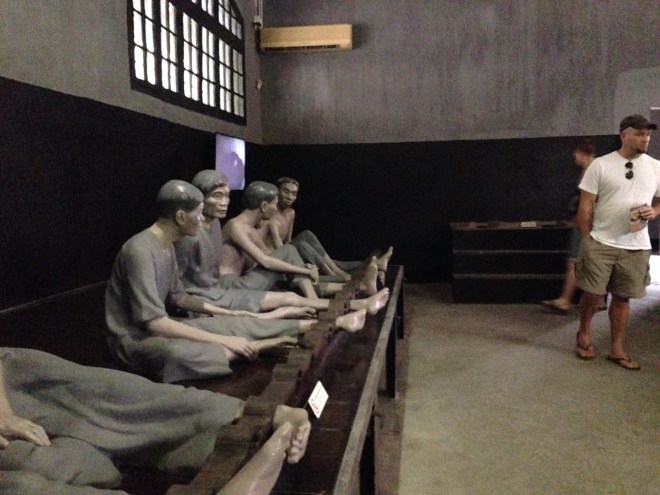
Another photo of the same room showing the “toilets” at the front of the room where they had to relieve themselves in front of everyone.
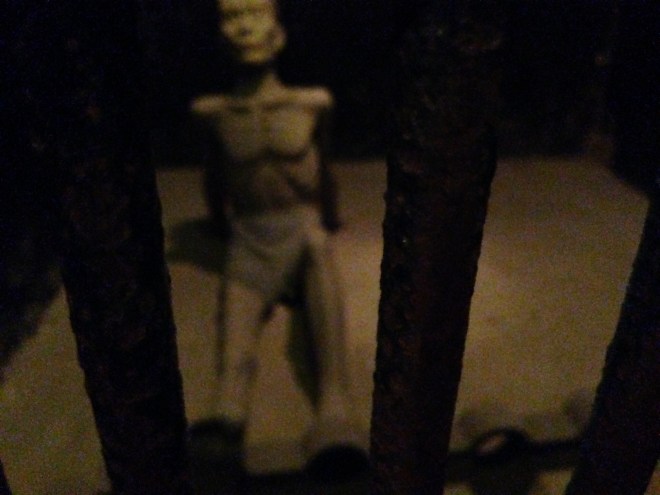
Solitary confinement for Vietnamese prisoners -this room would have been completely dark, and, according to the museum, prisoners were often left to relieve themselves right where they were sitting, leading to disease.
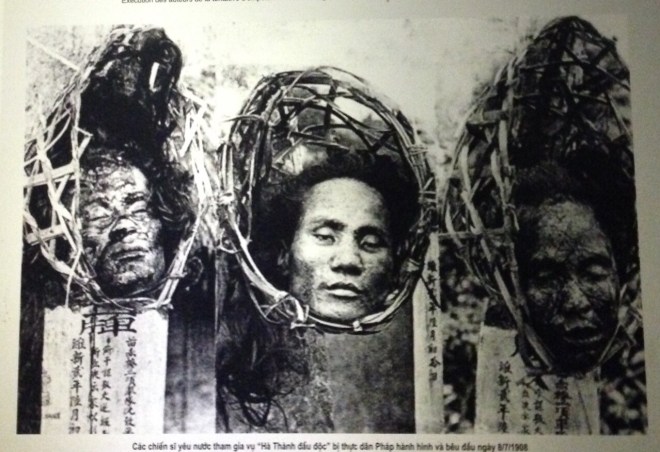
A picture of a picture that was next to a guillotine used by the French for decapitating Vietnamese prisoners, their heads then placed publicly as an example.
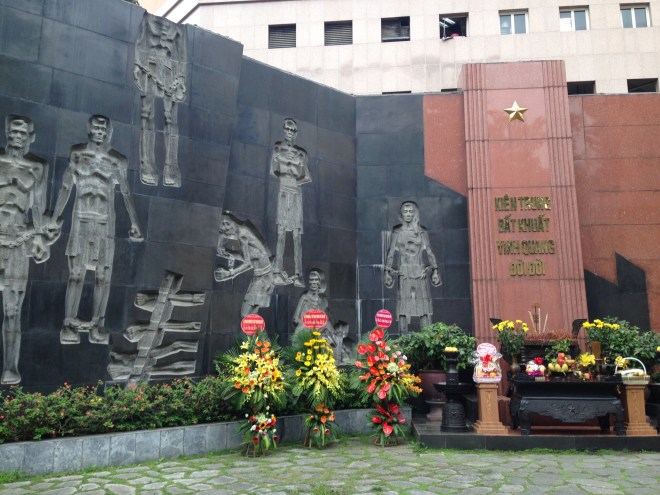
A monument for the Vietnamese prisoners.

Onto the American prisoners…
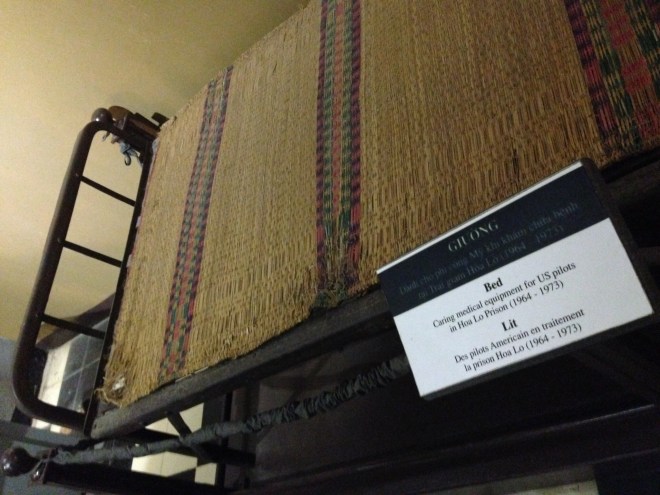
In case it’s hard to read, the description says, “Caring medical equipment for US pilots in Hoa Lo Prison (1964-1973)”
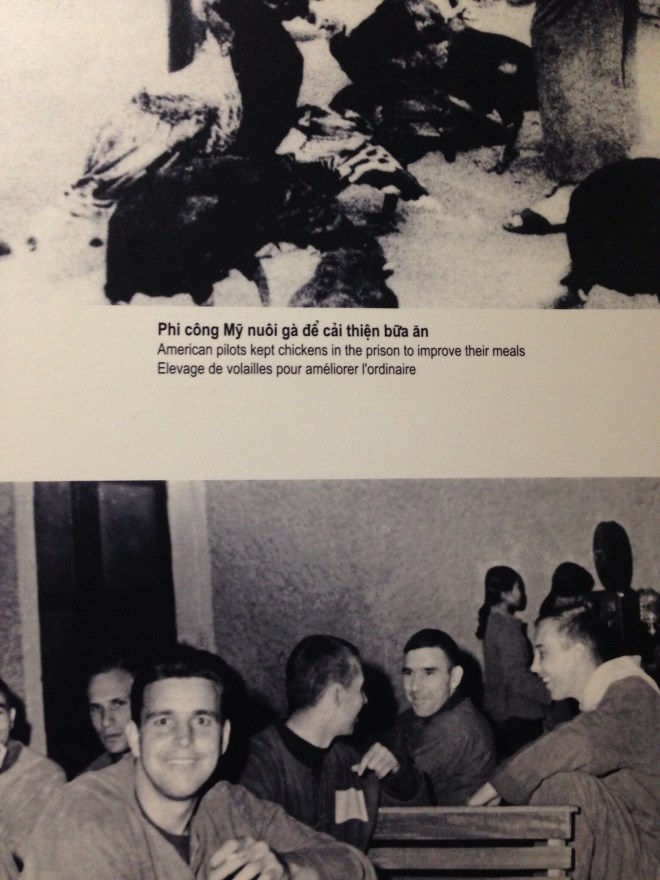
“American pilots kept chickens in the prison to improve their meals”
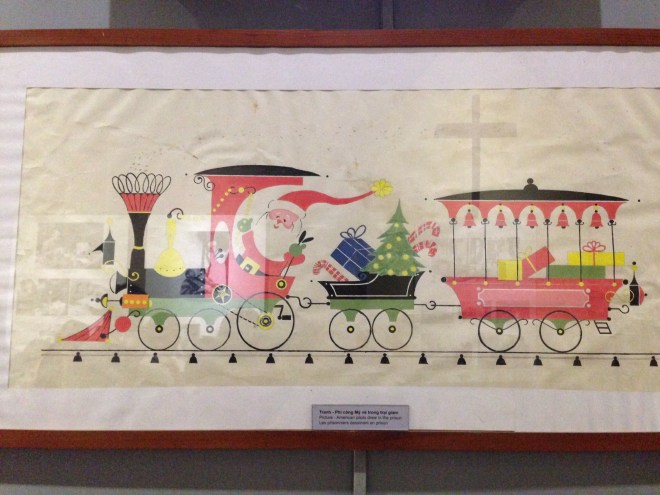
“American pilots drew in the prison”
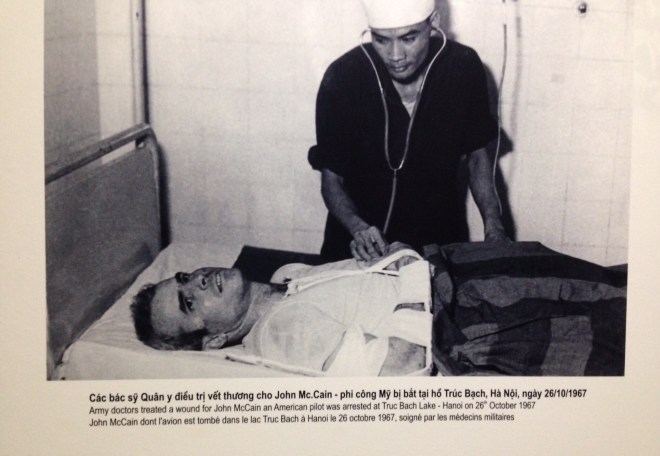
Army doctors treated a wound for John McCain an American pilot was arrested at Truc Bach Lake – Hanoi on 26th October 1967″
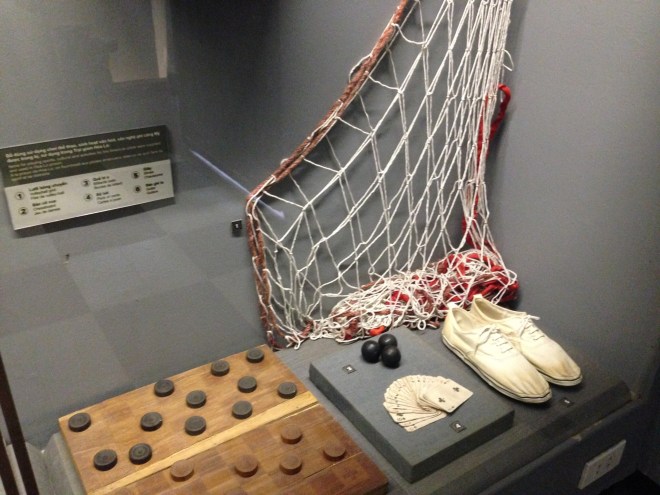
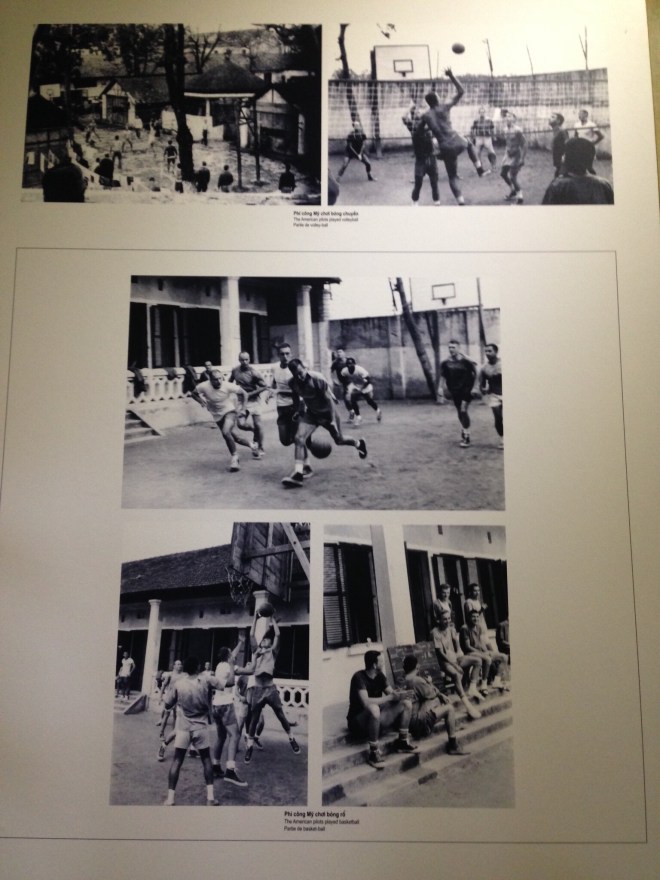
“Items for playing sports cultural and activities for the American pilots were supplied and used in Hao Lo Prison”

Other than a few notes about how the US pilots were captured, this is essentially the only type of information presented about the American POWs, and there were many other objects and photos like these on display – the POWs having Christmas dinner together, clothes presented to the POWs…

I mean, to be fair, I do think it’s possible that the Vietnamese prisoners were treated more harshly by the French than the Vietnamese treated the American POWs – the guillotine picture alone shows how harsh the French must have been to them – BUT it’s also well known that the Vietnamese on both sides were especially torturous to prisoners of war. I suppose everyone has their own view of history – this just serves as a pretty solid reminder that all history we hear is from a perspective – even our own. Though after visiting many museums throughout Vietnam, I think it’s pretty safe to say that they have an especially strong bias/agenda (more to come!).

At the end of the museum there was a picture of John McCain visiting the museum – I’d be fascinated to hear his thoughts.

Anyway, that’s more than enough of an introductory to our time in Vietnam. The next blog will be mostly pictures of one of the most beautiful bay I’ve ever seen. Stay tuned!

I leave you with a short clip of a random man crossing the street in Vietnam. Traffic never stops here, so you have to just keep going! There is a popular tourist shirt with a stop light on it that says:

(Green light) I can go

(Yellow light) I can go

(Red light) I can still go

It’s all too true!
Hong Kong, China

Hong Kong is the next destination to tell about in our travels. We originally picked Hong Kong as a starting point for traveling on land through Asia, but after a little research we learned that we’d need to postpone our on land travel until we hit Vietnam.

If you don’t know, Hong Kong was a territory of Britain for years. It wasn’t until 1997 that power of the city was given back over to China. It’s interesting though because even though Hong Kong is now apart of China and is surrounded by China on all sides, it still functions separately from China as an autonomous territory. What this means for travelers is that different visas are needed for each land. For US citizens, a visa to Hong Kong is free, but a visa to other parts of China is around $200 per person. What this meant for us is that we could fly to Vietnam for less than half the price of the visa we would need for the rest of China, so at the last minute, we bought tickets and skipped out on the rest of China for now.

Our six days in Hong Kong turned out to be nothing like what I expected. Honestly, I thought I wasn’t going to like it. The idea of being in a city full of millions of people, all speaking a language that that I don’t even know how to say “Hello” in sounded very stressful to me.

As it turns out, it’s kind of an introvert’s paradise. Aside from the occasional street vendor trying to sell you a custom made suit, and the random unknowledged shoulder hit from one of the thousands of people never looking up from their phones, everyone keeps to themselves. It was fascinating being surrounded by so many people and still feeling on our own. I think this atmosphere would make Hong Kong a difficult place to settle and make friends, but as a traveler, I was pretty happy.

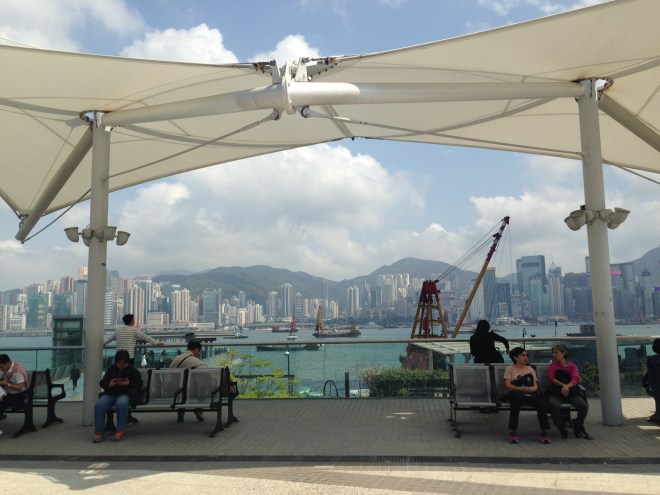
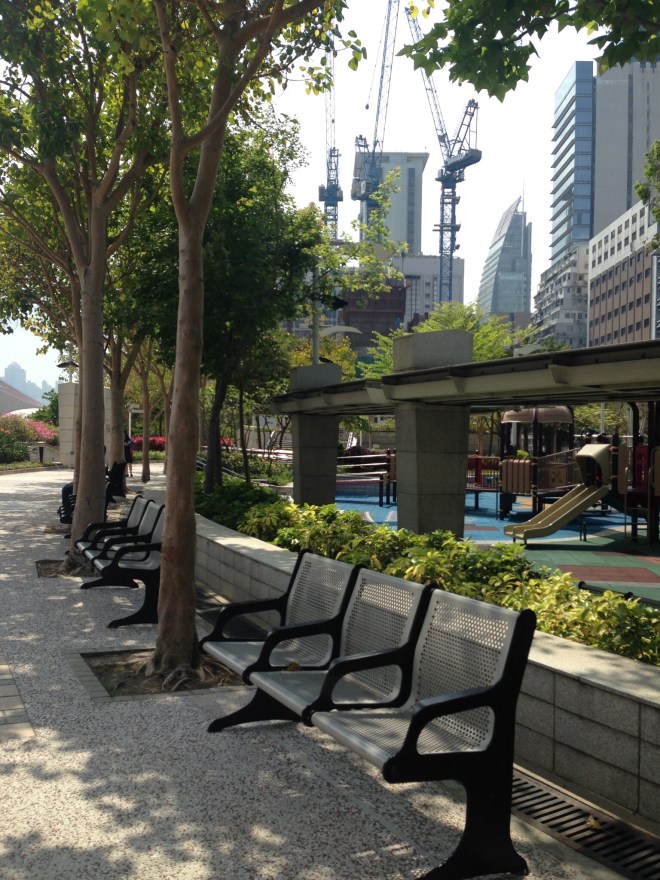
Even the park benches keep a barrier between you and the person next to you 😉.

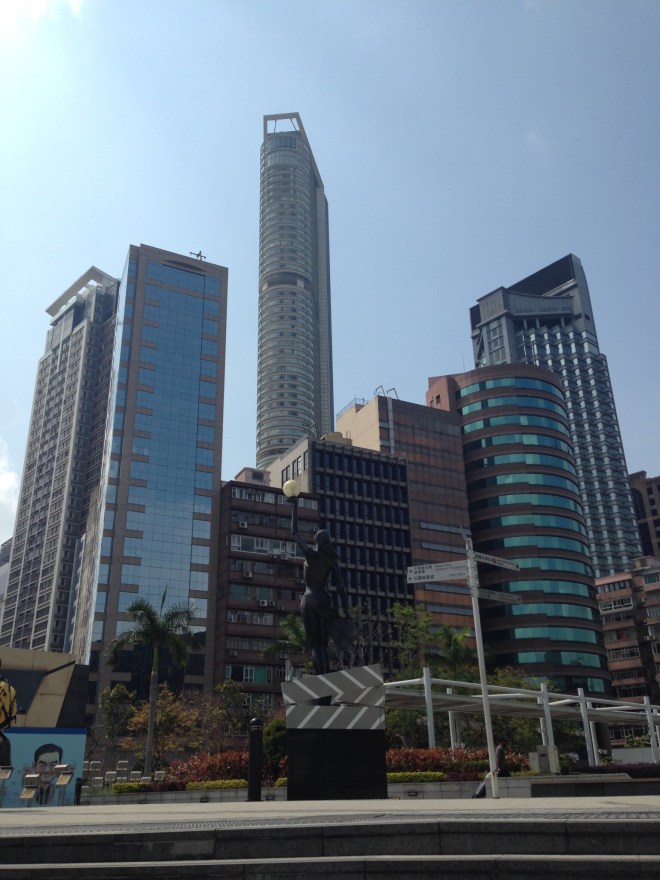
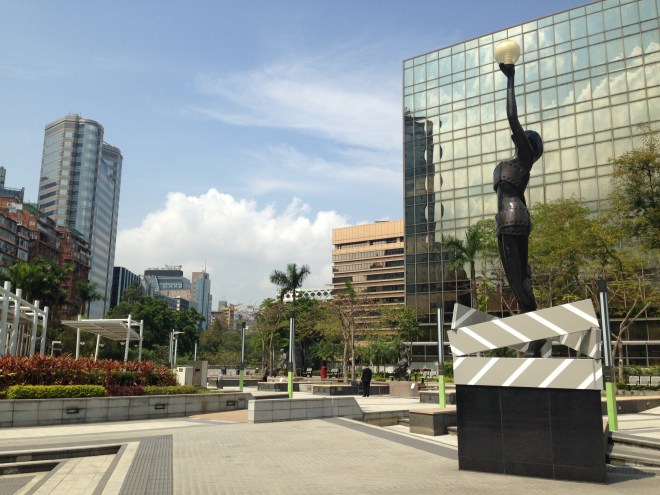
Overall Hong Kong as a whole is a pretty interesting place. From visiting the Hong Kong History museum we learned that this city essentially went from being a small fishing village to a metropolis of 8 million in about 150 years (let that sink in, it’s shocking!). I expected Hong to be filled with dingy looking buildings, much like other large cities I’ve visited, but I was surprised to find that Hong Kong is, in some ways, quite clean – sparkling, even. (Well, there actually is quite a bit of trash, but the buildings themselves are beautiful!) The growth of the city seems to have happened recently enough that huge sections of the city are filled with modern, towering glass buildings. I’ve seen plenty of buildings like this in metropolis areas in the states, but I’ve never seen so many of these buildings together, continuing for blocks on end. These blocks of buildings are all over the city, both on the mainland and the island of Hong Kong. It’s quite a sight to see from either shore line.

Sparkling buildings

A view of Hong Kong Island from the mainland.

Another view of Hong Kong Island shoreline with another another glass building on the mainland. And as a side note, a ferry between the two costs less than fifty cents!

Though you wouldn’t know it from the ferry or food prices, the wealth in Hong Kong is pretty crazy. Ranking among the ten wealthiest cities in the world, the amount of high end shopping available is unbelievable. We accidentally ventured through one of the malls one day and found that the majority of the stores were so high fashion we had never heard of them. I giggled occasionally, while also admiring the artistry, as I checked out the window displays, filled with eclectic runway type designs for absurd amounts of money. The higher end stores we had heard of could be found every few blocks – Louie Vuitton, Michael Kors, Tiffany’s. These types of shopping venues were as numerous as the glass buildings, scattered throughout the city, not confined to one area of town. We passed plenty of the people on the streets in these high end designs too. I remember turning to Kirk during one of our walks and saying “I feel like we are in the future.”

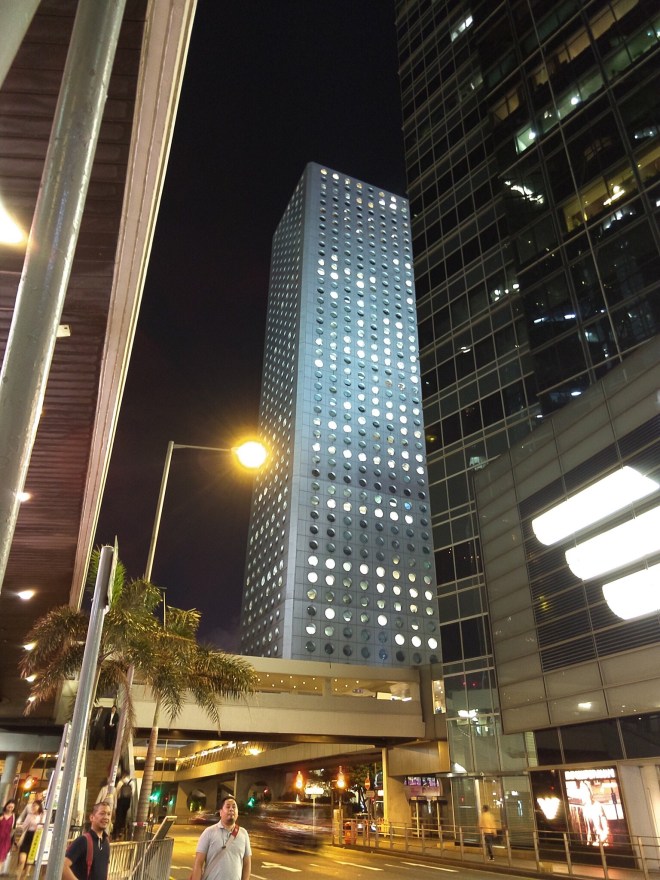
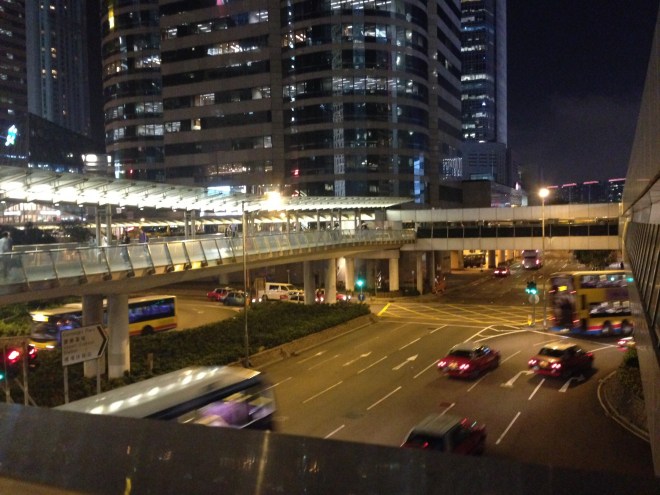
Really, something about some of the things we saw reminded me of the capitol city in “The Hunger Games.” Interesting styles, shine all around, disconnection with actual people due to technology – Hong Kong even has a pretty extensive above ground sidewalk system, connecting all the buildings, and allowing traffic to keep flowing. I’ve seen all of the above in other places, but never in such abundance. It was fascinating to be on onlooker there.

I thought this building with all round windows was quite a sight – but in this picture you can also see some of the walkways connecting between buildings. It’s an interesting walkway system because it takes you through the actual buildings, not around them. For shopping centers, this is an excellent way to advertise – people have to walk by to get where they are going – but we also walked through quite a few office buildings. I imagine they must have good sound proof walls to have so much traffic going through those!

This picture shows some of the other above ground walkways. If you look closely you can see them layer behind each other. In some places they had one for every block. They also have similar systems underground. The stairs that lead to the subways also lead to underground walking tunnels.

In spite of all the glitz and glam, Hong Kong is an incredibly affordable place to visit. Food is around 4-5 US dollars a meal, and if you don’t mind sharing a small place, sleeping is pretty affordable too :).

As for our actual stay, we booked a place called “City Guesthouse” in the Chung King Mansions that was right in the middle of town on the mainland. This building houses some of the cheapest accommodations in Hong Kong, with several guest houses inside. The rooms are small, but you have everything you need!

This was our original tiny room. They moved us to a slightly larger one for the rest of our nights there, but don’t confuse the word “slightly larger” for anything of great size – Neither bed was even a full sized twin 😂.

Though I found much to be fascinated by in Hong Kong, it probably wouldn’t surprise many of you to know that my favorite part was the food. Hong Kong is known as a “foodie” city, and it did not disappoint!

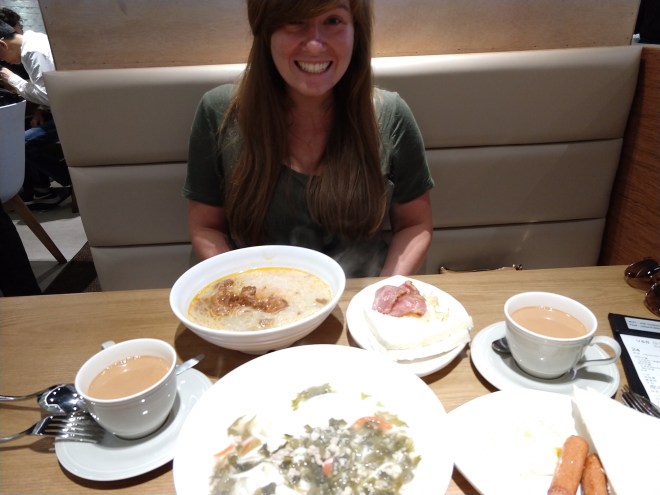
This is a picture of me excited to eat our first noodle dish! (Noodle soups/bowls are quite popular in various parts of Asia). We didn’t do research before stopping at this place and the food turned out be mediocre, but the jasmine milk tea was delicious!

Though that first choice wasn’t the best, we found one of our favorite places to eat when Kirk said “We need to find an alley, because that’s where the best food is.” We turned onto the next alley we saw and went into the first place that had prices posted and the menu in English. I ordered the Wonton Soup and Kirk ordered the Chongquig Hot and Sour Noodles with spicy pork, both dishes medium heat. Mine was delicious, Kirk’s was out of this world. We liked it so much that I’m posting directions on here in case any of you ever visit Hong Kong and want to try it, or in case Kirk and I visit again and need to remember how to find it :).

This is the menu telling what’s in each dish – don’t be deterred by anything that sounds strange – the mix of flavors was so good! Also I’d recommend the rice noodles instead of the sweet potato for the Chongquig. To me, glass noodles are a little slimy and don’t hold flavor as well.

Those are Hong Kong dollars. Divide by 8ish to get the US ($4-$5 for each dish 🙂 )

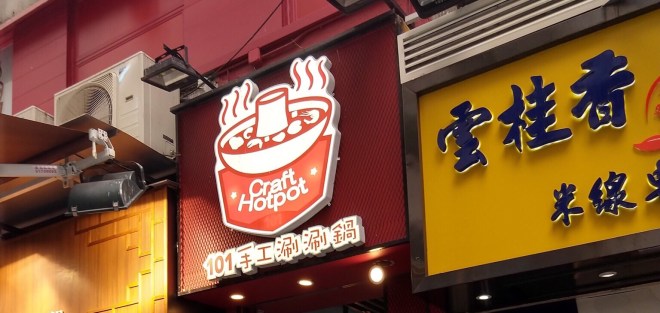
Some directions: The restaurant is on Hau Fook road. It has a yellow sign (seen below one the right), but is in Chinese. “Craft Hotpot” is next door, which is much easier to understand! It’s a few blocks from the Hong Kong History museum and the store we originally turned at to find it was “Cotton On.”

Wankwaiheung was on the menu – I wonder if it is the English translation/pronunciation of the restaurant name? If you google what’s above for directions, on our computer it was the third option, Tsim Sha Tsui.

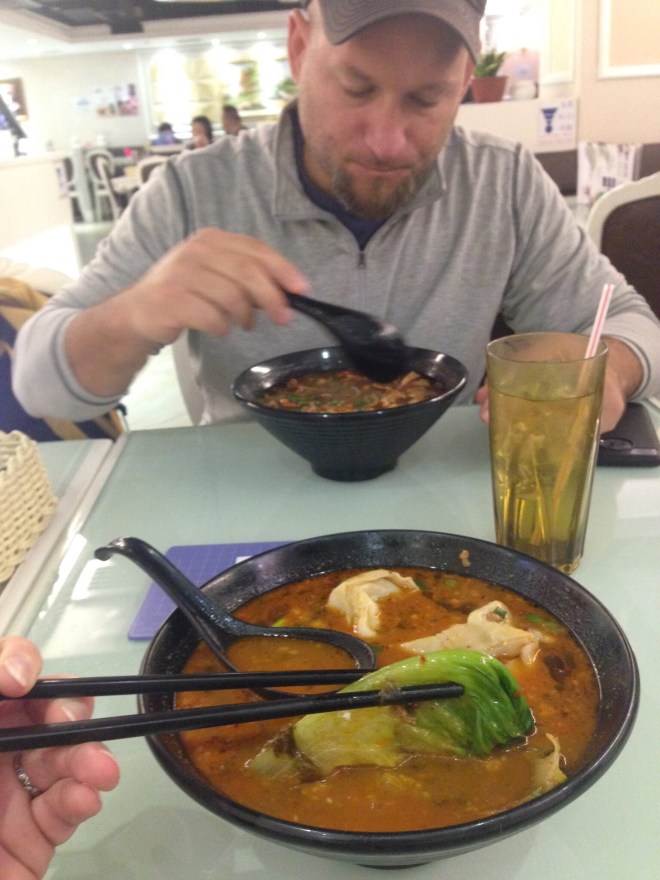
This is a picture from our first time visiting – the wonton soup in front and Kirk with the Chongqing. Also, medium heat was quite hot, but not hot enough to keep me from ordering it again when we went back!

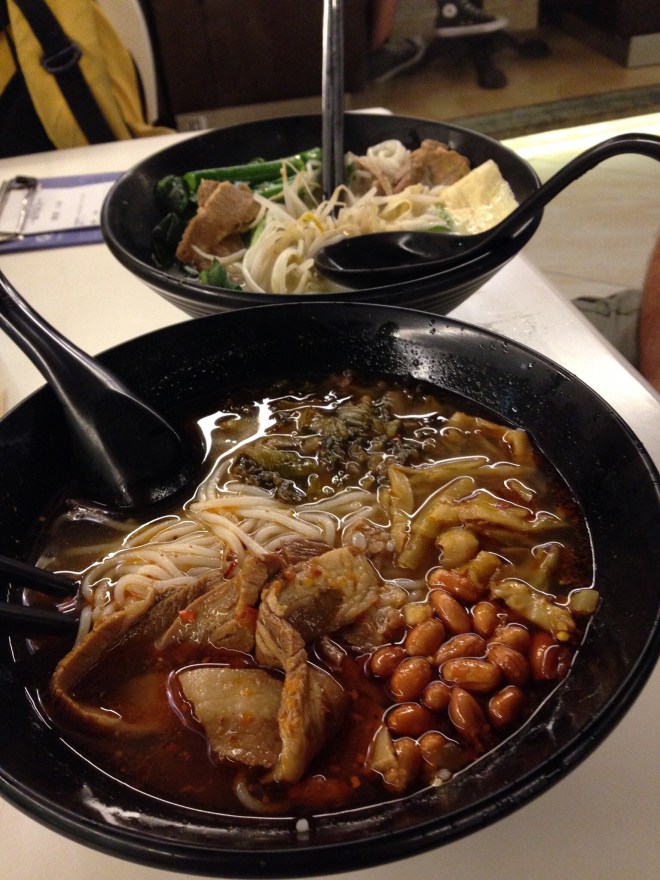
This is from the second time we went. I got the Chongqing and Kirk decided to try the HK Noodle broth. The HK was good but didn’t compare to the others.

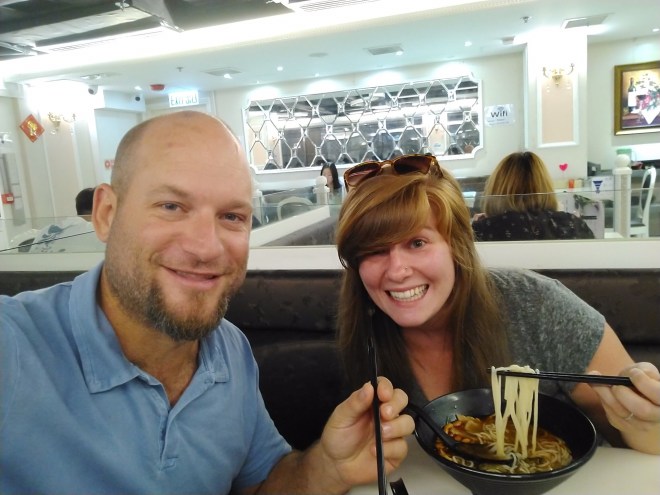
We’ve noticed that we get the most “likes” on Facebook on pictures of us, so we decided we should take one with our favorite soups :). Even though you can’t “like” pictures on the blog, we guess you must like seeing our faces 😉

After visiting there we also found a milk tea place down the same alley that had a mango milk tea that was to die for. If you’ve never had milk tea, it’s a drink that’s absolutely delicious and pretty terrible for you. It’s usually some kind of strongly brewed tea mixed with creamy milk and quite a bit of sugar (though you can adjust the sugar amount in it). You can also order tapioca pearls or candy jellies that you slurp up through a big straw from the bottom of the glass. At first it’s a little weird to have gummies in your drink, but then it becomes addictive. Our mango milk tea ended up being an earl grey tea with mango jellies – and the floral taste from the two of those was amazing. We ended up trying a different milk tea place everyday! Another notable one that we actually know that name of was “Coco.” It’s a chain with locations around the world (even a few in the US) and we were really impressed with their classic bubble tea. The pearls we had tasted slightly of coffee and we loved it.

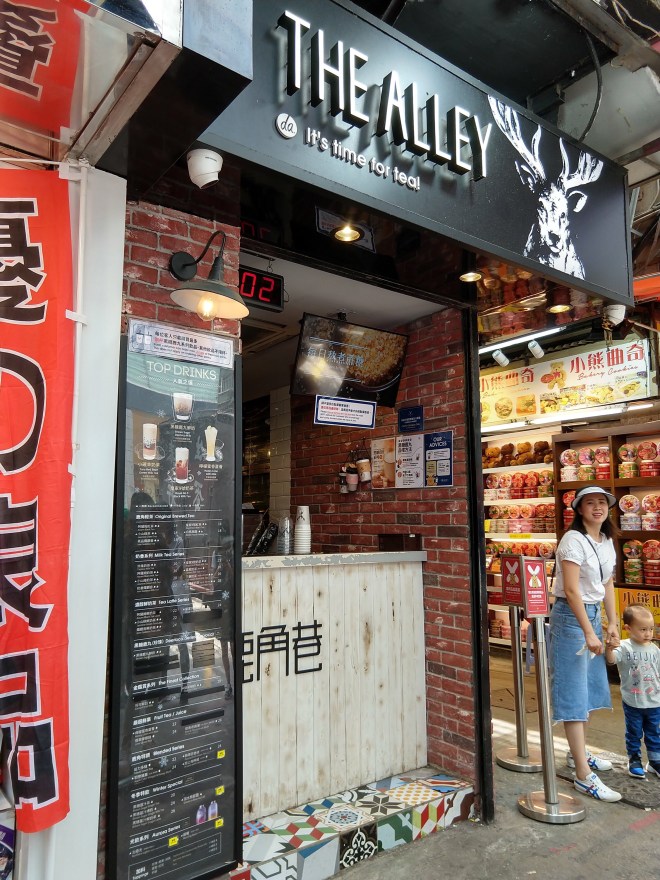
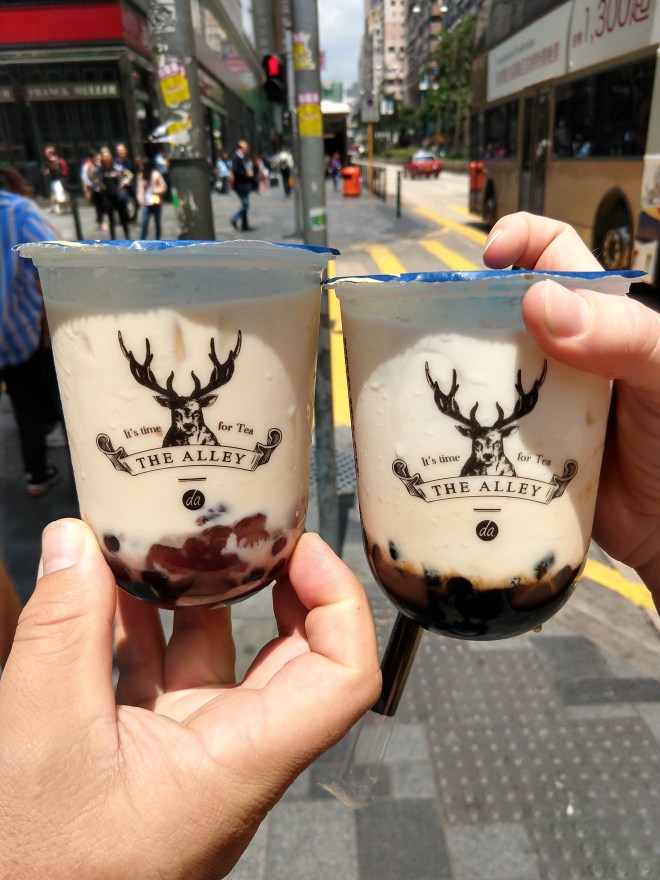
Another tea place that happened to be located right next to our guesthouse was called “The Alley.” “The Alley” had a line that reached all the way down the block nearly every time we walked by. The wife of a US businessman that we met in an elevator told us she goes everyday and usually waits around 2 hours for her drink! Who has time for that? The Alley opens around noon and one day we were walking by at 11:45am and noticed only 5 people were in line so far, so we hopped in. Our whole wait still ended up being about 45 minutes, but we tried the tea, and even while harboring the aggravation that I had waited in line for 45 minutes for it, it was probably my favorite tea we had (though not by far, and not so much that I’d be willing to wait for it a second time in the same trip – though I’d certainly go back if we find ourselves in Hong Kong again). If you are ever there though, it’s definitely worth trying their deerioca brown sugar milk tea, and their taro red bean green milk tea (which actually has beans in it, but the flavor is awesome).

The store front

We watched as every single person who got their drink took a picture of it, so we followed suit :).

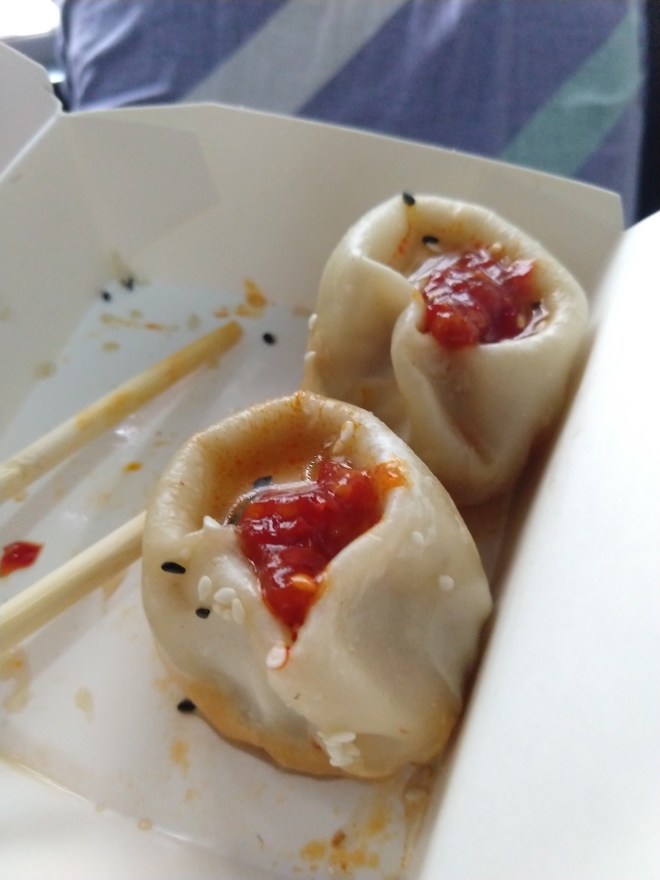
Another favorite place of ours was a dumpling place mentioned in the Michelin street food guide that also happened to be a block from our hotel. We ate these for breakfast four of our six days there, ha.

The sign of the dumpling place – I believe the last word didn’t make it into the picture. It should say “pan-fried buns”

I was always so excited to eat them that I forgot to take a picture when the box was full! Above are two dumplings with the chili sauce and vinegar on top. It might seem weird, but add the vinegar. It takes it to a whole new level! We tried all three types of dumplings they had and liked them all!

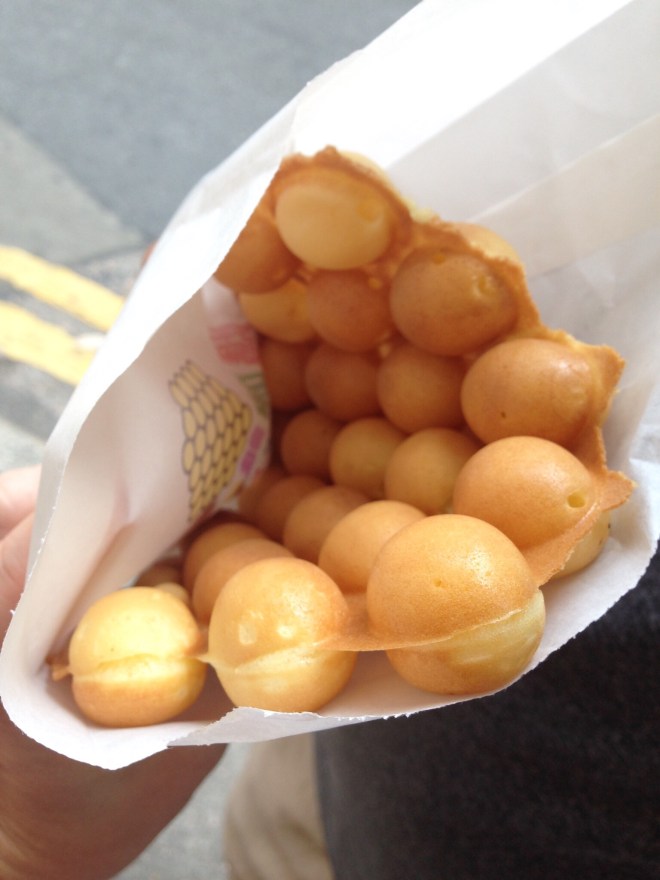
Another food we really fell for were the egg waffles. We’d heard they were worth trying and decided to give it a go even though all I could think was, “How good can a waffle be?”

Y’all. SO good! The “original” tastes essentially like a regular waffle, but the texture is what gets you. Super crunchy on the outside and chewy soft on the inside. We also had a coconut milk flavored one that had a delicious flavor, but wasn’t as crunchy. We’d suggest trying Mammy Pancake – they make them fresh ensuring the crunchiness!

Another notable food that I don’t have a picture of is the pineapple bun. No, there’s no pineapple in it, but’s it’s incredibly tasty. It’s basically a sweet yeast roll (think O’Charley’s or Texas Road House) with a sweet flour crumble on top. It’s served warm with a chunk of cold butter in the middle…Mmm…

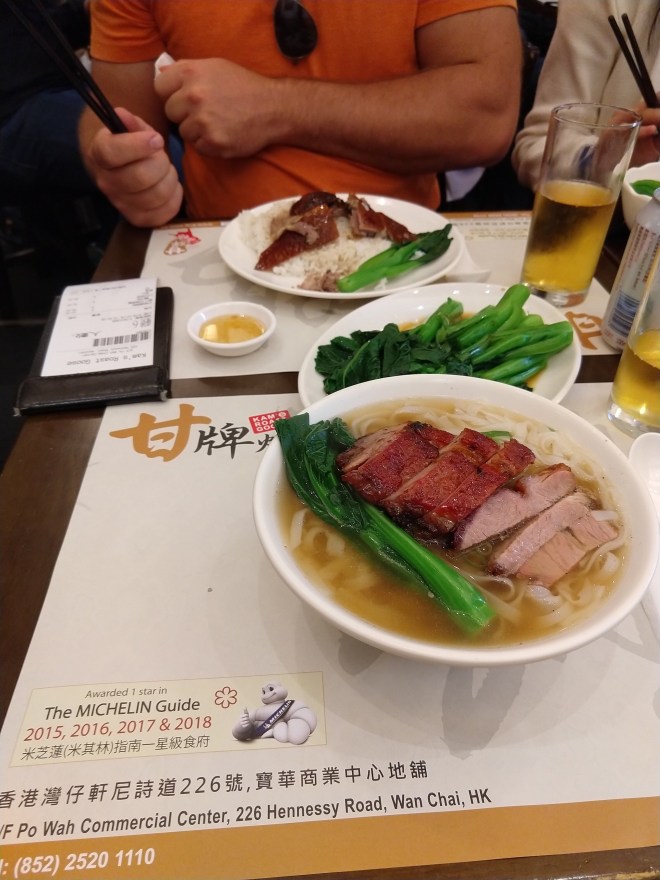
So far all the foods/places I’ve mentioned were on the mainland, but two days we ventured over to Hong Kong Island for some good eats. Hong Kong houses the cheapest restaurant in the world to have been given a Michelin Star. They are known for their goose and y’all, it’s worth the ticket to Hong Kong just to try it. It’s sweet and savory and perfectly crispy. I didn’t know I could get so excited about goose, and we got the cheapest cut they had!

Kirk’s plate is the goose, but we also tried their pig. It was tasty, but nothing compared to that goose!

The name of the restaurant is Kam’s Roast Goose. There is always a line, but it moved really quickly for us!

Tim Ho Wan is another cheap eats Michelin star rated restaurant, but we ended up not making it there. It’s on the list for next time though :).

A second place we went to on Hong Kong Island was Kau Kee Beef Brisket, a restaurant whom a local Hong Kong blogger said had the best brisket in the world. Coming from Texas, this is absolutely not true, but it was pretty delicious none the less. The meat we had here was a little tough, but this brisket in particular is served in a noodle bowl and the broth was fantastic. We got the curry brisket and the regular brisket and both were delicious in completely different ways. There is also a wait at this place, but it went quickly too!

Not a great picture of me, but this exemplifies several of our meals in Hong Kong.

Many of the restaurants are tiny, so they just put you at a table with other people. I bumped elbows with this guy the whole time, but we never spoke to each other! (Being hungry and stuck at a table with strangers, but then no one talks – that’s a hangry introvert’s nightmare turned dream 😂)

The restaurants are incredibly efficient and hand you the check as soon as you order. We were never rushed to eat, but we never lingered afterwards either. This is the opposite of South America – everywhere we went there, they wouldn’t give us a check until we asked – the culture is relationship based, so they expect you to linger and talk. Relationship based vs. efficiency based culture – America is somewhere between these two when it comes to most restaurants – waiters give you the check at the end without you having to ask – and want you to enjoy yourself – but not too long :).

Curry brisket on the left, regular on the right. Mmmm so yummy.

Another notable feature of Hong Kong is their green spaces. They have decorative greens growing on top of buildings, on walls of buildings, and in intentional parks around the city. While on Hong Kong Island, we visited their public park that has sizable free aviary. It was a beautiful space filled with tons of unique birds and it was large enough that I didn’t feel too bad for these flying creatures!

This is the only aviary picture I got, but there was much more than this to see!

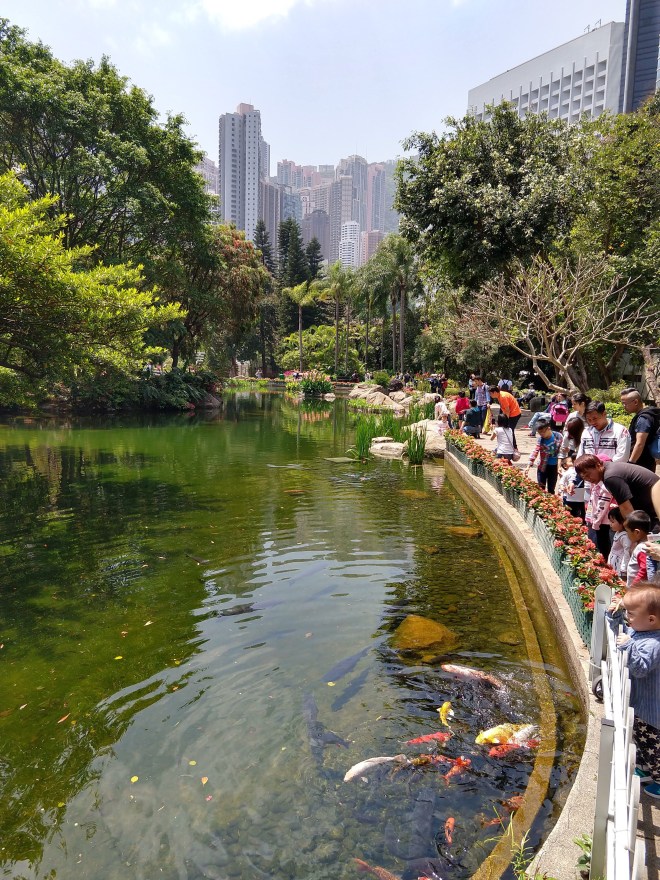
This pond is in that same city park. It’s impressive how much park space they’ve made in the middle of all the skyscrapers, and there were plenty of people utilizing it!

Earlier I mentioned that we went to the Hong Kong History Museum. Below is the only picture I took while there, but in spite of my lack of pictures, this free attraction is well worth the visit (I think it’s especially good to visit at the beginning of your time there). Hong Kong’s museum tells both the natural and political history of this territory that has been under the power of several different governments over the last 150 years. Reading about the opium wars was fascinating (when Britain essentially attacked China because China didn’t want Britain selling opium to their people anymore.) The museum even tells about the history of their land – how past volcanos and rivers shaped the land into how it looks now.

This picture in particular is from the more “cultural” section of the museum where they explained different cultural customs – dances, celebrations, etc.

We learned a lot about the land in which we found ourselves at this museum and it being free to visit was a big bonus!

One day when we were leaving the ferry we passed this group pictured below. A man from the group approached us and asked if we wanted a free turban, adding that they were raising awareness about their religion, Sikhism. We took his paper to learn more.

Kirk mentioned that he thought this event was probably more about clearing things up about Sikhism rather than trying to convert people, and after a little research, I found Kirk’s guess was right. It turns out International Turban Day began not long after 9/11. Because Osama Bin Laden was often pictured wearing a turban, people began to associate turbans with Islam, and with the association of Islam and terror growing, many Sikhs were (and are) attacked simply because of wrongful associations. International Turban Day is simply to teach people about Sikhism so that their turbans are no longer associated with terror.

Reflecting back, I feel quite moved by having encountered this group. Anytime I’ve seen pamphlets like this handed out by other religious groups the papers came with a message like, “Come join us.” To have someone hand me a pamphlet with information about their religion and the attached message is, “Understand us, so that we can stop being hurt” – that’s a sobering thought.

Understanding more about what the movement is about, I wish we had taken the time to have them wrap our heads. I can think of no better way to have sat in solidarity with someone in that particular moment.

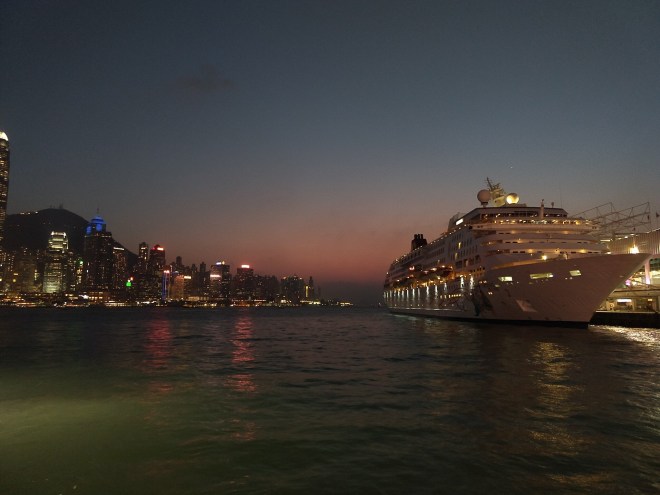
Well, I suppose that’s all I have to share about our time in Hong Kong! I leave you with a couple of pictures of the city all lit up at night. Though I’d prefer a nature walk to a stroll in the city, there is certainly something beautiful in all that shine.

Cairns, Australia (Great Barrier Reef)

Our brief 10 days in Australia were all spent in Cairns, Queensland, the gateway to the Great Barrier Reef. We booked an Airbnb with a pool that was walking distance from the beach, which turned out to be a bit farther from the city than we realized. Thankfully our hosts had bikes we could borrow, so we were able to get around to nearby restaurants and the grocery store. Still, without a car we found ourselves spending a lot of time in our Airbnb, which turned out to much better than we imagined.

Traveling for such a long time brings it’s challenges. As an introvert traveling on a budget (usually staying in Airbnbs) it’s often difficult continually invite yourself into someone’s home, sharing spaces while encountering a constant stream of new personalities with each destination. It’s a catch 22 though, because though it can be exhausting to constantly meet people, sharing space with people is also how you get to the heart of a land. While one family can’t tell you everything there is to know about a place, it certainly gives you a better look into a life different than your own than merely staying at a hotel does. That probably describes why I had so much to say about Vanuatu, but also speaks for our time in Australia.

During our time in Cairns, we found ourselves staying with a family of four, Peter, Vicki, and their two adolescent sons, Josh and Henry. A guy who would probably best be described as a “good ole boy” from Australia, Peter is the most entertaining host we’ve encountered so far. He is full of stories and laughs, but has an ease about him that’s warm and welcoming. His wife, Vicki, is a perfect counterpart for him. She is equally warm and easy going, taking everything in stride while keeping a steady balance within the family. I don’t remember the last time we laughed as hard as we did with these two, and in the midst of the laughter, we learned a lot about the country in which we found ourselves.

One story (that somehow had us cackling) was about Peter being injured while playing Footy (Australian football). Long story short (and the not-so-funny version), Peter broke his leg and ended up with a severe, life-threatening staff infection that put him in the hospital for three months. At the end of the story I couldn’t help thinking about the cost. Even with insurance, a that a stay like costs a fortune in the States. Knowing Australia’s healthcare system was different than ours, we asked, “What does a stay like that cost someone here?”

Do you know the answer?

It’s zero, nothing. It’s all completely covered in their universal healthcare.

This got us thinking, so we asked plenty of questions to learn more. Some of this is going to get a little number-y, but it’s also fascinating. If you care to learn more, read along. If not, there are pictures of the reef towards the bottom :).

It turns out Australia has a system in which the government automatically takes out 2-3.5% of a person’s earnings (depending upon a person’s income) and puts it toward their universal healthcare. After that, all of a person’s basic medical needs are met, including dental.

It’s true that some things aren’t covered and that some things are more easily covered than others (that seems to be a lot of people’s concern about potential universal healthcare in the States), but you might be interested to know that even with the exceptions, there are plenty of options still available. For example, Peter told us that because he broke his leg, he got care immediately, but if he had torn his ACL, he would have been put on a waiting list to have it repaired. However, even with a torn ACL, a person can opt to wait the 1-2 years to have it fixed for free or pay a private insurer and get it fixed immediately. There are always options.

Now, I’ve done some calculating since we left Australia, and I’m shocked by the numbers. If you really want to participate, take a moment to calculate 2% of your income (multiply your salary by .02 to see how much you’d have to pay yearly for their universal healthcare) and compare it with your current insurance premiums and deductibles.

If you are feeling too lazy, here are a few examples – a person making $40,000 a year would only be paying $800 a year for healthcare. Someone making $100,000 would be paying $2,000 yearly. A person making 300,000 still falls in the 2% category and pays $6,000 a year. (And as a side note, these amounts are taking directly out of your check, like taxes, so it’s paid in small increments throughout the year).

With taxes having just been filed, I can tell you that even with my last place of employment paying around $600 a month for me to be insured (over $7,200 a year, total), I still paid over $2,000 in medical bills (including dental) last year. That means that a person making $300,000 annually in Australia, paid less for healthcare than I did on a fresh out of grad school salary of $32,000, plus benefits.

That’s crazy (and it doesn’t even account for the fact that our dollar is currently stronger than theirs – or in other words, they paid even less for healthcare once you convert their dollar amount to USD).

Are you ready for the next crazy thing we learned?

Minimum wage in Australia is $18.29 an hour (that’s $14.08 USD) which, on a 40 hour work week, comes out to $38,043 gross income a year ($29,293 USD). With taxes taken out (which are higher in Australia than in the US) a person making minimum wage still brings home an actual $33,800 (or $26,029 USD). And keep in mind, that number has all healthcare included.

In the States, a person making the federal minimum wage earns $7.25 USD an hour. If a person works a 40 hour work week consistently the whole year (without getting sick) they will have a gross income of $15,080. With taxes taken out that’s $13,618 – and that doesn’t include healthcare.

Now, those are all estimations, and that was a lot of numbers to have read through, but the final numbers:

$26,029 USD yearly working minimum wage in Australia (with healthcare covered)

Versus

$13,618 USD yearly working minimum wage in the US (with no health care)

That’s a staggering difference.

What’s interesting about Australia is that the cost of living is only around 10% higher than the US (Buying groceries, we didn’t even notice a difference) – the cost of living is only 10% higher, but their lowest paid individuals are making nearly 100% more than ours.

If we aren’t caring for people at the bottom, what are we doing?

In the end, I don’t know all the outcomes and effects of raising minimum wage and implementing universal healthcare, but given what we’ve seen in other places (like New Zealand) and heard from fellow European travelers (who also have similar systems to Australia), I thought it was worth mentioning. Can you imagine a world where you don’t have to worry about what seeking medical help will cost? That sounds liberating!

Anyway, that info might have been more than you bargained for, but I thought it was too fascinating not to share! Now, time for pictures!

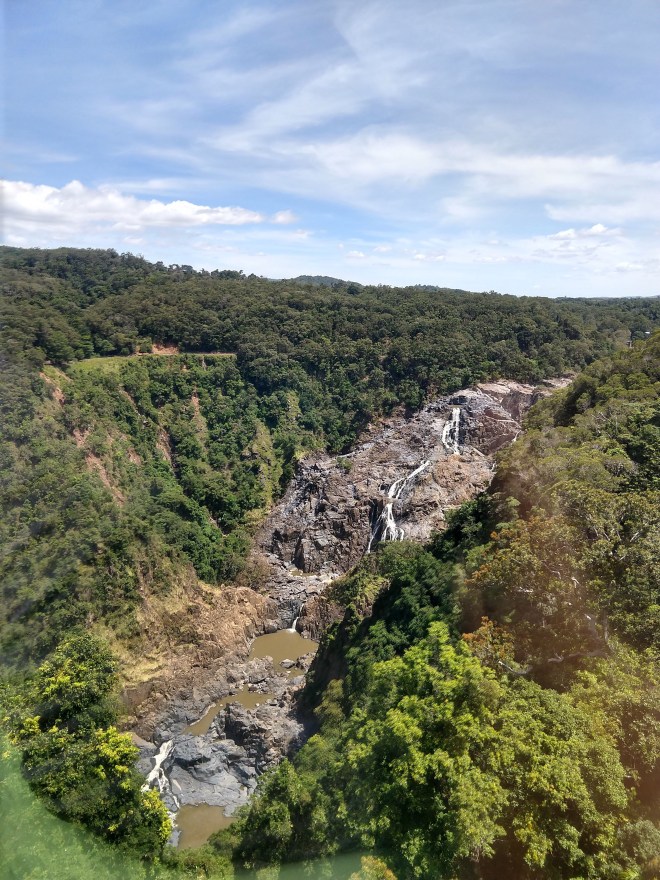
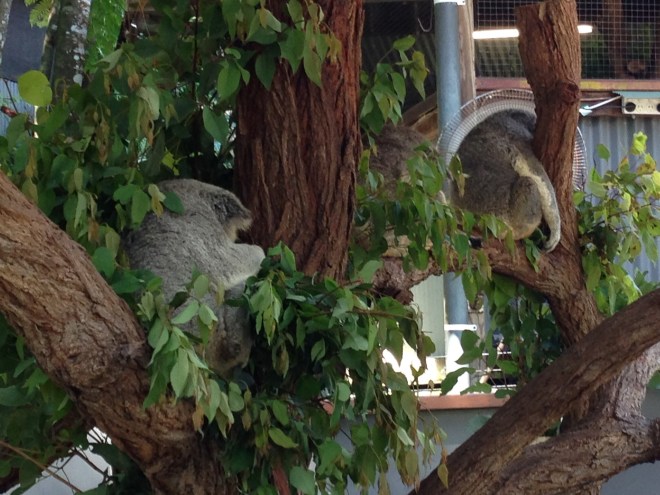
One of our days in Cairns we took the Skyrail to Kuranda Village. This cable car in particular glides you over parts of the Queensland Rainforest, stopping to let you walk down and view Barron Falls, a well known waterfall in the area. The end of the Skyrail drops you in Kuranda Village, which I can now only refer to as an immense tourist trap. Aside from the waterfalls, we ended up being pretty disappointed by the whole thing. We did see some cute koalas, but the habitat they were kept in made us a bit sad. I’ll post some photos of the sleepy creatures anyway though 🙂

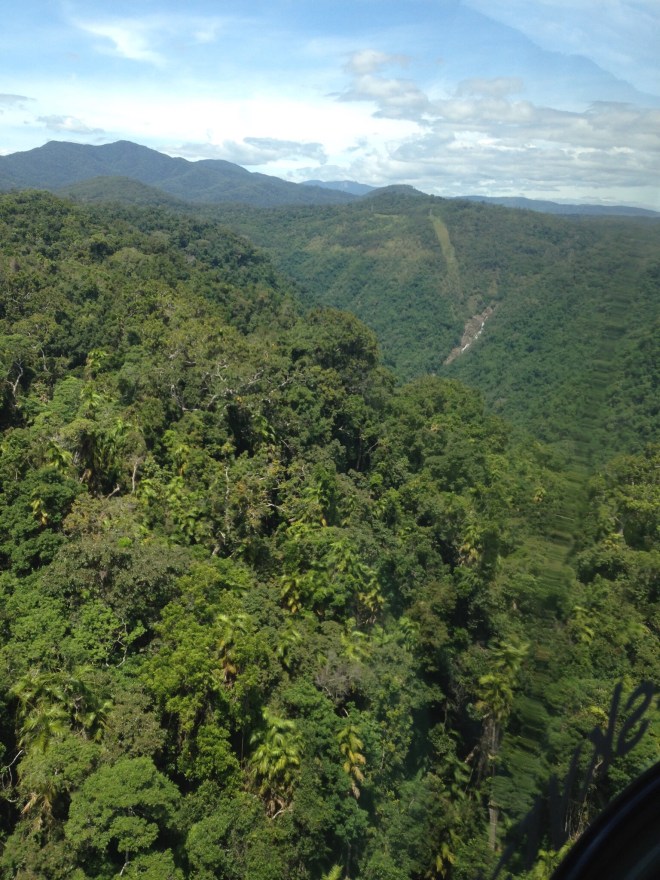
On the Skyrail, going over the rainforest tree tops.

A short walk in the rainforest.

Barron Falls in the distance.

A closer view of Barron Falls from the Skyrail- this thing is huge! Kirk saw a picture of it in rainy season and it was even more impressive!

These are the first koalas we saw. It turns out Koalas sleep 16-22 hours a day, this was evident in our viewing experience 😂

Three more sleeping koalas.

And the last two sleepers! The one in the front did wake up to scratch his head at one point, but went back to sleep immediately afterwards 😂.

And now, to the reef :)!

If you are unaware, at 1,400 miles long, the Great Barrier Reef is the world’s largest reef system – and sadly, it’s quickly dying. I recently read an article that said that since 2016 the reef has lost half of all it’s corals. Recent rising ocean temperatures are taking a heavy toll on the once brightly colored organism. The first heat wave came in 2016, killing a third of the reef, and the second wave came in 2017, bringing the reef to the half point at which it is now. Large sections of the reef are now bleached out, and most people are contributing it to global warming. I know a lot of people out there still don’t believe in global warming, but most Australians would say that these pale colored corals are dying proof of it. Whatever you believe, one thing is sure – if you want to see the Great Barrier Reef, you should visit soon!

We got a tip from our hosts that since much of the reef has lost it’s color, the best place to go view it is the outer reef. We searched online and booked the cheapest tour we could find, unsure what we were getting ourselves into. It turned out to be a crazy, awesome day.

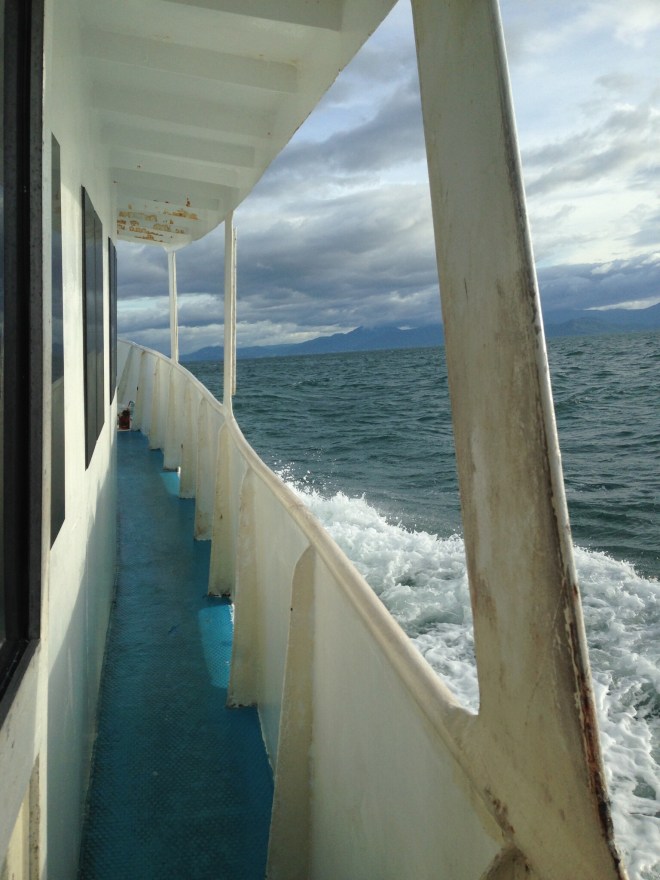
Upon arriving on the boat, 3 announcements were made that the sea was going to be particularly rough that day, so everyone should consider taking Dramamine. It was already in my system prior to the announcements, but upon that advice, Kirk took it too – and it’s a good thing. That boat ride was an especially rough 2 and a half hours. We watched as nearly every one of the 40+ people on board took the offered barf bags, though only a few ended up actually using them. It was a tiring ride either way, and most people slept the way there!

A view from the boat side

Lots of napping :).

The tour included two stops, Hasting’s reef and Breaking Patches. At our first stop, Hasting’s Reef, I eagerly jumped off the boat into the water – and quickly found myself freaking out. The same waves that had rocked the boat on our journey there, were throwing me around, hitting me in the face, and coming in my snorkel! I quickly grabbed onto the boat ladder to regain my composure. After a lot of self talk, the acceptance of a life vest, and Kirk’s coaching, I got back in and reminded myself to breathe. It took a few minutes, but my body got used to the flow of the waves, and the real key – keeping my face in the water. I found the waves only came in the snorkel when I was fighting against them – when I gave in and rolled along with them, everything was fine! There’s probably a life lesson in there somewhere :).

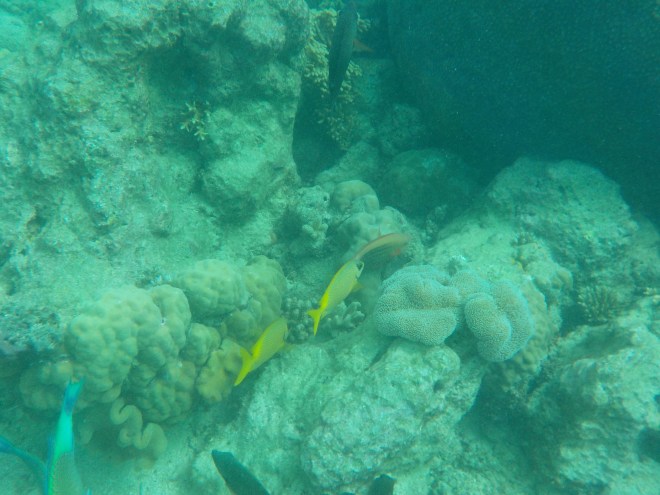
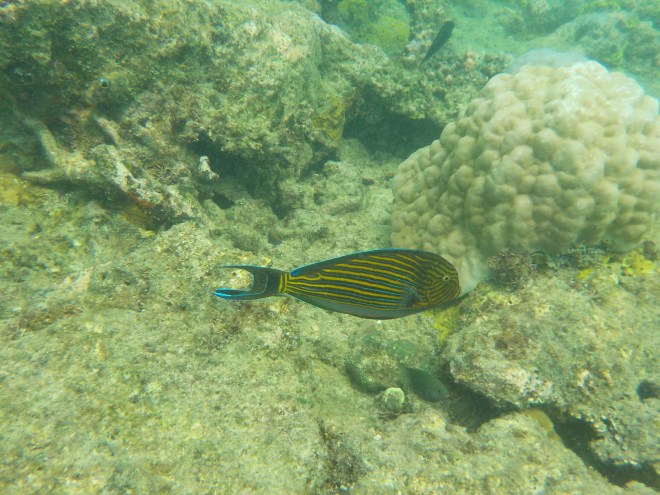
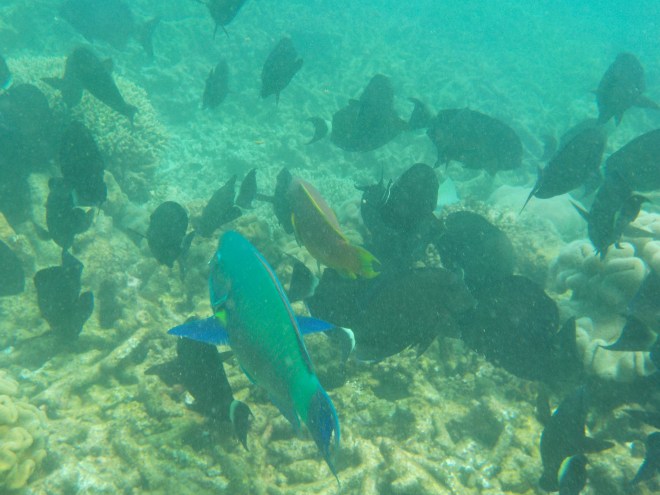
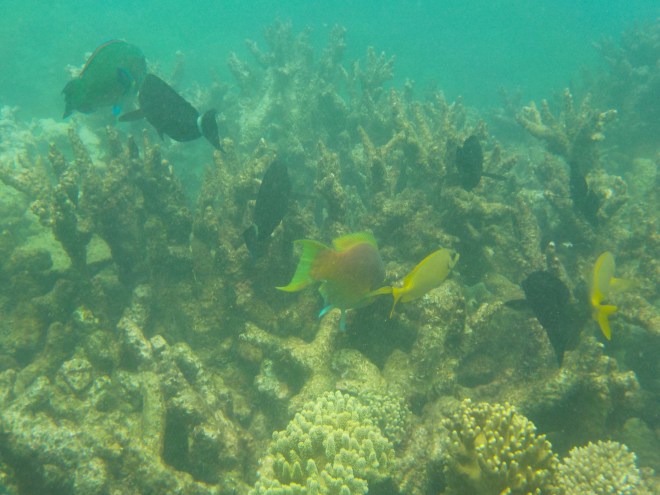
At Hasting’s reef the water was a bit cloudy, but we still saw a lot of beautiful fish. The second reef, Breaking Patches, ended up being the best place we’ve snorkeled this trip, especially when we broke away from the group. None of the pictures show the full amount of fish we saw, but hopefully they show some of the fishes’ colors! Even at aquariums I’ve never seen so many colorful fish!

We’ve confused which pictures are from where, so I’ve grouped them all together :). Kirk took most of the pictures, as he has no fear of the water and was able to dive down near fish with just his snorkel on. Here’s a peak into what we saw!

Those yellow fish always traveled in pairs!

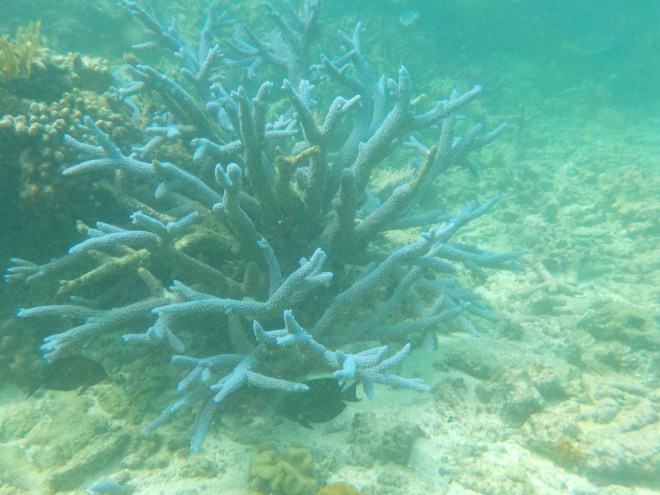
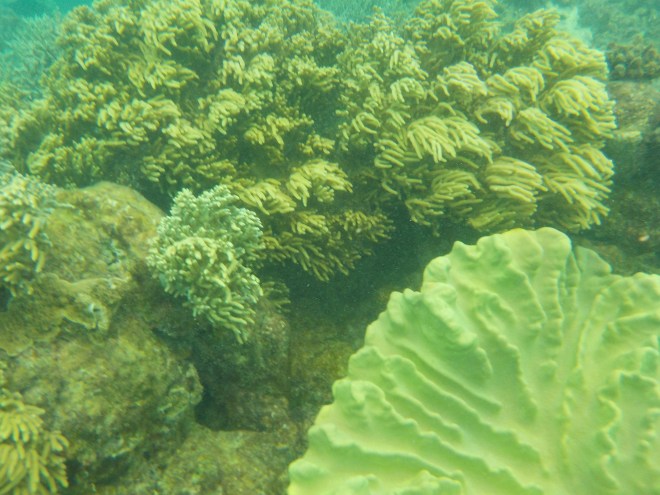
Some coral that isn’t bleached yet :).

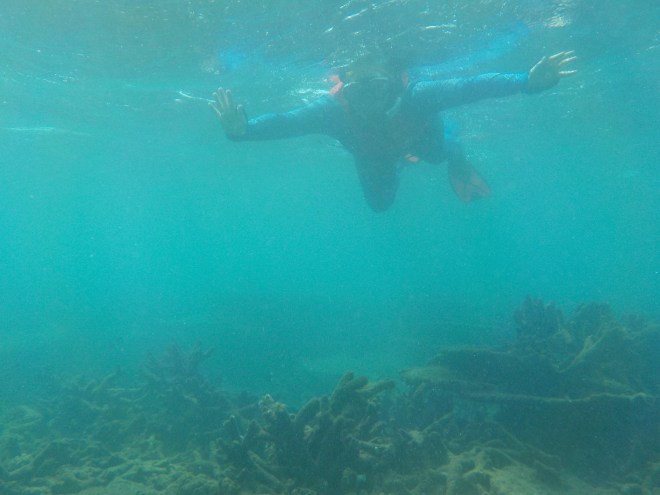
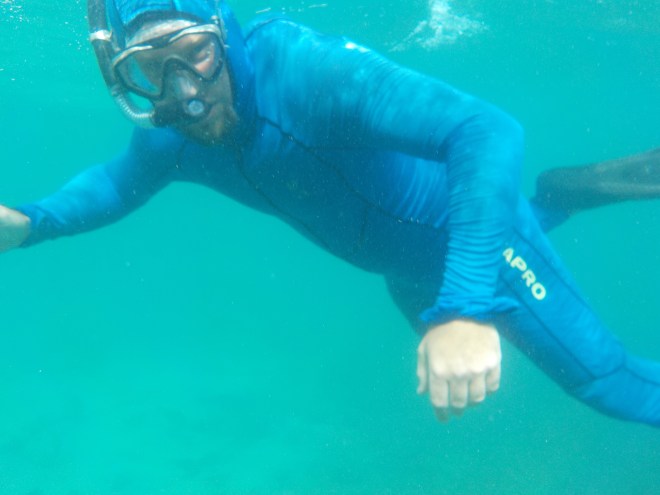
Me in my “stinger suit” – “stinger” refers to jellyfish. Since it was jellyfish season, we had to wear these, though we didn’t actually see any! Also, the water here was much clearer than it looks in this picture, and though I’m unsure how you can’t see any in the photo, we were surrounded by fish! I remember asking Kirk to take the picture because there was a school of them swimming by!

🙂

Aren’t these beautiful? These yellow ones were often in pairs too.

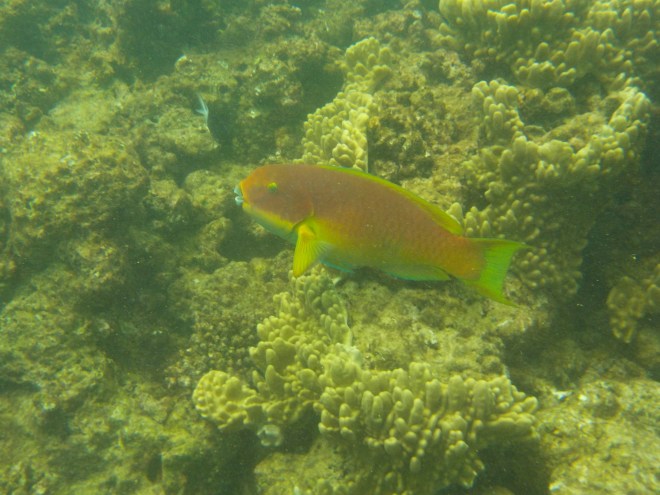
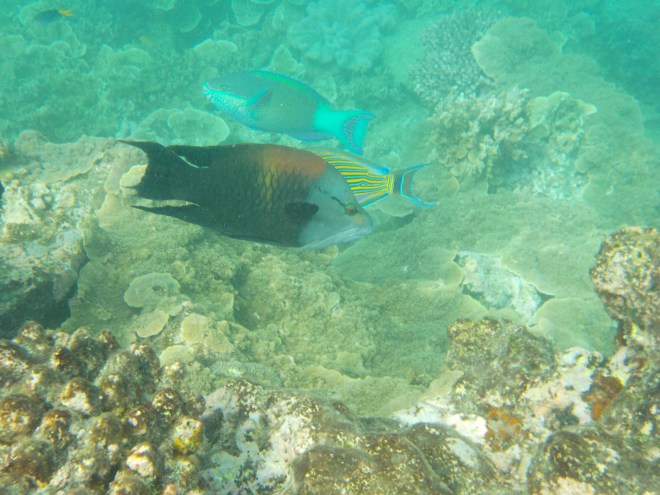
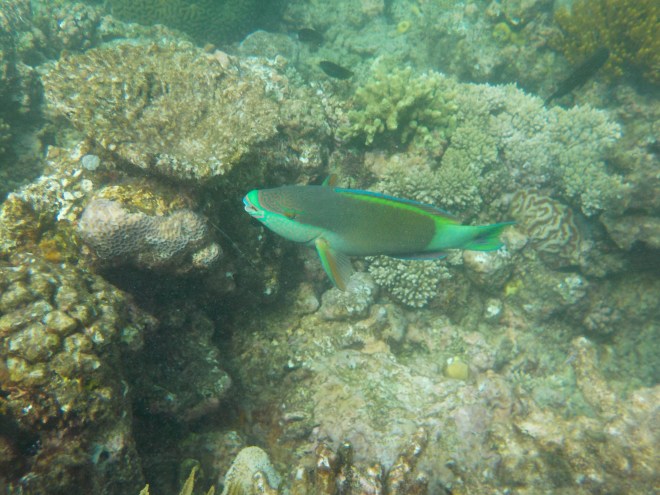
Red parrot fish

Blue parrot fish

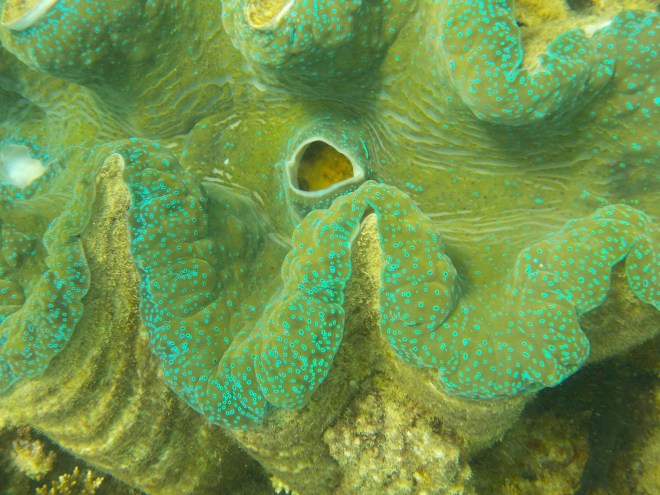
Giant clam, this guy was around a meter wide!

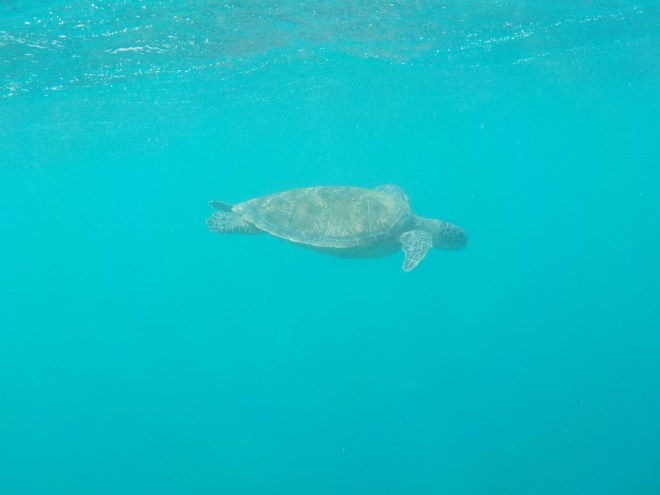
This was definitely Hasting’s Reef. I lost Kirk for a little bit and when we found each other again he told me he had seen a sea turtle. You’re getting the only view I saw of it! At the next reef Kirk saw a shark, but I missed that too. Unfortunately that one was too fast for him to get a picture, but he said it was pretty big!

Sea Cucumber

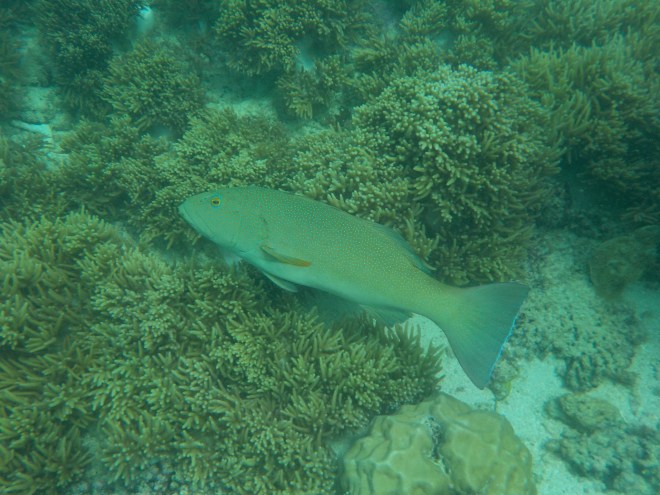
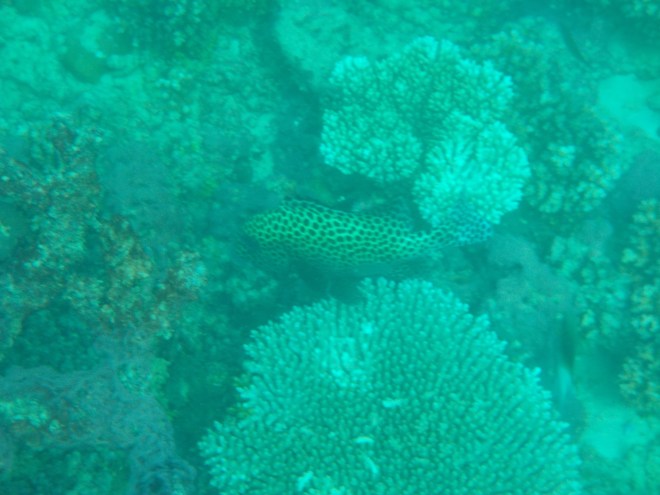
This guy’s spots glowed bright in the dark!

Another type of parrot fish – the parrot fish were my favorite. There are so many different varieties, all with beak-like mouths and bright colors!

Another spotted guy

A smaller giant clam, that was still large. His coloring was different than the others we saw.

I loved the way this coral waved with the sea!

A better idea of how many fish were usually around us!

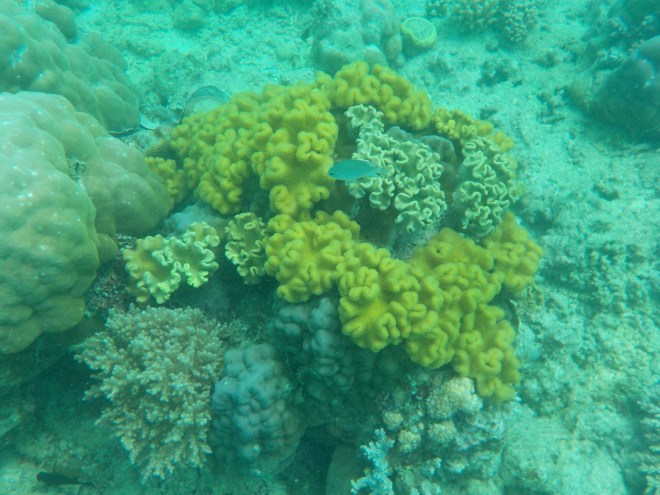
Another coral still full of color 🙂

One of Kirk swimming down.

You can sort of see how the spots glow in this picture 🙂

Different types of coral

School of fish with some parrot fish

As we left the reef we watched as the sun began to set over the ocean. It turned out to be a lovely day in spite of the waves. I think it always feels good to see beauty and conquer fears.

When we arrived back at our Airbnb that night we heard some interesting news. While out on the reef we had been surprised at the lack of other boats on the water – it turns out that the sea was so rough that nearly every company except ours had canceled their tours (there was actually a cyclone nearby, though we only got rain from it in the early morning)! Personally, I think it added to the adventure of the whole thing while also contributing to my pride of having snorkeled in those waves :).

Our final days in Cairns we found ourselves with house sitters. Peter, Vicki, and family went on vacation, leaving their house in the hands of Zach and Brad, two aboriginal young men with whom Peter works. Peter had already told us stories about these fearless guys swimming with local crocodiles that wandered near their place of work during a flood, and Kirk was excited to meet them and discuss what life had been like for them growing up. After all, many native tribes in Australia still live on islands off the mainland, and Kirk wondered what types of similarities, if any, those islands might have with Vanuatu.

It was fascinating talking and getting to know these guys. Both were from aboriginal clans (of which there are hundreds in Australia), and had grown up on their family’s native land – one on an island, and the other on mainland Australia. Both were very proud of their heritage and were invested in keeping their native languages and customs alive. We listened intently to story after story about their customs, including different types of “magic” that are still performed amongst the people. They even pulled up YouTube videos of a festival that happens every two years where all the local tribes get together to sing and dance for each other, chronicling some of their tribe’s history and folklore through artistic expression. The videos were pretty awesome, and if you are interested in watching any, you can google “Laura Festival Queensland” and some should come up.

Perhaps the most fascinating part of our conversation was about how the Australian government has left or reinstituted a lot of the rights of the tribes (although this has not always been the case – and many clans have suffered because of it, much like indigenous peoples in the States). There is currently a governmental program in place to slowly restore clans claims to their historical lands, and native peoples in Australia (in particular, on the islands off the coasts), are now often left to their own, still hunting customary foods in the sea and dealing with tribal conflict through customary means (rather than through Australian government -or police). What’s interesting is that some of the foods the tribes customarily hunt are sea turtles and manatees, and while it’s now legal for them to hunt and eat these, it’s illegal for them to sell them or for anyone outside of the tribes to eat them. Though it was a little shocking for me to hear this (especially after hearing stories my entire life about the efforts in the States to save sea turtles) it’s kind of cool to see a government entrusting a peoples with rights they once had and seem to have managed fairly well. I suppose I don’t actually know much about the current population of sea turtles around Australia, but these guys have lived on this land for thousands of years without causing extinction of the turtles, so that’s at least something.

It actually reminded me of some of the culture Kirk told me about in Vanuatu. While he was living on the islands, Kirk learned that anytime he saw a staff with a namale leaf attached, it meant whatever was there was forbidden in some way. These leaves are used to mark unsafe roads, taboo areas, and also, reefs that need to be restored. The chiefs in Vanuatu keep track of when fish in the area get low, and will mark a reef forbidden until the population of fish come back. It’s cool to learn how people’s traditional customs look out for things like this, and also makes me wonder if some of the clans around Australia have similar systems. For now, I don’t know – that question came to mind after we’d already left, but it’s sure all interesting to think about.

I suppose that’s about it for out time in Cairns. I leave you with a few final pictures of our time there.

Cairns was the first time I have ever ridden a bike on the highway! It’s pretty scary, but at least they have large shoulders and lots of bike lanes!

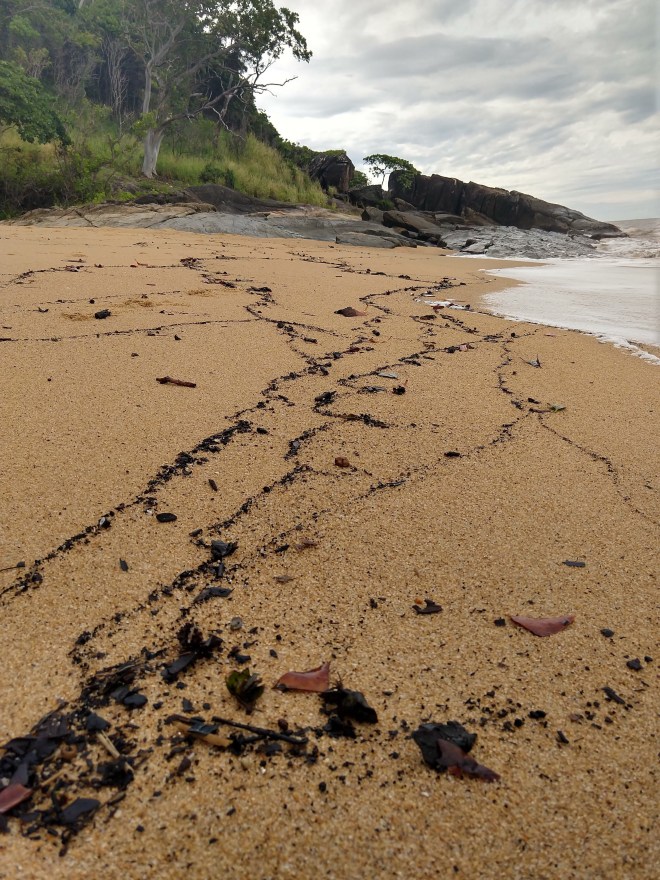
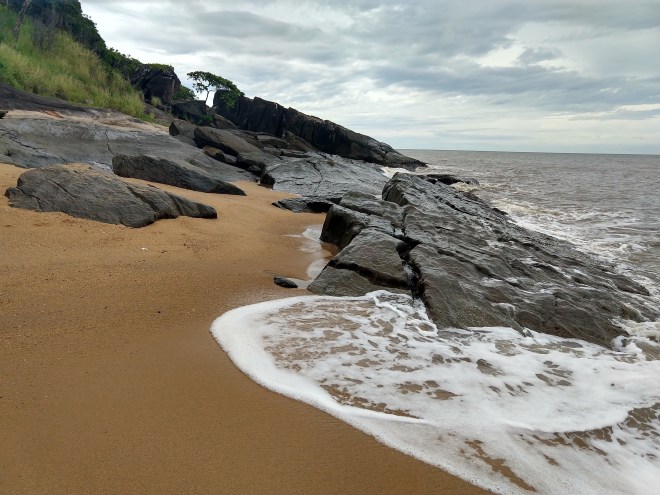
This is at Trinity Beach, the popular beach closest to our Airbnb. I love these lines the tide had created!

We actually ended up not getting in the water here, though we lounged around on the beach quite a bit. As it turns out, many beaches in Australia are dangerous because of the crocodiles. Daytime is a safer bet, but it’s especially dangerous at night!

A final picture at Trinity :). That sand really was a caramel color, and it was some of the coarsest sand we’ve encountered!

Next blog, Hong Kong. Spoiler alert: We loved it!!

Luganville and Port Vila, Vanuatu

The part of our time in Vanuatu that I’ve yet to tell you about are our stays in Luganville, on the Island of Santo, and our second stay in the capital, Port Vila. First, Santo 🙂

The island of Santo, actually called Espiritu Santo (Holy Spirit), is where we found ourselves transitioning between islands on two occasions. The first time we were only in Santo for one evening, but during our second stop we stayed for three nights in hopes of doing some sightseeing. As I mentioned in our first Vanuatu blog, Santo is the island that Kirk often visited during his time on Ambae to stock up on groceries. While parts of the island still live tribal life at it’s fullest, Luganville itself is a town with just about any modern convenience you could need.

While in Luganville we were welcomed in by Jocelyn and Jack, the sister and brother-in-law of Reynold (from Kirk’s host family on Ambae). Though Kirk never met these two members of the family during his time in Vanuatu previously, with one phone call from Reynold, Jocelyn and Jack opened up their wonderful home to us, housing us, feeding us, helping us get around, introducing us to the rest of the family, and sharing stories and life with us. They even introduced me to one of my new favorite foods – coconut crab. I already knew I was a lover of crab, but I’ve never had a crab that had so much meat on it! Coconut crabs claws are large and strong enough to crack coconuts, one of their food sources (hence the name). While coconut crabs are mostly only found in The Banks islands in Vanuatu, they can be bought in the bigger city markets throughout the islands.

This coconut crab meal ended up being one of my favorite meals I’ve eaten on the trip so far, so of course I’m going to tell you a little more about it :). It was pretty simply prepared, but SO delicious! Jocelyn and Jack boiled this large coconut crab in fresh coconut milk and served it with boiled sweet potato chunks with the salty crabby coconut broth poured on top 😍 ( If you like sweet potatoes in the states, you’d be floored by how delicious the variety they have in Vanuatu is!). They also prepared some boiled island cabbage for us, about which I previously described our love. It was too kind of them, and I am so thankful to have experienced that meal :). I wish we had gotten a before picture – while the crab was still alive, he was blue! He turned red after being boiled.

That’s a platter, not a plate, and they grow bigger than this!

Most of our time in Santo was filled with visiting, relaxing, or walking around town. Though there are a few places tourists in the area usually hit up (like the blue hole or Millennium Caves), we found ourselves needing to save up money for Tanna and only did one touristy attraction, Million Dollar Point.

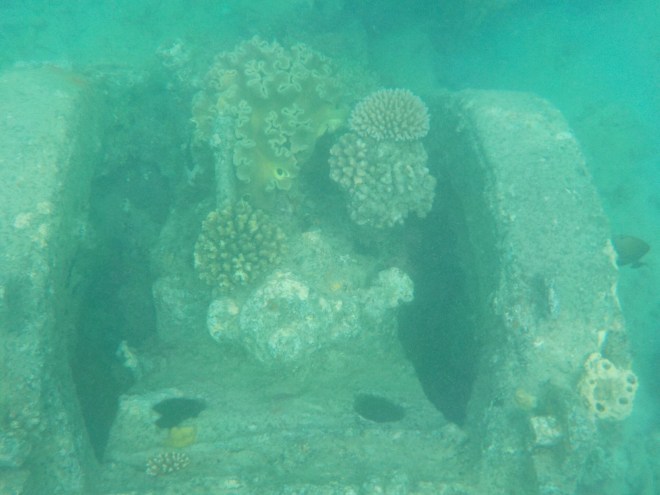
If you haven’t heard of it, Million Dollar Point has a pretty interesting story behind it. In WWII the U.S. had troops stationed throughout Vanuatu and with the troops came plenty of expensive equipment. At the end of the war, the French plantation owners on Santo were interested in some of the jeeps and equipment from the U.S., and the U.S. named a price. The French turned down the offer because they believed that the equipment would simply be left behind for the taking (because the cost of getting it all the way back to the U.S. wasn’t worth it). To prove a point, the U.S. generals stationed there built a wharf for the sole purpose of driving all the equipment into the ocean – and did. There are now millions of dollars worth of equipment buried in the sea, and you can pay the local owner of the land $5 USD to go snorkel amongst the equipment and reef at what is now known as “Million Dollar Point.” It’s a cheap attraction, and well worth the visit (though a bit ridiculous that all this stuff was wasted, it has made a source of income for the owner of the land). Thankfully Kirk and I invested in a cheap underwater camera for our first trip together to Mexico, so we can share a few pictures from our time snorkeling there :). I mostly just have guesses of all the stuff we were looking at – so much time has passed since this stuff was dumped!

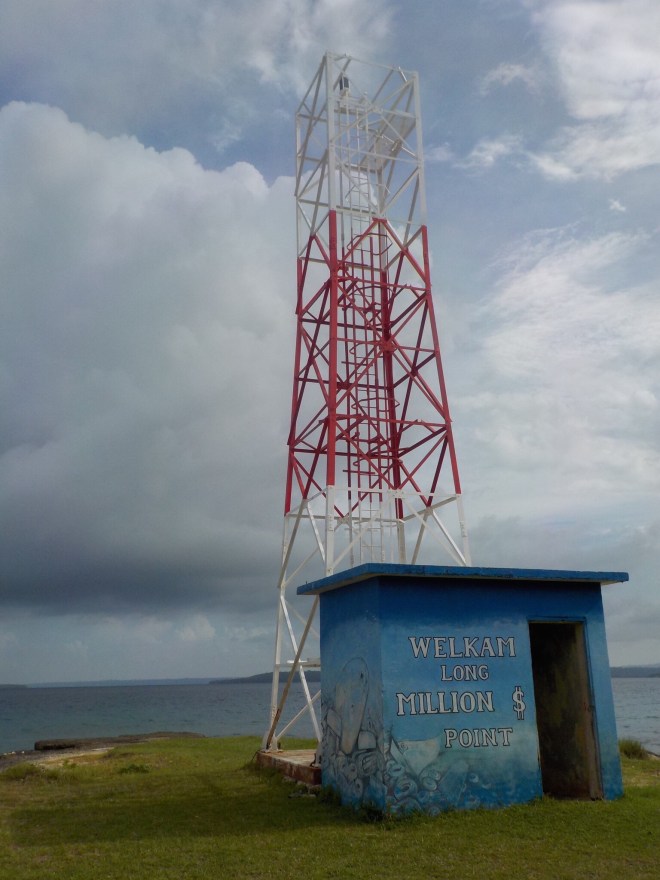
The marking point for where the wharf once was.

Wheels of something

Maybe an old Jeep?

The reef is gradually taking back over its area 🙂

A canon

More wheels.
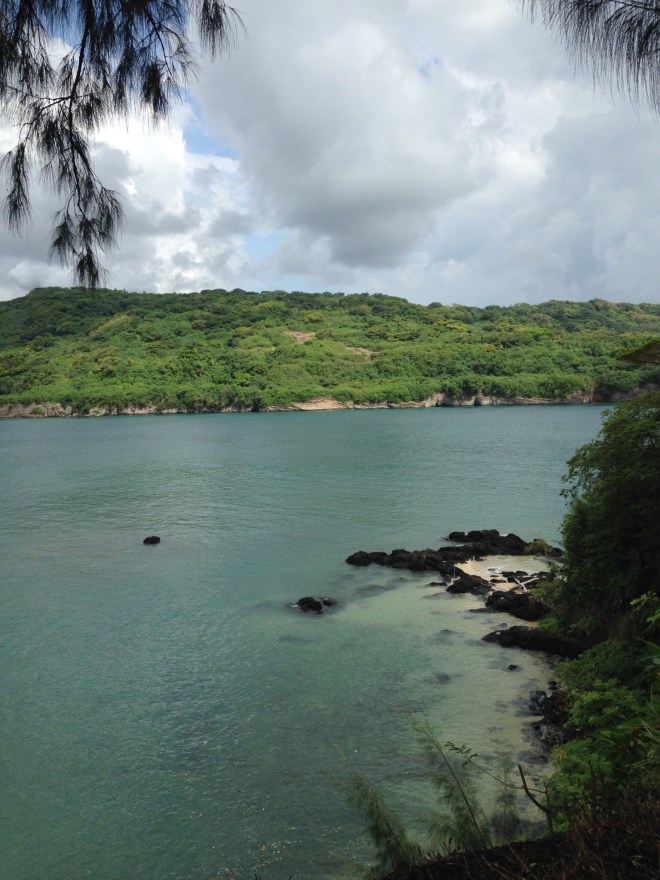
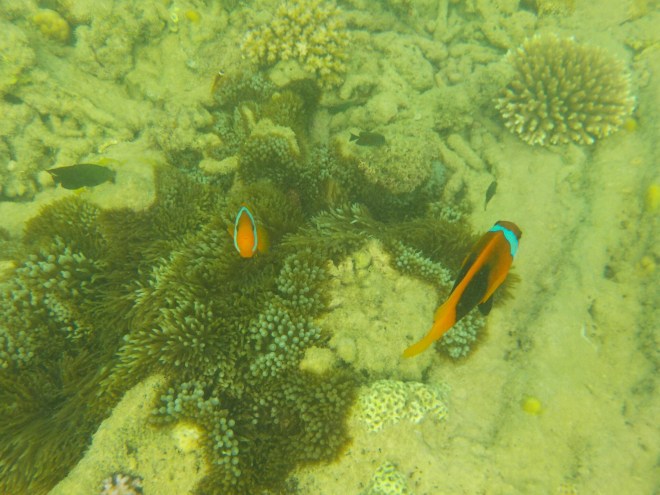
Nearby all the sunken equipment there is a large reef area. Though it’s not as bright or filled with fish as some of the other areas we’ve been in, it is the only place we saw clown fish (and that’s including the Great Barrier Reef, which I’ll post pictures of in the next blog :)!)

There were three, including the little yellowish one on the left! The one in the middle was funny. As Kirk was taking pictures, he looked up and swam closer…

And closer…

And closer…

I was watching from a few feet away as he swam right up to Kirk as if to say, “get out of my anemone!” 😂 I say “he,” but maybe this was momma fish :). We promptly moved on.

One bright colored piece of coral we saw!

These are called Christmas Tree Worms, and if you wave you hand in front of them, they quickly close up into the rock.

Over all Million Dollar Point was a lovely place to visit – and if you are ever in Vanuatu and find yourself wanting a little more adventure, one of the largest, accessible sunken ships in the world, the U.S.S. President Coolidge, is right down the beach. It was sunk by friendly mines (accidentally hitting our own mines) in WWII. We didn’t go this time because I’m not a certified diver, but Kirk went previously and says it’s awesome!

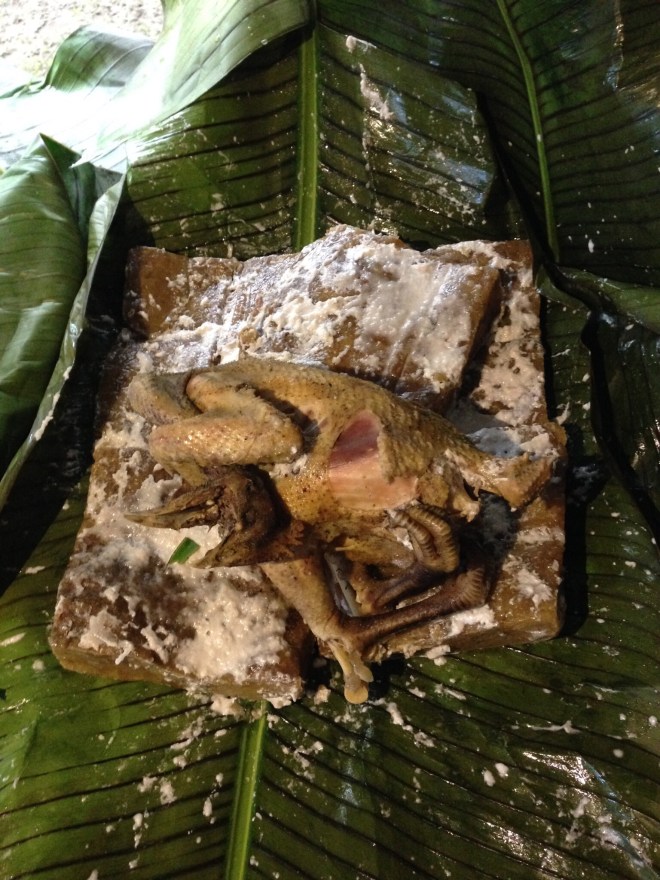
Our final night on Santo, Jocelyn and Jack organized a big celebration for us, inviting along some of Kirk’s family and friends from his time in Ambae to come see us off. The ladies spent all day cooking bunia and it was fascinating to watch. This particular dish is cooked in a way similar to laplap, but the taste is completely different. Chunks of sweet potatoes, manioc, small bananas and island cabbage are placed in lap lap leaves with meat and fresh coconut milk squeezed on top. If you don’t know (as I didn’t), coconut “milk” comes from fined grated coconut fruit being mixed with the coconut’s water, then squeezing the “water” back out. It’s pretty impressive to watch because they do it all by hand! Here’s a short clip of Jocelyn squeezing the coconut milk out onto the bunia.

Here are a couple of other photos of the bunia process.

Placing it all in the leaves to be cooked.

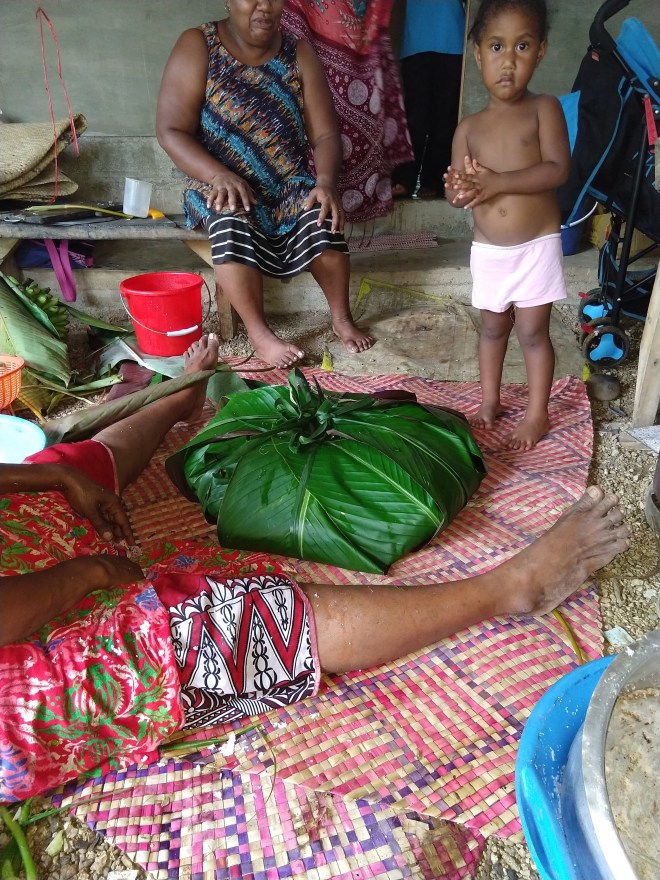
All wrapped up and ready to place on the hot stones. Those leaves are incredibly sturdy!

The food package covered in the hot stones. They then added several layers of insulation to keep the stones hot and cookin’ – lots of leaves, burlap bags, some wood. This was the final “oven”:

It was left to cook for hours, and the finished product was delicious! This was my favorite traditional island food we had. The flavors of the lap lap leaves seep into everything and it’s quite tasty!

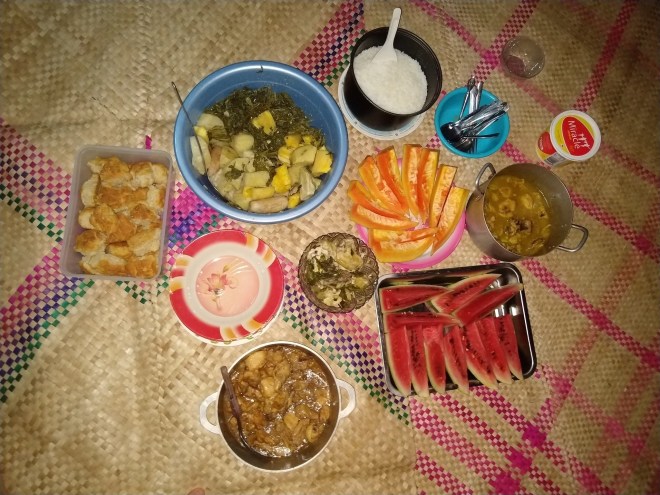
This is an array of the food we had that night –

Two chicken curries, the bunia, fresh watermelon, papaya and coconut scones! 😍

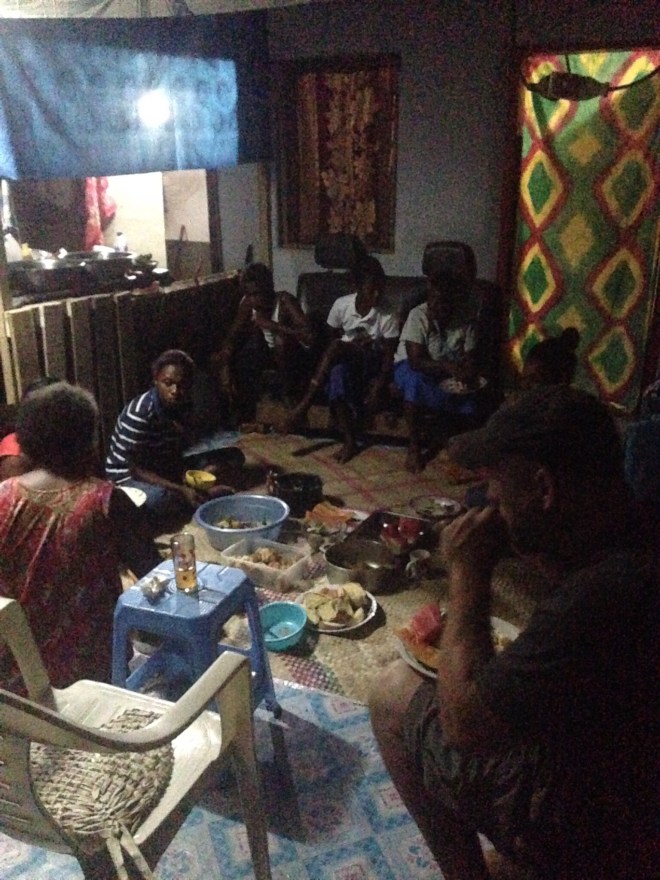
Not a great picture, but a great memory of part of the group sitting and eating. It was a wonderful night! We truly felt like we had new family by the end of our time with them :).

We took one final selfie before jumping in the car to go to the airport the next day.

Don’t be fooled by some of those frowny faces. They all took selfies on their phones too :).

The next morning we headed to Tanna (see previous blog to read about that) and then we headed back to Port Vila for our final few days in Vanuatu.

We planned on our final week in Port Vila being relaxing and fun. After living the village life for several weeks, we decided to get our own room by the sea. We found a nice hostel with a kitchenette and private bathroom in each room that was right on the beach. We were so excited and made plans of things we wanted to do during our final days, but our first morning in Port Vila, I woke up with a crazy severe migraine. I couldn’t move without tears coming to my eyes and the migraine lasted a day and a half! It turned out to be severe dehydration brought on by a fever – a fever that lasted four of our five final days. While talking with one of Kirk’s Peace Corps friends who now lives in Vanuatu, we learned that lots of local people are having the same thing happen, and no one knows what it is.

Our final day in Vila, I finally got out of the house a bit. Kirk and I visited the Peace Corps office where he saw some old friends, and that night we dressed up and went out for a nice dinner at Erakor Island. It was too dark to get a good picture, but I think you’ll still get an idea of how handsome this guy looked in his dress shirt :).

Right next to our table was incredibly clear, shallow water filled with hundreds of starfish (most of them tiny, but a few big ones!). We watched as they swayed with the tide and as two eels eventually made there way through the corals. Again, terrible picture, but awesome memory.

The red star is over one of the biggest starfish. There are tons of other white little ones in the sand, but they camouflage well against their home! Also, it was eerie watching those eels slither through their surroundings. They even attacked each other once!

Earlier that day I also snapped some pictures of our hostel by the beach.

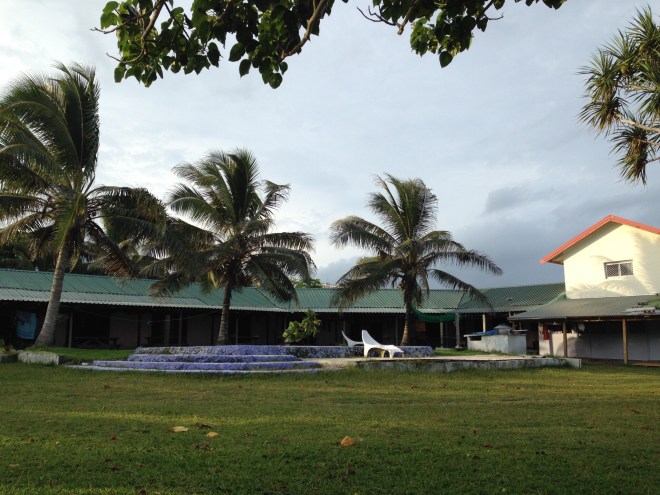
It was called Blue Pango, and the owner was lovely!

🙂

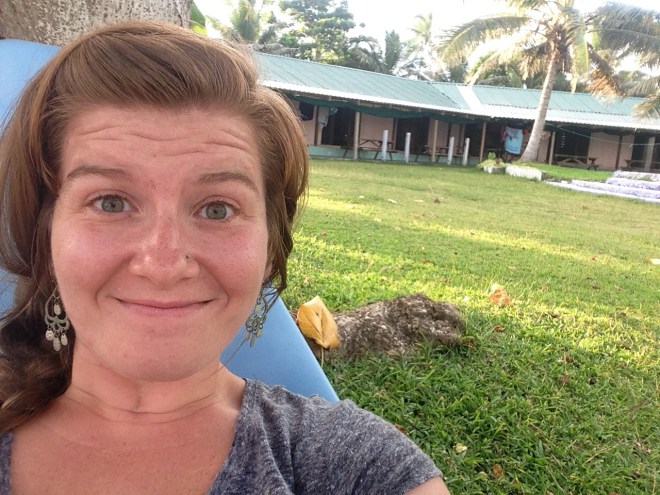
A selfie of me finally outside our room!

A view of the beach in front of the hostel – this is where we were sitting in the above pictures.

And finally, a couple of pictures from around Port Vila from the couple of times we wandered into town between flights.

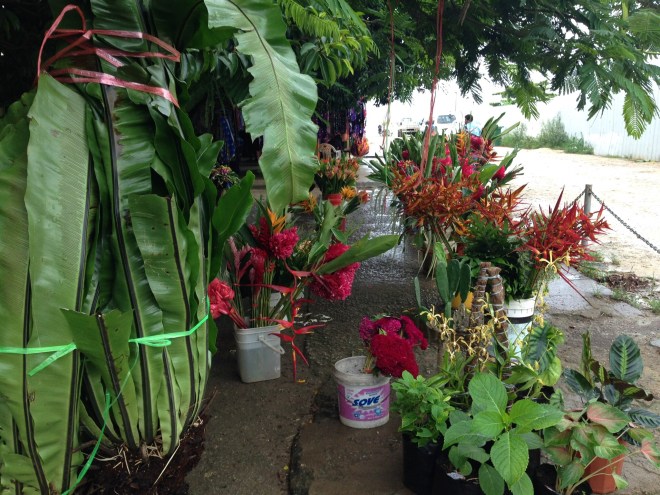
Tropical flowers for sale at the city market.

The beach front area near the main town strip – restaurants overlook this around less than a block away.

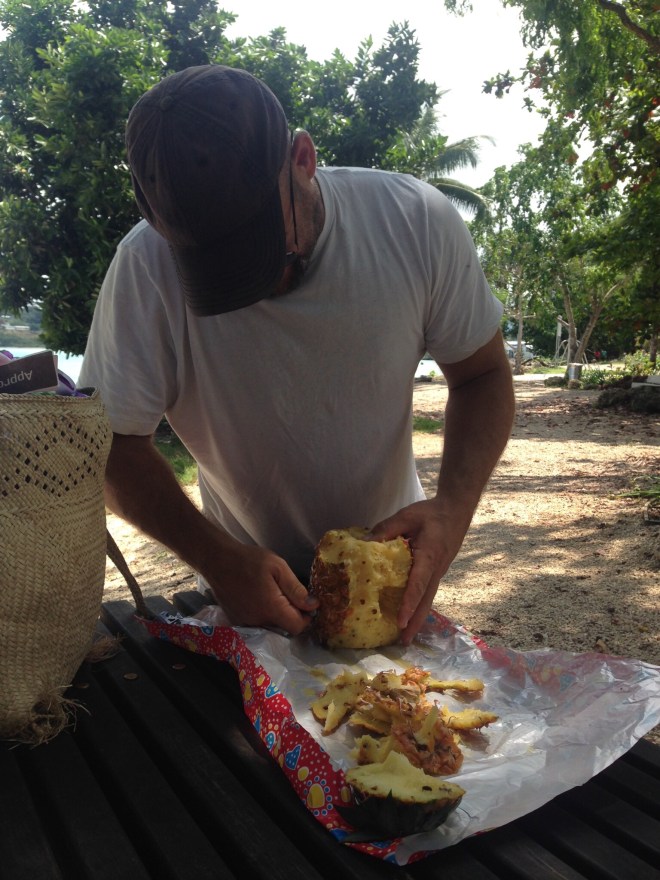
Kirk cutting into his first Vanuatu pineapple in 12 years :). We sat and ate this in the beach/park area beside the ocean.

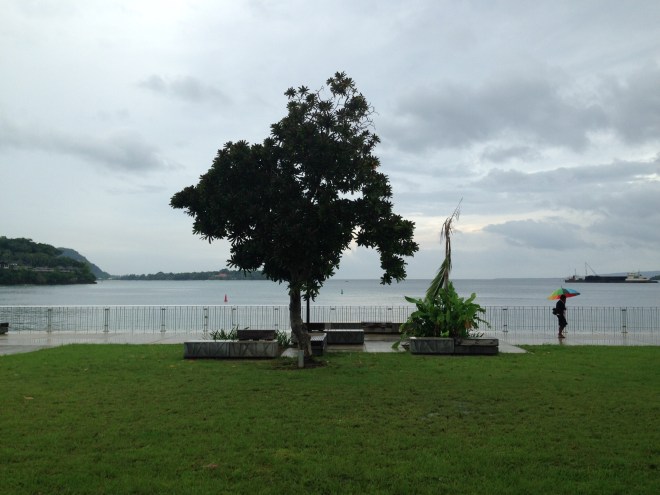
A final picture with one of my favorite moments in Port Vila before I got sick. This is a rainy day view of the beach in front of the city park. When it’s sunny, this is the same bright aqua the other photo! Right before I took this picture I watched as something large splashed to the left. I tapped Kirk an said, “There is something big over there.” We got closer and kept watching in that area when suddenly, to my delight, 40-50 foot long fish leapt out of the water in unison! I wish I had had my camera ready then! We watched as they went along skipping down the bay, jumping 5 more times before they were out of sight! It’s amazing how in unison they are!

Going into this trip we knew that Vanuatu would be a highlight of the trip – after all, it was once where Kirk called home. It’s taken me a long time to gather all my thoughts about our visit there, but this blog brings that time to an end. Vanuatu is a special place and I hope the blog has brought some of that to life!

We’ve actually been in three other countries since we left Vanuatu, so stay tuned! I’m working on trying to catch up – next blog: Cairns, Australia (Great Barrier Reef).

Tanna, Vanuatu

Today’s blog is about Tanna. Though our actual journey in Vanuatu was Port Vila, Santo, Ambae, Santo, Tanna, Port Vila – I’m going to save Santo to talk about in the final blog alongside our final week in Vila. There is far too much to ponder from our time in Tanna for it to be combined with anything else!

During our time in Tanna, I think I experienced just about every emotion possible. Happiness, anger, fear, sadness, overwhelmed, confusion, awe – we hit the whole spectrum. I’m not completely sure where to start with our story from there, but I do think I should put a disclaimer here that part of this post is not very suitable for a young audience, and while no one was physically harmed, it has the potential to be a trigger for someone who has sexual trauma in their past. If any of that is a concern for you, there are some pictures of an active volcano and beaches toward the bottom if you want to just read this next paragraph and then skip to the first picture you find :).

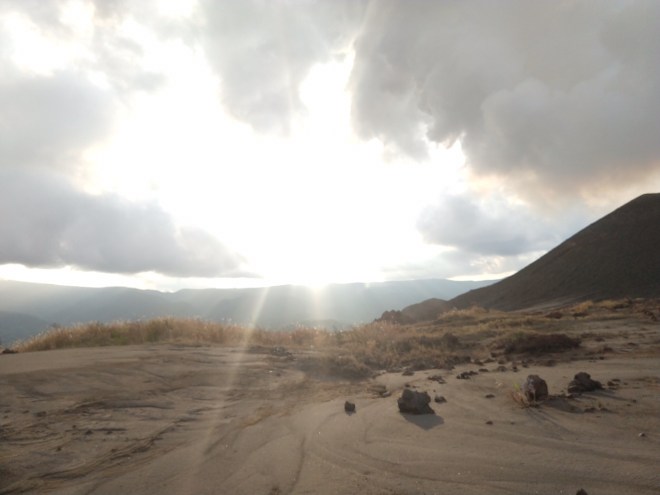
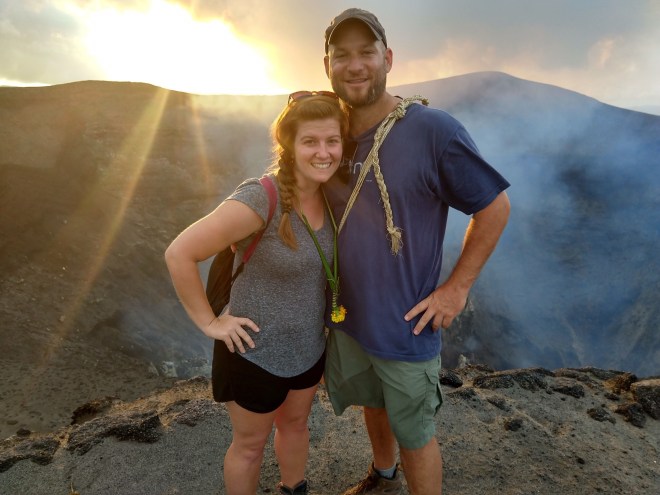
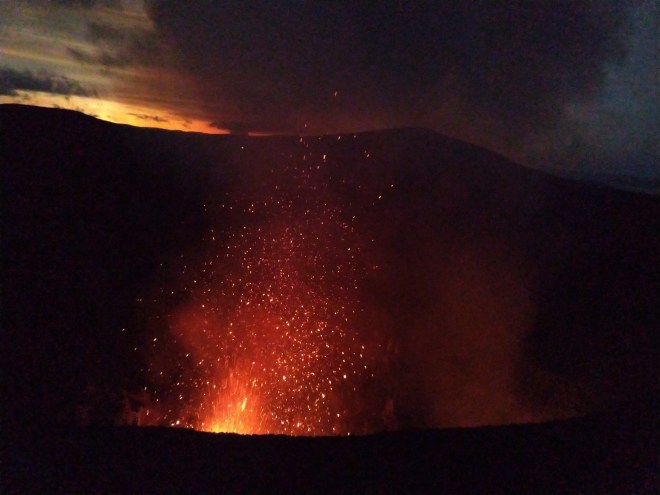
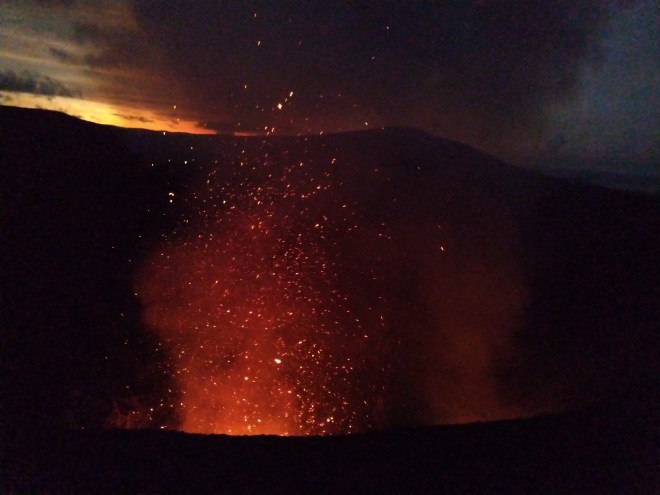
Tanna is home to the most accessible active volcano in the world. If you can walk up hill for 5-10 minutes, (equivalent to 4-5 flights of stairs), you can see this volcano in all it’s glory. For this reason Tanna is the most known outer island in Vanuatu and is visited by many tourists. It’s created an interesting atmosphere there. Tourists are fully seen as “other” and charged prices that, while mostly reasonable for tourists, are astronomical compared to local prices. It’s created a strange dichotomy on the island though, because while tourists are often charged rates at least 10 times of that of locals ($50 for a car ride instead of $5 – even though you are sharing the same vehicle), in some villages, tourists are still expected to follow local customs. For example, when we arrived in the village we were staying in, I was informed that I was not to walk by the Nakamal (meeting area) when men were present and in fact, I was to keep my head down as I walked the “woman’s path,” as a woman is not allowed to look at the Nakamal when men are present. I’m normally very okay with adhering to other’s customs, as I am the one visiting their land, but it was frustrating to feel somewhat taken advantage while also being oppressed because of my sex. That feeling is how we began our time in Tanna, and sets the stage for the next part of the story.

Our first full day in Tanna we decided to go to the beach that is located right next to the village we were in. We set out down the short path, taking the detour on the “women’s path” as to avoid the Nakamal. We arrived at the beach and walked a ways down as to not be too close to the village. We feared a tourist swimming might draw attention, even though this village is no stranger the occasional foreigner. About an hour into our swim, Kirk, who was a little further out in the reef looked up and pointed. At first I didn’t understand, but he then came close and let me know that he had just seen a man sneak behind a tree located directly behind the place we’d been sitting earlier. My eyes scanned the horizon several times, but I never found him. If Kirk wouldn’t have happened to look up when he did, we’d have had no idea the man had come.

I thought – there is no reason to sneak unless you are up to something. Anger welled up inside my chest as the frustrating emotions I was already feeling swirled around. I’m not allowed to look at your Nakamal, but you have the gall to come watch us swim?

Kirk got out of the water and addressed the man as Kirk walked towards the small straw shade covering our belongings were under. Though he really just wanted the man to know we knew he was there, what he asked was “Is this your cover? We can move if you want it back.” The man replied no and after a couple of minutes, left, me still having never seen him. We sat drying for a while, discussing why he might have been there and how creepy the whole thing had been, and then gathered our belongings to head back to the village.

We walked down the beach and onto the path, but as we turned off the “woman’s path,” I noticed movement in the bushes behind us. I glanced back just as a man emerged from a bush carrying a machete in his right hand. “Kirk, is that him? There is a man behind us. Is he following us?” After a ways Kirk glanced back and confirmed it was him. He seemed to lurk behind us, careful to maintain a certain distance, slowly veering off as we entered the village and continued on to our hut.

I felt concerned, but really torn. Kirk stood about ten feet away chatting with our host as I sat outside our door, my thoughts running wild, “Who is this man? What if he’s important and we tell someone and they get angry with us? Women don’t seem to be very valued here – will anyone care that he came to watch? Are we just paranoid or was he actually following us? Where is he now?”

In that moment I glanced up to take in my surroundings. To the right, Kirk stood talking with our host, directly in front of me three woman sat chatting as their children played on the ground beside them, to the left – my heart jumped. There he was. About 30 yards away, stationed between two houses in a place where he was hidden from everyone’s view but mine. His eyes were wide in a dead stare, set right on me. A nervousness came over me and I glanced away. Hoping my initial gaze had made him quit looking I glanced back to a shocking realization. His gaze was still deadlocked, his pants down, and he was pleasuring himself as as he stared.

Vulnerability. Fear. I’ve never felt so alone and targeted while being surrounded by people. We still didn’t know who this man was, but I could no longer not say anything. “Kirk. Kirk..” I got up and quickly made my way over to where he was, quietly explaining what was happening. Kirk told our host what I had said and our host looked relatively unsurprised.

“Oh, him, he does that all the time. He’s smoked too much marijuana. Everytime he does that we yell or swing at him and he runs away. He’s harmless.”

Marijuana? (That word is the same in Bislama and English) That’s not a common reaction to that drug.

The women nearby joined in on the conversation, recalling times he’d done it to them and telling about the previous tourist who was targeted as well. Kirk took in the stories to tell me later as we looked at one another suspiciously. The man’s appearance was a bit disheveled. He wore long pants and a coat that had not been washed in some time. That doesn’t sound like drugs, it sounds like mental illness.

Kirk began to ask questions:

– Does he ever sit and talk to himself? “Oh yes, he sits and talks and laughs to himself all the time.

– Did this start later in life maybe in his 20’s? “Yes, yes, he used to be a very bright kid. He worked at Iririki (one of the nicest resorts in the capital) but one day he jumped in the pool with all his clothes on and he’s never been the same since. When he first came back to the village he was really violent.”

– Has anyone else in family ever been…different? “Oh, yes. He is one of eight children – six boys and two girls. One of his brothers used to act similar to him and one night he walked into the ocean and drown himself. He has another brother who doesn’t act right either. There is also another brother who he is scared of. That brother beat him with a big piece of wood last time he was caught looking at a woman. He ran away and we didn’t see him for a while.”

All my emotions were on overload from the parts I had understood. I felt such great sadness for this man who had been beaten for something that wasn’t his fault – for him living in a village with people unknowingly blaming him for this incredibly difficult thing he is facing. I imagined how alone he must feel while also acknowledging how scared the people in the village must feel facing this unknown thing. At the same I still felt fear myself. I still hadn’t recovered from feeling targeted and the image of him with a machete and the thought “he used to be really violent” kept replying in my head (the image of out bamboo hut with no locking door playing alongside it).

Kirk then began to tell them that we knew people back home who acted similar to this. He told them that part of my job as a social worker has been to counsel people facing similar situations. Most importantly, he told them – “It wasn’t drugs that did this to him, in fact, it’s not his fault at all. It’s a type of illness, an illness in his head. There is nothing he did to cause nor could he have prevented this, and you should know that sometimes illnesses like this follow down the family line.” Kirk also explained that just because he was once violent and it stopped, doesn’t mean that it could never happen again.

They listened intently, never having heard of such a thing, but because Kirk’s initial questions were so dead on, they were very interested. Our host explained that when the man first started acting like this, they took kava away from him also as punishment for his bad behavior.

A little info on the side for you guys before I continue on – the most popular substance of choice on the islands in Vanuatu is something called Kava. It’s a type of tea, made from the roots of the kava plant and while it’s just catching on in the states, islanders have been drinking it for ages – in particular, the men. Drinking kava is what they are doing when women aren’t allowed to look at them in the Nakamal. It’s so greatly a part of the culture for men that you are unlikely to find a man who doesn’t drink kava unless they’ve opted out due to religious beliefs (and not all religious groups are opposed to it, somewhat like alcohol in the States). The effects are calming. It reduces anxiety, but when drank in small amounts, it doesn’t greatly affect cognitive function. In other words, people on the islands still drive after using it. Many people say that it isn’t addictive, although I suppose that’s yet to be seen. Research in the states is actually currently being done to test kava as an anti anxiety medication, and prices for kava are soaring as drug companies from the States buy up crops in the area. I just found this article if anyone is interested in knowing a little more about it. Though there are potential side effects, there is nothing conclusive yet.

https://www.psychologytoday.com/us/blog/integrative-mental-health-care/201703/kava-is-effective-and-safe-treatment-anxiety

After asking how the man had previously responded to kava and them replying that it calmed him, Kirk thought, and then told them in Bislama – “I’m no doctor, but I would think that since it calmed him before, it could calm him again.” Kirk and our host talked a while longer and the host ended up bringing it up to the man’s family.

Ni-Vans (people from Vanuatu) are known for being slow decision makers, so the next morning when our host came to us and said they had decided to allow the man to have kava again, we were surprised. In fact, they had given it to him that very evening, including him in the community of men as they partook. They noted that he ended up being calmer than they had seen him in some time and felt good about him continuing to participate with them. I don’t know what this means long term for this village or this man, and I think the road ahead is very long, but I can tell you that on the ride home, the man from the village in the front seat turned to Kirk and said, “I just realized today that it’s not his fault that he acts this way.

After all the fear and crazy emotions, that’s a lovely thing to hear. Education is so important, and even when the best decision isn’t always clear and resources are lacking, recognizing the humanity of a person is always a beautiful thing. Mental illness can be scary – I felt the fear first hand as his eyes were deadlocked with mine, but he is still a human being, worthy of being treated as one.

I don’t know where all your mind travels after reading this story, but I know for me, I have a million unanswered questions, while also sorting out all the emotions I faced in that brief time. How can mental illness be better addressed in a place that lacks resources? When Kirk was in training for the Peace Corps, one book they gave him to read was entitled “Where There is No Doctor, “ because for the majority of people in Vanuatu (including volunteers), there is no access to doctors. Most islands have health clinics run by local volunteers, but those clinics have few resources other than bandaids, Panadol, and if you are lucky, an anti malaria medication. For most islanders, there are no prescriptions, no counselors to send people to, not any type of asylum (there was once one in Port Vila, but it shut down due to lack of funding.) There are police in some places if something goes terribly wrong, but culturally, they are under utilized. Communities tend to handle problems on their own, as they have culturally always done.

Considering all this, my brain wandered to questions of ethics. Do ethics take on a different face in a place with few resources? Though Kirk was the one doing all the talking and relying it to me in English later, I wondered if I would have said the same thing about kava to the community had I spoken the language. As I stood alongside Kirk, working to decipher the Bislama, I had thought to myself, “Could kava be a resource to this man in someway? It’s so immensely apart of their culture.” The thought made me feel a little crazy though, because it would never cross my mind to mention something like that in the States. There are so many other resources that we know more about – evidence based practices and professionals – that we can utilize, but in an area with so few resources, what does “doing the least harm” look like? I’m interested in thoughts you might have. That’s ultimately why I wanted to share this story. Traveling presents a lot of gray areas, and it seemed like a good thinking opportunity for us all.

The final question I’ll raise for now that’s been on my mind – how do we get education out – not only to communities lacking in resources, but also in places with abundant resources? There are tons of organizations around the world working to better educate people about topics such as this, but so much is still unknown. Even in the States mental illness is often misunderstood. People who have been diagnosed with something are often looked at as “other” when in all reality, I’d be shocked to find a person who hasn’t been touched by mental illness in some way in their lives. There is still much work to be done in education, and I think this was an important reminder of that.

I suppose that’s enough thinking and heavy stories for today, but if you have any thoughts, please send them along. For now, I’ll move in to some pictures. Though our time in Tanna was filled with plenty of heavy mental lifting and sorting emotions, it was also filled with great natural beauty and awe.

This is a picture of a traditional hut in the village in which we stayed. The house on the left has coconut tree branches on top of it. During cyclone season many people place those on top of the house to help weigh down the roof. I was actually trying to get a picture of the color in the clouds I when I was taking this. The small amount of red you see is lava reflecting off the clouds from the volcano below.

This is a picture of the beach right next to the village in which we stayed. This is one of my favorite beaches we’ve been to. It’s practically untouched, with colorful reefs growing close to shore. The water is shockingly clear and the perfect temperature for swimming. The sand is white with speckles of colored coral, and it’s just coarse enough that it’s soft to walk in, but brushes off easily.

Once, when we were near the shoreline, I looked down and saw this being tossed back and forth by the waves. This is the most beautiful shell I’ve ever found on a beach. The bottom was already broken and it was too fragile for us to consider keeping it, but we did walk it up to the village and gave it our host. That purple!

The last picture was to show size, but here’s a close up showing the coarse sand as well.

One day our host took us for a walk around the village, showing us two other beautiful beach areas.

This area is near a yacht club that has been built nearby. Isn’t the water beautiful?

The view from the other side of the yacht club

Next we went to a beach filled with waves. We sat under a thatch covering as kirk chatted with our host and I listened to the waves crashing over the rocks.

The view to the left

View to the front

View to the right

And now the main attraction…

This was our first up close view of the volcano. We drove right by it on the way to the village our first day on the island.

It’s getting more and more expensive to climb up the volcano, but the company that does it is gradually making it into more of a tourist experience. They had our group sit and watch a local tribe do a “volcano dance” prior to going up the volcano. I thought it was going to be hokey, but I was actually really impressed. When they collectively stomped or jumped, the whole ground beneath us shook. It was quite impressive.

Here is a short clip:

After the show they gave us bottle of water and we loaded onto trucks to head up the volcano. It’s about a 20 minute truck ride up, followed by a 5-10 minute climb to the top. Seriously, this is THE most accessible active volcano in the world. There are others you can climb and watch, but this is the easiest. If you missed the Facebook post that explained this, this volcano in particular has been continuously erupting for hundreds of years. When it is at a level two (which it usually is), you can safely climb up to the second rim of the crater and watch and feel as the volcano throws rocks and lava into the air every couple of minutes. Some booms are bigger than others, and occasionally a shock wave will lightly push you back from the pressure.

The following pictures don’t do it justice. Most pieces you see flying in the air are larger than a human, and the height they are reaching is hundreds of feet up. The camera catches it as a concise picture, but the actual view is nothing like that.

I snapped a picture of Kirk as we pulled up to the walking part of the trail. It has rails to hold onto, and what you see is the whole thing, the equivalent of 4-5 flight of stairs.

The sunset nearing the top

We were able to view the volcano from two points. The first allowed us to get some beautiful sites of the crater with the sunset, while also getting our first views of the eruptions. There are different times of the day you can go, but if you ever go, we suggest evening for sure. You get to see the volcano in the light, watch the sunset, and then see the hot lava glow as it erupts in the dark.

The crater at sunset

Below is a short clip of the first major eruption we saw. My recording it was a happy accident!

All those flying pieces are what glow bright red in the dark!

We hiked up to the second viewing spot and could see farther down into the volcano.

The red glow was starting to show!

Our tour guide asked if we wanted a picture and we said yes.

I think these are our best photos taken by a stranger at this point in the trip, so I’m posting both :).

After that we sat for about an hour watching the sunset and the volcano continuously erupted. It was quite a sight as the colors shown behind the fiery bursts.

I love all the colors in these!

Here’s a nighttime clip as well:

Before we descended back to the trucks I took a couple of final pictures of the fiery glow reflecting on the ash clouds.

It’s truly unbelievable!

Reflecting on our time in Tanna, the whole experience was truly unbelievable. It’s also pretty unbelievable that all of it, the good and bad, is everyday life for the people on the island. Traveling introduces you to different ways of life. It’s amazing all the things you can learn and be reminded of in the midst of that.

Ambae, Vanuatu

As I begin typing this we are on the plane, leaving one of the most anticipated locations of our trip, Vanuatu. For those of you who don’t know, Vanuatu is where Kirk spent two years as a Peace Corps Volunteer. It’s been twelve years since he served there, so going back was no small deal. He was excited to see the community that brought him in as family, and I was excited to meet everyone and see where he once lived. The last three weeks have been pretty amazing, and it’s going to take a few blogs to describe the craziness and wonder that occurred in our time there.

Before I fully get into some of our stories I’ll tell you some of the things that I’ve found interesting about this place that Kirk once called home. First, the language.

Bislama is the official language and common tongue in Vanuatu. There are over 100 local languages spoken and school is taught in either French or English, but Bislama is the one language that pretty much the entire country speaks fluently. It’s considered a pigeon language, a mix between English, French, and local words. As I would listen to people speak, I found that it was easy to figure out the main idea of the conversation as so many of the words have English roots. I have to admit though, when I first saw the language written, I couldn’t help but think of the game “Mad Gab.” Like the game, there are a lot of phrases and words in Bislama that look completely foreign upon first glance, but if you read them out loud, suddenly it starts to have meaning. It’s an incredibly phonetic language, being pronounced just as it looks, so for you teachers who are used to deciphering phonetically misspelled English words, learning parts of Bislama would not be so different. For example, I saw this written in an advertisement:

“Gud wota gud lief” (Good water, good life)

Another said, “Tuff Tomas” (“So strong” – or as I like to think of it – “too much tough”)

Here are a few without the answers right next to it in case you are in for a bit of fun :):

1) Buk blong mi

2) Hemi woman blong saiens

3) Nambawan

4) Tankyu Tomas

5) Nem blong mi

6) Olsem wanem

Don’t get me wrong, there are plenty of phrases and words that have no resemblance to English, but it got easier to decipher some of those as well by the end of our time there. Below are the answers:

1) That book belongs to me 2) She is a woman of science – “hem /hemi” is the word for him, her, he, she, and it. 3) This phrase is used the way we would use “the best,” but it definitely sounds like “number 1” 4) Thank you very much 5) My name is 6) This one was a trick :). It’s a greeting that means “How are you?” Or “What’s up?”

I’ll also note, even having not spoken it for 12 years, Kirk’s Bislama is unbelievable. I’ve been impressed with Kirk’s Spanish, but his Bislama far surpasses his Spanish. He never has to search for words and the locals were shocked by his accent everywhere we went. I eventually heard some other white men speaking Bislama, and I finally understood why the locals were all so impressed with Kirk! This guy has a knack for accents in language. It’s true of Spanish too – I forgot to write it in the blog, but every time we met a person in South America they would comment on Kirk’s accent. One taxi driver we had in Argentina even asked Kirk if he was from Mexico!

Moving on from language – the country itself is made up of 83 islands located in the South Pacific. All of the islands have beautiful beaches, some sand beaches, some coral, some volcanic rock – some white, some multicolored, some black. There are also plenty of reefs to snorkel on with an assortment of “Finding Nemo” fish, brightly colored corals, and beautiful untouched shells. Vanuatu is also located on the “Ring of fire,” so there are plenty of volcanos to climb and soil rich with nutrients.

Each island in Vanuatu is home to multiple tribes, with some of their territories being quite small. I remember walking down a road in Ambae where Kirk stopped me and said “That house behind us is the end of that territory. The house in front of us speaks a completely different local language.” Isn’t that crazy? People have speculated that the previous prevalent practice of cannibalism contributed to the distinct territorial lines of language that still exist, as it was not safe to go to the neighbor in the next village to borrow some sugar. In fact, the practice of cannibalism was only stopped in recent history with the arrival of western missionaries. The first missionary was actually eaten, and the last men known to have eaten someone are still alive.

With the presence of these many different tribes and customs, each island is completely different. Most tribes have held on to their roots in some way and all tribes still speak their local tongue. Some tribes still wear their traditional outfits (like Nambas – covering only the male genitalia). Other tribes have switched to a more modern type of dress, but hold on to traditional dances, ceremonies, or chiefs. People in the cities that host many tourists live a more modern life.

For example, the capital, Port Vila, is a large city that caters to the many tourists that visit from Australia and New Zealand. Cruise ships port here, prices are significantly higher in this area, and electricity and running water are widespread.

The island of Santo (where Kirk often went for groceries during his time in Vanuatu) has a modern city right alongside traditional tribes. You can sometimes see a person walking around the grocery store in a loincloth and parts of the island have sewage systems and electricity.

Kirk lived on the island Ambae, and it’s somewhat of a mix. It’s still very much life, as they say, “in the bush,” but they dress similar to people back home, and though they have chiefs, their role in the community has changed immensely from their role historically. There are French and English schools on the island, but no power grid and no sewage system. Some houses have solar panels to charge phones (there is a tower there that also runs on solar power) and stores on Santo, the nearby island that I just mentioned, sell small solar panels connected to a single lightbulb for the equivalent of $8 USD. Although, 12 years ago, less of that was available. Houses vary, but there is a mix of cement block homes and bamboo/thatch houses around the island and all of them have a separate “bush” kitchen (wood fire kitchen), dry or pit toilet (usually a significant distance from the sleeping quarters), rain water cistern, and bucket shower stall.

I suppose that’s enough background from now, onto the beginning of our time on the islands 🙂

We arrived in the capital of Vanuatu intending to fly straight into Santo, then on to Ambae, but were delayed because a cyclone was passing through the northern islands when we arrived. We had to wait out the storm a few days in Port Vila, but thankfully one of Kirk’s closest friends from his time on the island was living in the capital and invited us in, housing us and feeding us. We spent a couple of days with him and his family, feasting on the island food Kirk had missed and “storian” (pronounced like story-ahn – there’s no direct translation for this, but it means telling stories and talking) as the rains poured outside. Here’s a picture of Brian, the friend, and his sons in front of their wood fire kitchen.

The kids were actually taking a picture of Kirk taking their picture 😂.

One “island food” called simboro. It’s a type of dumplings made of grated manioc rolled inside island cabbage and boiled in coconut milk. Y’all. I love island cabbage. The tastes falls somewhere in the middle of all the leafy greens at home, and texture is a mix of spinach and kale – soft and easy to chew, but durable enough to make dumplings. I now see why Kirk missed it so much!

Check out these plants on the way to the toilet. Tropical plants are so beautiful and they grow so easily here! That pink flower is of the ginger family, but you can’t eat this particular variety.

Nearly everyone in Vanuatu wear flip flops, and you leave them at the door of your house before entering. They are the most practical thing, especially during cyclone season!

Brian, Kirk’s friend, had another son who was a month old. I was fascinated by this “baby hammock” he slept in. Before arriving in Vanuatu I was reading an article about new baby hammocks that can be put in cribs (so that the fall isn’t far, if they somehow get out). The article talked about how hammocks replicate the snug womb, helping the baby rest more easily while also ensuring that they are sleeping facing up, because hammocks are harder to roll over in or sleep tummy down in. I thought it was so interesting to have read that article and then seen this set up a few days later! I would definitely research it more before recommending it, but I thought it was interesting enough to mention 😊.

When the flights finally got going again, we flew into Santo for one night (I’ll talk more about Santo in a later post, as we spent more time there later), then on to Ambae. The flight into Ambae is the smallest plane in which I have a memory of flying. 20 seats and no stewardesses. We sat in seats 1b and 1c, directly behind the pilot, so we were able to watch out the front as we neared Ambae.

Us with the few rows behind us.

Our view out the front

Getting our luggage

The landing strip on Ambae is interesting. It’s a long strip of grass that starts near the beach and goes straight up. If you are standing at the “airport” (a tiny building with a check in desk), waiting for a plane to arrive, you will see the plane in the sky before it drops down and disappears, not to be seen again until it’s already slowed and pulling up by the loading zone.

This is a picture of the very top of the landing strip with the airport to the left

It makes sense that the landing strip is so steep. The entire island of Ambae is essentially part of a volcano. It’s shaped like a football, all sides gradually going upwards towards a tall cone in the middle. Though the volcano is only around 5,000 feet above sea level at it’s tallest point, the base of it continues down beneath the ocean for another 8,000 ft.

Our seven days and six nights in Ambae were filled with greetings and smiles. We stayed with the same host family whose land Kirk lived on during his peace corps years. Though the house he stayed in previously is no longer suitable to live in, we were welcomed in and given a room inside the family home. This was the first place in our journeys that I feel like we were truly immersed in culture, and that’s only because Kirk knew the culture so well from before. I was fascinated by island life and found myself comparing it to my previous experiences in traveling.

Ambae is unlike any place I’ve ever been. In some ways what they call “island life” is not so different than “village life” that I’ve experienced in different parts of Africa. In both places there is a vibrant joy spread throughout the community in spite of circumstances. Modern conveniences are lacking, but the love and willingness to share and give is abundant. Uganda is the first place I remember experiencing a joy like that, but you might be interested to know that this joy is not just seen in Vanuatu, but also calculated. Vanuatu is consistently rated among the top five happiest countries in the world. We actually met a German girl in the Amazon who was ecstatic that Kirk had lived in Vanuatu, as she had been studying the happiness index there in hopes of finding a way to spread the joy around.

What’s strikingly different about Vanuatu from other places I’ve been is the food situation. Many of the people in the villages in Uganda (and other parts of Africa I’ve visited) face an everyday battle with food. I remember driving through Mali and watching individuals dig through the landfill for scraps. During a meal, nothing was wasted. Bones were picked clean, all innards were eaten, food dropped on the ground was washed off and consumed, no part of a plant was wasted. Even during my time in Peru we watched families rise early in the morning and spend sunrise to sundown in the fields – bent over, walking the rows, tending to their crops to ensure they have food, growing extra to stock up for winter.

Vanuatu is different. The volcanic soil on the islands is so fertile that food just grows, and much of it does year round. There are even several foods that can be grown by breaking a piece off of a another plant and sticking it in the ground – then you just wait – little to no tending needed. There are also foods that grow in the wild. Some people plant papaya or mango trees in their yards, but there are also trees just growing out in the bush. If you are walking down the road and pass a papaya tree with ripe papaya that isn’t next to someone’s house, you can just take it. Coconuts grow in abundance. When dinner time comes, you walk into the bush, pick up one of the 100’s of fallen coconuts, and boil up dinner in the milk. Peanuts, taro, manioc, sweet potatoes, bananas, island cabbage – there’s just so much that you can grow with relatively little effort, and since the islands are not overcrowded, there is more than enough for everyone, much of it for free.

That’s not to say that there isn’t hardship though. Kirk described their food situation as feast or famine. Either there is abundance and plenty to share, or a natural disaster has hit (cyclones or volcanic activity) and everything has been destroyed. We actually arrived as a time of famine was coming to an end. Plants were finally beginning to produce fruit again. It’s terrible though, because by the end of our week, famine was coming back in full swing.

If you’ve seen my facebook posts, you know that the volcano on Ambae has recently become more active. Over the last year it got active enough that they had to evacuate the entire island. Everyone unpinned their animals (so they could feed themselves) and deserted the island to head for safety. They were only gone for a short time before being sent back, but upon coming home, acid rain greeted them, killing all their food. Thankfully rice and canned fish were sent to the island so that everyone could eat, but they’ve been eating that a long time now. Canned meat and rice was still the main meal during our time on the island with a few occasional “island foods” from crops that had slowly returned. However, the day before we flew out of Ambae, the volcano spit out heavy amounts of ash. We watched as the sandy soot covered the water cisterns and greenery. All around you could hear and watch as surrounding food sources were crushed by the weight.

Tall grass, flattened by the ash

Banana trees, leaves snapped from the weight

The water cistern, covered in ash. Though little of ash got inside this time, other cisterns have been spoiled by the ash.

One of the tropical plants with a thick ash cover

This picture was taken a few days later, but once we arrived in Santo, we found that the ash fall had actually made the front page of the Vanuatu paper.

Though we could hear the rumble of the volcano from miles away throughout all of our days in Ambae, the winds only blew the ash our way twice. The rest of our time was filled visiting people, with a few beach visits in between.

This is one of the beaches closest to the village Kirk stayed in, right next to the center of town. Years ago Kirk spent many a days spear fishing in these waters. While beautiful, the volcanic stones make this one of the less comfortable beaches on which to hang out.

One day we walked to an area called Devils Rock. It has some of the nicest beaches on the island made up of coarse multicolored sand and large pieces of coral. Some of the beaches in this area are considered taboo, haunted by spirits, so not many people visit. We ended up having the beach to ourselves!

It would have been a lovely day, but the volcano decided otherwise. We watched as grey clouds spewed from the volcano, seen looming over the beach in the picture above.

At one point we were sitting on the beach eating lunch when my arm started itching. I looked down and saw that I was covered in black specks. We spent the next several hours “hiding” in the water to keep the ash off. Though the ash that broke so many plants was more like sand and didn’t itch, this ash was light, irritated our skin, and dissipated upon contact with water. Eventually heavy rain came, washing all the ash down at once, and allowing us ash-free travel for the road home.

A third beach we visited was a talk of the island. Not long before our arrival, a village nearby woke up to find literal tons of sand had traveled from the top of the volcano, down the creek banks, covering their once rocky beaches. Somehow, none of the houses were affected, but the sand did sweep a car down with it.

This picture shows where the waves have washed away much of the sand, revealing the rocky shores the beach once had.

For reference, I’m 5’2″, and this sand goes a very long way down the shore.

This is Kirk standing where sand filled in the gaps between some of the large volcanic stones. It’s hard to see, but the frame of a car is buried back behind him too.

While we are on pictures, here are a few pictures of useful plants in the area that you may or may not recognize.

That “elephant ear” plant is called Taro. The roots are huge and taste similar to potatoes.

Us walking through some of the many coconut trees. Coconut water is drank from green coconuts on the trees. Coconut milk/fruit is used from ripe coconuts, that have often already fallen.

The plants in the middle of the dirt are pineapple plants. The grow best in rocky soil

The tall tree behind the banana leaf is a mahogany tree that Kirk planted 12 years ago. It’s around three stories tall now! They aren’t indigenous to this island, but they grow well here!

A group of papaya trees. I thought I didn’t like papaya, but that’s only because I’d never had it straight off the tree! That stuff you find in the states isn’t close to ripe!

I don’t have any pictures of the plants, but leaves from many of the palm like trees here are used to make all kind of things. Walls, roofs, baskets, fans, temporary plates, mats, bags, purses – it’s shocking how useful and durable they are. The roofs made from thatch and bamboo last around 20 years, and (as Kirk experienced during his time in the peace corp) they are capable of keeping out level 2-3 hurricane/cyclone winds.

This is a traditional Nakamal, a gathering place for the community, with a thatch roof. Kirk was in one of these when cyclone Ivy came.

Banana and lap-lap leaves are also often used on the island for cooking or packaging food. They flavor the food and hold up well in heat. Fires are often used to heat stones, then packages of food wrapped in these leaves are placed under the stones and left to cook for hours. It’s so economical, and the leaves are often used as plates as well!

This is a very traditional dish made for celebrations also called lap lap. It’s made from any of the grated root crops or bananas mixed with coconut milk, and cooked in the leaves. This one was cooked with a whole chicken. The texture is pretty gummy, and the flavor changes depending on what crop was used. Kirk loves it. We received several of these as gifts, which was very kind of people!

This is Kirk with an old friend, Pastor Titus. Lap lap is packaged in those lap lap leaves. Customarily, when this meal is gifted in this manner it’s considered a big sign of respect.

One day when we were in the town center, Kirk ran into Evelyn, a woman he knew during his time in the peace corps. She offered us a scone and they were delicious – perfectly moist and mildly sweet! She was so kind to give us the recipe, and I’m putting it here for safe keeping. It would be especially delicious with some fresh or dried cranberries mixed in with the sweet coconut milk! If you want to give it a go, SFR is self rising flour and you mix it together in the order listed. Dessert spoon is close to teaspoon and baking temp and time is up for discussion (probably around 350 for 15-20 minutes). honestly, I’m not sure canned coconut milk will have the same effect as fresh, but work with what you got!

Here are a few pictures of old friends.

This is part Kirk’s family in Ambae. We missed out on getting a picture with our main host, Reynold, because we ended up being rushed leaving, but above is one of Reynold’s extended cousins alongside his mom and dad.

This is Kirk with Charlie, Reynold’s uncle. Charlie and Kirk storian-ed many a nights during Kirk’s time in the Corps, and it was fun to watch them interact again. Charlie has a great sense of humor!

This is pastor Adam and his wife. He ran a village store near Kirk’s house, and he and Kirk visited often when Kirk was living there.

There are so many people we ran out of time to get pictures with, and so many other who welcomed us with kindness and generosity. Upon leaving, Reynold and his family gifted us bags. Kirk received a straw bag, a traditional bag men wear here, and I received a large bag made by Reynold’s sister. During our time in Ambae, we were often asked about children – if we had them and when they were coming. When the family gifted me the bag, we all cracked up as they joked that it was a diaper bag for our future children 😂. This bag will definitely hold a few diapers!

We were quite lucky to fly out when we did. Right before boarding the plane we watched as the volcano shot out more ash into the sky.

Unfortunately, it’s continued to grow in activity since we left and talk of evacuating the island is going around again. Articles are saying fire can now be seen on the top of the volcano, reflecting in the clouds, and more landslides have occurred, some damaging homes. Keep Ambae in your thoughts and prayers. It’s going to be hard if they have to evacuate again, but even harder is the volcano fully erupts!

I think this has been my longest post, but now that you’ve been introduced to Vanuatu, stayed tuned for interesting story telling from our time on other islands there.

As I end this post, we are on our final day in Australia. Tomorrow we head to Hong Kong!

Tongariro Alpine Crossing, Hobbiton, and Auckland, New Zealand

Most of the rest of our time in New Zealand was spent chasing my dreams of visiting Middle Earth. If you aren’t a Lord of the Rings fan, no worries, New Zealand is beautiful enough to appreciate aside from the films.

From Wellington we rented a car and went North to Lake Taupo where we had rented an Airbnb for the night. We originally planned on taking buses during our time here but through reading other people’s blogs we learned that in New Zealand, so many people rent cars in Auckland and go south that many rental companies offer vehicle relocation deals for cheap or free if you are traveling South to North. We missed out on the free ones, but got a deal good enough to skip out on buses. Kirk had past experience driving on the left side of the road, and I do now too ;).

The ride up highway 4 (which we actually ended up on because we missed a turn) was one of my favorite parts of New Zealand. The pictures don’t do the miles of rolling green hills and little white sheep justice. There were look outs posted every few kilometers and we drove slowly, stopping to take in the beauty around us pretty often. We stopped for lunch and ate take out on the beach. It was a good day.

😍

I was a pretty big fan of the single tree growing on the very top of the hill, roots framing the crest.

From there we were very close to the Tongariro Alpine Crossing, which we’ve been told is the most beautiful hike in New Zealand. It’s free to get into the park, but it’s a one way hike and you have to pay for a bus to return to your car on the other side of the park. 19.4 kilometers that pass between Mount Tongariro and Mount Ngauruhoe – the stratovolcano used in Lord of the Rings to represent Mt. Doom. I spent the evening before the hike looking up blogs and photos to see what we would see – the pictures looked so beautiful! Emerald lakes in the middle of black volcanic stone. A red crater left from a previous volcanic eruption. A brilliant blue lake that you aren’t allowed to touch because the locals consider it sacred and a view of the city from one of the highest points around.

The next morning we got up early and began the hike with 100’s of other people hoping to see the views. They told us that on some weekends thousands of people will pass through on a single day. Thankfully we went on a weekday, but we were still back to back with people the whole first half of the hike (Torres Del Paine was the opposite – we rarely passed people except people headed in the opposite direction).

Starting the hike with a line of people.

The beginning of our hike was beautiful. Fields of purple flowers and frosty moss growing all around the desolate volcano. We watched as the sun rose behind the mountain, thankful we’d remembered our sunglasses.

“Mt. Doom” with the mossy field

The sun rising up behind the volcano/mountain.

The look back after hiking several kilometers

The beginning of the trail is mostly flat, but about 4 kilometers in you come to a sign that basically says “Turn back now if you aren’t ready for this” with other warnings about risk of volcanic activity. We continued up and found ourselves hiking in some of the most desolate looking places, which held a beauty of their own.

From there, we went up. Everyone on the trail took turns resting and passing one another until we arrived to a top. A top, with three surprising things.

1) It was flat, completely flat. I’m assuming the first level you come to must be some type of crater because it levels off for a suprisingly long time.

Me on part of the flat ground.

2) There were children. At the top of the first level we turned left and saw a group of around 100 boys, probably near age 10. Apparently a scouts group took a trip and camped out there. Every boy had a huge backpack on, some almost bigger than themselves. Kirk and I were shocked and impressed. This hike is not for the faint of heart and it’s also pretty treacherous! There are many high cliffs to pass over and around and also a steep sandy bank that’s pretty hard to descend. Those were some strong boys and brave chaperones! I know I wouldn’t want to be in charge of that many young kids on a mountain 😂!

3) There was a cloud cover. Fog everywhere! At first it was difficult to see much farther than 100 feet. We eventually came to the end of the flat ground and continued up, to see this view.

And one of Kirk – we paused for lunch here eating one of my hiking favorites, “adult lunchables”: pepperoni salami, a block of aged extra sharp white cheddar, and seedy crackers 😍

Unfortunately, almost as soon as we arrived here, a thicker cloud cover came in and this was the farthest you could see…

This cloud cover stayed the entire time we were on the top. All those views mentioned earlier – we didn’t see a single one! Well, we saw the “emerald” lakes once we were right beside them, but they didn’t look emerald!

Kirk by the lake

The second “emerald” lake.

The other lakes and craters we never got a view of. We hiked for about 14 more kilometers, getting some killer looks as beautifully colored rocks, sliding down those sandy declines I mentioned, and trying to stay dry, but the cloud cover and strong winds had soaked us through by the time of our descent.

Look at all that color! Rocks like this lined the trail down.

This orange covered so many of the rocks. It was beautiful against the dark volcanic stones.

Us in front of one of the river beds filled with orange covered rocks. If you can’t tell, my hair is soaked through from the clouds!

Eventually we came down out of the clouds and Kirk turned back to take a picture.

You couldn’t see the tallest peaks anymore!

The views on our way down were similar to those with which we started. Flowers, greenery, windy paths. As we left those views we came to a forest where everything was vibrant green.

Eventually we came to this sign – I’m still unsure what noise we should have been listening for, but we came out alright, so it must have been okay!

We ended our hike exhausted. We walked a pretty difficult 19 kilometers (12 miles) to see mostly fog! If we ever go back, I think we’ll try it again, but only if it’s a very clear day!

Also, I mentioned in our “Torres Del Paine” blog that it was impossible for us to finish the hike in the time slots they had listed, but I’m proud to report that this hike said it took 5-8 hours and we finished in 6 hours and 15 minutes (and that includes a lunch break)! It probably would have taken longer if we’d have been able to see the views because I would have wanted pictures of them all, but it felt so good to finish in the shorter end of the time slot 🤗!

Here’s one more pic of Mt Doom from the first time we spotted it, driving into town.

After the hike we stayed near the lake a few days, exploring around there. The water was so clear and the shore held tons of volcanic stones that floated.

Not the greatest picture, but that giant rock, it floated 🙂

Check out this plant we found walking around one day – it’s naturally shiny, though the shimmer looks like something I only though paint could do.

We then headed to the Bay of Plenty to sleep one night before heading to Hobbiton early the next morning. The beaches there were beautiful with cliffs and big rocks all around. There was a small peninsula from which you could hike up and watch the many surfers gliding along the huge waves. There are supposed to be hot water beaches somewhere in the area where you can take a shovel, dig a hole in the sand, and quickly reach ground water so hot that you can’t get in it. We were unable to find the beach, but it had been a long day of driving and we didn’t have a shovel, so we also weren’t trying too hard.

Those are just a couple of the many many surfers out.

A panoramic view of the beach we visited in the area

The land to the right is part of the peninsula we hiked up

The next day we headed out early to Matamata and traveled with the first tour group of the day to see Hobbiton. This part of the Hobbit film set is located on the bright rolling green hills of a local dairy/sheep farm. It’s beautiful just driving through the pasture, and once you enter into the actual set, you feel like you are apart of the village itself. After Lord of the Rings was filmed, the set was torn down, but so many people visited the empty set (just to see the rolling green hills and place the hobbit “holes” once were), that when they decided to film “The Hobbit”, they rebuilt the entire set permanently, actually digging into the hills and keeping to New Zealand’s building codes. Most of the holes only go about a meter into the hill and, as a tourist, there is only one you can go in to, but it still a pretty mesmerizing place, with no detail overlooked. They meticulously groom the area and everything has a beautifully crafted “aged” look, even though the set itself isn’t very old. At one point we walked past pumpkins in a garden that were humongous, at least 2 feet wide, making the garden feel like a magical place. I assumed they must be crafted, but our tour guide pointed out that the pumpkins are, in fact, real. The groundsmen have a pumpkin growing competition going to help keep up the magical appeal of the area.

Here are some pictures.

The green fields of the dairy farm you pass through right before reaching Hobbiton.

One of the many Hobbit holes

An especially memorable hobbit hole.

Another view of Bag End with the famous fake tree behind it – and though this pumpkin is fake, it shows the size the real ones were in the garden.

Hobbit holes on a hill.

The one hole you can take a picture in!

Where Bilbo’s 111th birthday party occurred.

The bridge crossing over to the Green Dragon Inn (behind me)

Entrance to the Green Dragon. They built it life sized, and give you a free drink there at the end – a locally brewed beer, cider, or ginger beer.

The Green Dragon Inn

A stranger saw us sitting together and asked if we wanted our picture taken. It was too dark to turn out great, but it’s a memory!

The rest of our time in New Zealand was spent in the Auckland area. We stayed right outside the city in the home of a vivacious Catholic Argentinian girl and her kind, softer spoken Muslim boyfriend from Saudi Arabia. If I ever saw a case of opposites attracting, this was it. They were so welcoming and fascinating to talk to as they discussed their home countries, politics, religion, and the qualities in the other that they were so attracted to. If you know Kirk, you know he just ate this opportunity up. We both love talking to and taking in learning opportunities from people different than us, and though this was the time that I ended up catching another stomach bug, he had ample time to sit with them while I slept. They were both such lovely, strong individuals who had moved to New Zealand on their own and learned English after arriving. I think that’s a pretty brave thing to do!

Prior to catching the stomach bug, we did get a chance to visit one of the many beaches in the area. I’ll leave you with a picture from there.

Next post, Vanuatu!

Wellington and Martinborough, New Zealand

We are currently in Vanuatu and haven’t had internet. I started writing this post in New Zealand, but wasn’t able to finish and post it because I got a stomach bug right before we left! I’d nearly gone two months without any illness, but it caught me again. We are now in the capital of Vanuatu and have internet, so there will be several posts coming your way soon to catch everyone up on the past few weeks!

On February 20th we crossed the International Date Line and journeyed forth onto New Zealand. This is the farthest from home I’ve ever been – 19 hours ahead of our families and most of our friends. So, on whatever day you find yourself reading this, we are likely already a full day ahead of you, which is a crazy thought!

It’s been a bit of a shock coming back into a more developed country. While Chile and Argentina have heavy European roots that influence the culture (especially the food culture), the price tags, stores, and language here in New Zealand are much closer to home. We just returned from a trip to the supermarket that was a little overwhelming! In most of South America, shopping is separate. Drug stores are separate from grocery stores, many grocery stores are separate from fresh food stands, and even clothing and shoes are often sold separately. If you need sunscreen, milk, and apples, you go to three places. We are now back in the land of everything being in one place – which seems like it would be convenient, but it ends up just being a little overwhelming when you aren’t used to a particular set up of a store or any of the brands they have.

As with South America, we arrived in New Zealand during their summertime, so there have been plenty of festivities going on during our time here. We started out in Wellington, the capital of New Zealand. We’d heard there is a big music scene in Wellington, and as we flew in from Auckland we met a Kiwi (what you call a person from New Zealand) excited to tell us about everything going on. As it turns out, both the New Zealand Festival and Performance Arcade concert series were going on during our time there, and both were free! We saw some interesting acts, including a musical art performance by the Gold Instrument (Body), which really stood out. I think some of you will appreciate this more than others, but this artist in particular is a classically trained pianist who walked out completely naked, covered in gold paint, with a “mask” ( a bush) covering her face. She put on a performance, first playing a piano with hammers on top of the building, then slowly coming down, walking through the audience, interacting with people silently, as she made her way to the stage where she played a different piano with her hands. It was like watching a statue interact with people and play fantastic classical music. At first I was shocked because we didn’t know she was going to be naked, but the longer she played the more the act made me think. When Kirk and I later reflected on it, we decided we really enjoyed it.

It was such a stark difference to most of our culture. Kids ran around, playing with the “statue”. Adults interacted without freaking out. It made me think about how sexualized bodies are in the US by both by secular and conservative cultures. One side flaunts sexuality while the other side hides it – both ultimately making people out to be more like objects than humans. It was refreshing to see someone treat a body differently – as art – reflecting the beauty of our bodies as instruments in and of themselves. Our bodies are pretty amazing things.

Anyway, below is a short clip of the show that I hope you can hear- it isn’t loading the sound when I try to play it from the site. And no worries, you can’t see any real nakedness in it.

As for the rest of the festival, we watched lots of musical acts with electronic music, which isn’t my favorite, but it’s surprisingly entertaining to watch it be put together right in front of you. We were also in the capital for the opening night of the New Zealand Festival. They had a huge event celebrating their heritage that thousands upon thousands of people came out for. We were nearly suffocated by the crowds. The event was posted live on Facebook, so I’m sure you could look it up if you want to see how many people came or get a taste of what the event was. It was held in the harbor where they sailed in ships while what I believe were descendants of the original Maori people (the first people group on the island) narrated and sang. It was cool to see how much the country as a whole seemed to value this original heritage of theirs – especially since I don’t recall seeing many events honoring indigenous peoples in the States, at least not on such a national level.

I guess in the States, many of us see our roots as European, African, Asian, or Central or South American, but ultimately, that makes ours the immigrant culture. America’s roots lie further back, and the more I think about it, it’s kind of strange how little the majority of Americans seem to identify with those roots. Sure, I’d guess that the majority of Americans have little indigenous blood in them, but the land that we live on has a deeper history than merely 200 years ago, and I think we all miss out (and are hurtful to those who were here originally) when we remain ignorant to that. I don’t have an answer on the best way to go about working though or fixing that now, but it was really beautiful to see an indigenous culture celebrated in a way I hadn’t seen before.

These are some of the boats that were sailed around later in the evening for the festival.

The harbor. On opening night of the festival, there were crowds of people lining every edge.

Statue/view of the harbor from the other side.

On another day Kirk and I hiked up a small mountain in the nearby neighborhood, Mount Kaukau. There were some beautiful views.

I was telling Kirk, I think New Zealand is one of my favorite places I’ve ever been. There are things about other places that I liked better, but New Zealand has so many great things all in one place, that it’s hard to beat. Good food, beautiful beaches, rolling green hills, volcanos, mountains, hot springs, friendly people – all right there on one island. We only visited the North Island during this trip, but I hope to visit the south in the future. Kirk says it’s even more beautiful – or at least beautiful in different ways!

If you are ever in Wellington, a must see is their national museum – Te Papa. It’s free and humongous (we went twice and didn’t make it through the whole thing)!

The museum is all about New Zealand – the history, the animals, the land – they have the only persevered giant squid on display in the world inside the building! They have a lot of interactive exhibits that are great for kids too. For example:

This is me next to a life size model of the heart of a blue whale – kids could climb inside 🙂

The exhibit that impressed me most told the story of New Zealand’s involvement in WW1. They had several larger than life statues that were incredibly realistic – hair, sweat, blush, veins, fingerprints – it felt like I was standing next to a giant. Part of me kept waiting for it to move 😂! Above you can see a woman standing next to the statue to show you the size. Below is the best picture I got of the details, but since it was dimly lit I don’t think the picture does how realistic they looked justice!

New Zealand has a big coffee scene going. One day we looked up some of the best shops in town and decided to try Hangar.

I am surprised I haven’t seen more coffee houses that do this, but at this one you can purchase a “flight” of coffee – a tasting. They give you approximately 4-5 ounces of each one and you can compare tasting notes or just pick your favorite. I loved it 🙂 They also had options of getting one coffee prepared 3 ways – fun stuff.

These are the three we tried. They were all my favorite at some point in the tasting – the flavor changes so much as coffee cools!

Another day we took a train over to Martinborough to try some of the famous New Zealand Pinor Noirs. Compared to South America, wine tasting in New Zealand is so easy and cheap! In Martinborough all of the vineyards are just a few blocks from the city center – and there are over 30 there. You can rent bikes or walk from one to the next and pretty much all tastings are $5 ($3.75 USD), which you can split. We ended up visiting 6 of them, but at one the tasting and tour was free! We liked most of the wines we tried, but my favorites are noted below (blogging is how I’m remembering which ones we liked for the future!) The six we visited were:

1) Palliser – this was my first experience in New Zealand wines. We liked everything we tried, but nothing stood out as much as some of the ones to come.

2) Martinborough Vineyards – Our favorite overall. Their 2017 Home Block Sauvignon Blanc was my favorite Sauv Blanc we had (which New Zealand is also known for).

3) Muirlea Rise – We stopped by this one on a whim and it was our most interesting tasting. The owner was a character and the tasting consisted of three Pinor Noirs made exactly the same way, but from three different years. It was shocking how different they all were and he told us about how the crops did better or worse due to rain. Their 2014 was our overall favorite Pinot Noir. He also let us try a liquor he makes from the grapes called Apres. It was sweeter than other liquor from grapes I’ve tried.

4) Schubert – Award winning wines. We tried a 2017 Tribianco and 2017 Dolce (dessert wine) that were especially delicious. They sold out of their most famous Pinot Noir as soon as it was named the best. The one we tried was good, but not our favorite.

5) Haythornthwaite Vineyard – We also stopped here on a whim while waiting for an appointment at the last vineyard and while the wines tasted fine, what we loved were the jams! We ended up buying an especially good chutney and a citrus jam (lemon, lime, grapefruit, mandarin). SO yummy!

6) Ata Rangi – The final vineyard we visited offered a free tasting and tour if you booked in advance (we emailed only a few hours before we wanted to go and they still had 2 spots available!) They were so friendly and the tasting consisted of 6 wines – we got to try 7 though because they had opened a bottle of their 2008 Pinot Noir earlier in the day for an employee who was going to give a presentation on it. This aged wine in particular doesn’t stay good very long after being opened. None of their wines were our favorite, but it was a really good experience!

The grapes here look so different than South America! The bunches are much smaller, there is more greenery around, and many of the vineyards protect the vines from birds with nets, so the whole look is different!

In all our time in Wellington was well spent and I would love to return someday. This was my first time encountering a culture so similar, yet very different than American culture. Something within that has lead to a lot of pondering on my part, which I like. That’s what I really believe traveling is for – to teach you – to expand your thinking. With any luck I’ll pass a few of those nuggets on along the way! I’ll get the next blog up soon!

I leave you with a picture of a fence we passed in Martinborough. I loved the colors!

Colchagua and Maipo Valleys, Chile

We spent our last week in South America in the wine valleys of Chile in the towns of Placilla and Alto Jahuel. Our decision to again avoid the big city (this time, Santiago) put us out in the country, walking distance from tons of wineries, with beautiful views all around. The two AirBnb homes we stayed in were welcoming beyond belief. The “southern hospitality” in South America greeted us as family, sharing laughs, stories, and feeding us beyond the descriptions in their AirBnb ads. We had so many delicious fresh fruits and vegetables, which was a fortunate accident – we happened to end up in the region at the time when everything was ripening – including the grapes!

The first house we stayed at was in Placilla, a small town next to the larger city of Santa Cruz. Our hostess, Cecilia, a native Chilean, is married to a Swiss man and together they own Suiza Restaurant (Swiss Restaurant) that is connected to their house, right on the town square. Her husband and children were out of town, but her mother and sister were visiting, which also brought her brother, who lived down the street, over to visit quite often too. Her brother owns a vineyard in town that has a contract with China. Last Monday they picked and loaded up the grapes to be put on a ship that will make a 40 day journey to China, where the grapes will be sold. Looking ahead, those grapes will arrive in China about the same time we will, but we will be doing a lot more in these 40 days than merely sitting on a boat!

While Cecilia’s brother’s grapes still had a little ripening to do after being harvested, there were plenty of vineyards in the area with vine ready grapes. At the farmers market we bought a kilo (2.2 pounds) of grapes for 600 Chilean pesos ($1 USD). Y’all, they were so delicious!

Another welcoming member of the family is pictured below. We’ve found that we usually build relationships with the pets faster than people 😂. Really, it makes sense. Once a pet decides you are trustworthy they dive full in – as people we nearly always hold some kind of reservation or politeness. It’s some of what’s so endearing about animals – they just go for what they want (which is usually full attention 🙂 )!

When we arrived Cecilia pointed at this particular dog and said “He LOVES to play.” This was no joke. He was incredibly patient, but every time we walked out of the restaurant to our room, our opened our room into the courtyard, there he was with sad eyes and either a soccer ball or an orange, begging for a playmate. He loved playing with the oranges – anytime one fell from the tree in the courtyard he would run to grab it and bring it for you to throw 😂. When they would burst, he’d feast on the juice!

This picture was taken from our doorstep. Early one morning, we opened the door to greet the day, and found him, head on the step with an orange in his mouth. He raised his head, opened his mouth, and the orange rolled into the room 😂. So pitiful :). We, of course, couldn’t resist, which ensured future morning greetings with soccer balls and oranges accordingly. He loved playing soccer and would even kick the ball around by himself like many of the kids in the area.

These are some very old grapevines in Cecilia’s courtyard. They form a beautiful canopy over the table where we often ate dinner. I never realized how many grape bunches one vine could produce. There were only seven vines here, but many, many grapes – red in the front and green in the back!

As a side note – you might be interested to know that Cecilia’s entire house opened to the courtyard. The bathroom, all the bedrooms, living room and kitchen all opened to the outside, almost as if the courtyard were the main gathering spot. The only two rooms that were connected by an inner door were the living/dining room and kitchen. Well, and there might have been a separate bathroom in Cecilia’s room, but we didn’t go in there. It’s a pretty cool concept for a house in an area that needs very little heating or cooling throughout the year. Just walk out and enjoy the weather!

While many of our days were spent at vineyards, one day we hoped on a bus to Pichilemu, a nearby seaside town. It was colder than we expected, so we ended up not swimming, but it was fun to sit and watch locals brave the cold sea while we snacked. We bought a full stick of chocolate covered strawberries for $1.50, and, like the rest of the fruit we had, they were ripe and tasty!

That was the coldest ocean water I have ever felt!

There were tons of people! I was shocked at how long some of them stayed in the water!

Yep, that’s a llama

As you walked the shoreline to a different area of beach, you came to huge rocks and surfers. It’s hard to tell by the pictures, but the waves here were enormous! This was my first time to see surfers catch a wave larger than themselves and ride it out as it crested behind and around them. Pretty impressive!

Surfers in the background. I loved the green on these rocks 🙂

Most of the rest of our days we spent at vineyards in the Colchagua Valley. With our South America budget getting low we had to get creative in how we did our tastings, but thankfully the bottles here are cheaper than the tastings! Isn’t that crazy? We actually still have a few bottles with us here in New Zealand that we ran out of time to try before we flew out 😂.

The first vineyard we visited was Montes. We couldn’t afford the tour, but if we could, we would have been taken in a horse drawn carriage around the vineyard, then down to the cellars where they play Gregorian chants for the wine while it ages. They view the wine as a living thing – and what living thing doesn’t enjoy music?

The grapes and yeast must really enjoy music, because this was some of our favorite wine in this region, and good news, it’s available in the states!

The whole vineyard was beautiful!

Kirk got a panoramic pic before we left :).

The next vineyard we visited was Viu Manent. Getting to this vineyard was my very first experience in hitch hiking, and it was a good one! Though this winery is walking distance from the other (a couple of miles) we were running short on time before they closed and, having heard that hitch hiking is pretty common in Chile, we took a chance.

In the midday hot sun, walking in the direction we needed to go on a busy highway, we put our thumbs up and held our hopes high. Lots of people passed without a glance, but about five minutes in we watched as a small car pulled over 20 yards ahead of us. He happened to pull over right in front of a small store, so at first we didn’t think anything of it. As we took our slow steps, thumbs still up, we noticed that he never got out to go inside, and suddenly it dawned on us – he had stopped for us! Clearly we are new at this 😂. We took off running and hopped in upon arrival. It was a young guy, who was happy to lend us a hand. He drove us a couple of miles down the road, then pulled over and let us out near the gate. Easy and free.

Our luck continued as we enter the vineyard. We’d gotten there so late in the day that they were no longer offering tastings, but the wine shoppe had a few bottles open and the head cashier said we could try one. Our true luck was when the guy who did the “one” tasting ended up being from the States – born and raised in Waco, Texas (where, before moving to Tyler, I lived for 5 years :))! He let us try all 3 for free, one from each line :).

Viu Manent sees to be a pretty stand up place. Cecilia was telling us how involved in the community they are – hosting children’s event and such. You can’t see it in the above picture, but a little to right was a playground right in the middle of the vines. There were also children’s horseback riding lessons going on that we watched while we sat on the patio.

They are also working to bring wine to the younger Chilean generations. Wine is deep rooted in past generations of the Chilean community, but they say the new generation is turning away from wine for cocktails and Pisco (a liquor with a taste similar to rum, but it’s made from grapes). Viu Manent has a new line of wine out called Secreto aimed directly at the new generation. Each bottle is majority the grape listed on the label, with another secret grape added in – only the wine maker knows which one. This line ended up not being out favorite (we tend to prefer the wines that have had a little more time in barrels), but we liked some of their more traditional wines a lot.

Another day we went to Santa Cruz visited Laura Heartwig Vineyard. Their tastings were a reasonable price, so we got to try several of their wines. We liked all of them – especially a Family Edition wine that is a really balanced blend with an excellent aftertaste. I still didn’t like it as much at the Montes wines, but the table next to us went on and on about it! They were a pretty funny older couple who apparently met when she tripped and he caught her in a “dip” (ballroom dancing-like) pose 😂.

This vineyard must have horse drawn carriage tours also because one rode through while we were doing on tasting on the porch!

Also, while in Santa Cruz we visited a marketplace where I got stung by a bee! While walking he got caught between my leg and the tongue of my shoe and stung me right near my foot! I’m pretty sure this was my first bee sting (though I think I’ve been stung by a wasp as a child), but the good news is that I’m apparently not allergic!

The next Vineyard we visited was Las Ninas. They are a fully organic vineyard with reasonably priced tastings, and we liked them okay. Every wine we tried had a lighter taste, like something you’d enjoy chilled in summer by the pool – even their deep reds. It was different, but nice.

Las Ninas also had a wine made from Mourvedre grapes, which we had never heard of before. The Mourvèdre Rose seen above, definitely had the melon taste as noted!

On a side note, for the first time in my life wine is tasting like something other than “wine” 😂. I’ve finally had enough tastings side by side that I can pick out some of the tasting notes! I mean, I’m still not good at it all the time, but I feel very proud of the moment when I tried one of Viu Manent’s Carmenere’s and corrected identified “bell pepper” 🤗.

The last vineyard we visited outside Placilla was “Clos Apalta” where Lapostolle is made, and boy was it an experience.

I can easily identify Clos Apalta as the most pretentious vineyard we visited. On our budget Kirk and I often walked miles to reach vineyards. This one in particular we hitch hiked/walked to, and upon reaching the entrance we noticed the the gates were closed – this is very rare here. Vineyards, stores, and restaurants leave their doors open most of the time to show that they are open (and because they don’t need to have a/c running). Having the gate closed somewhat said “keep away”, but as we approached a guard came out and asked our agenda. We told him we wanted to do a tasting and his response was “Are you sure? The tasting room is up there (pointing to a mountain in the back of the vineyard).” He seemed genuinely concerned about us wanting to walk that far, but as we would soon discover, it seems as if they posted the tasting room so far back to discourage those without vehicles from coming.

Above – grapes we saw on our walk to the tasting room.

He opened the gates and we began our walk – down a long dirt road in the beaming sun with little shade and no sidewalks or areas for people to be separate from cars (clearly not made for walking clients). Four cars passed us during our walk, and while only one of them didn’t slow down or move over at all (so dangerous!), we received a dust cloud from all of them simply by sharing such a small road.

So, we walked over a mile and a half and entered the winery covered in sweat and dirt 😬🤷🏼‍♀️,

The building itself was beautiful. Above is a picture of the spiral staircase that descended into the cellars.

We asked someone about a tasting and found out that they only give tastings as a part of a tour package (not so uncommon in this area). We knew we couldn’t afford it, so we opted to just go to the wine shop in hopes of buying a bottle to sip on while we rested a little while. We bought one of their lower line bottles and splurged a little on their 2014 Lapostolle Cuvée Alexandre Cabernet Sauvignon because it was one of the highest rated affordable wines we’d seen (rated 95 points and just under $20 – though that was much more than we spent on any other bottle). As we purchased them we asked about a sitting area to drink it in and the clerk informed us that we were not allowed to sit and drink wine on the premises for the safety of the people renting rooms from them. Seeing the bizarre look on our faces due to the shock of hearing that we were perceived as a threat – she then informed us that if we needed to rest, we could stand outside and if anyone inquired as to why we were there we were to tell them that we just needed a little rest before our walk back and that we were about to leave. 🤨

So, we packed our wine in our backpack, filled up our water bottle with their nice water dispenser, and headed back down the drive, a little appalled and while also laughing hysterically. Apparently, if you are willing to walk miles to try wine you also have potential to be a hazard to people who can afford to sleep next to the vines 🤷🏼‍♀️😬😂.

Who knows, maybe they’d had something happen in the past that made them put those guidelines in place, but since we didn’t encounter anything like that anywhere else, it was certainly strange!

And if you are wondering, we did like the highly rated wine (especially after it had been open a day), but Montes was our favorite! However, in our opinion, Clos Apalta’s lower line didn’t compare to other equally valued wines we’d had.

We snapped this before leaving the gate – the road we walked with an arrow on the tiny house on the hill we walked to.

The rest of the vineyards we visited were during our one night stay in Alto Jahuel in the Maipo Valley. We didn’t snap any pictures, but the house we stayed in had a humongous beautifully decorated backyard with a pool, and the hosts we so hospitable! This was by far the best breakfast we had in South America – fresh fruits, eggs, croissants, toast, fresh smashed avocado spread, French press coffee (the first we’d seen in South America), tea, ham, and cheese. A great final breakfast for our time spent there!

On our final day in South America, the first Vineyard we visited was Perez Cruz. We arrived at the gate, not knowing we needed a reservation (or that we had gone to the wrong gate), but they called ahead and let us come anyway. As we began a half mile walk through the vineyard down a wide shaded road we began to hear squawking and knew parrots were nearby. As we approached different trees, large groups of them would fly out and above us. As they took off their tail feathers would spread and you could see their greens, yellows, and reds underneath. We passed hundreds of them, which was quite a treat, as they aren’t native to this area! Parrots and vines, a beautiful site!

This is the best picture I got of them, though the video on instagram gives you a taste of how loud they are!

The people at Perez Cruz were helpful and accommodating. We really enjoyed all the wines we tried there, and their best selling Cabernet Sauvignon can be bought for $12 in the States!

The last vineyard we did a tasting at was Concha Y Toro, which you’ve probably seen on shelves in the States.

Concha Y Toro are one of the biggest wine producers in the area (over 3,000 different types) and their facilities are enormous. We split a tasting, trying the first four wines, and then purchased a half glass of the last, one of their highest rated wines. The first four were okay (I liked Perez Cruz far more!), but the last was my favorite wine we had in South America (Kirk’s favorite was in Mendoza). However, though it was my favorite, the price tag knocks it off my list. It wasn’t $100 better than our other favorites, but that’s how much more per bottle it costs!

On our way back to the house we passed Vina Portal Del Alto and snagged a bottle of Carmenere for the road. We’ve opened it since we arrived in New Zealand and it delicious for the price, but doesn’t compare to some of our favorites.

Isn’t the house of their vineyard beautiful?

We are now in New Zealand where we spent most of our time so far in Wellington at a free music festival and a little farther north, hiking the Alpine Crossing. I’ll post about those soon!

Punta Arenas, Chile

Goodbye South America, hello South Pacific! It’s hard to believe, but the first leg of our trip is over. We flew out of Santiago last night and are now in the Auckland airport, waiting to fly on to Wellington. This is the farthest I’ve been from home, but we’ll be even farther soon! If you are wondering, we are currently 19 hours ahead of those of you in the Central time zone!

The last two weeks we’ve been in Punta Arenas and the Colchagua Valley (Chilean Wine region). I’ll just write about Punta Arenas today and tell you about Colchagua in a separate post because those experiences were completely different. Stay tuned 🙂

Last week we spent 8 days in Punta Arenas staring at the sea, watching HBO in English (what luck!), and cooking. As our time in South America came to an end, so did our budget for South America. We were originally planning on visiting Magdalena Island during our time there, an island with over 100,000 nesting penguins, but realized our need to save money and mostly just stayed at our motel, resting from the trek and watching dolphins from the kitchen window :). We think we’ll have another opportunity to see penguins later on – here’s hoping!

We found the place at which we ended up staying in Punta Arenas through Airbnb, and though it turned out to not be what we were expecting, it was really great in other ways. We thought we had booked a room in someone’s house on the Straits of Magellan, but it turned out to be a motel with a small community kitchen that we shared with eight other rooms (that a lot of people for one kitchen!). Most of the people there spoke English, so we had quite an adventurous week getting to know some characters who live there permanently and mingling with others coming and going like ourselves. We thought it might be stressful sharing such a small place with others, but we ended up loving it!

So far the country we have met the most people traveling from is Germany :). Last week we spent time with a young fireman from Germany who has been given a year long sabbatical from work. From the people we’ve encountered, this valuing of rest seems common for many European countries – and I love it. The more I travel, the more it seems that in the U.S. our search for progress often comes at the price of peace of mind. I tend to believe that rest is as essential to life as sleep. When we lack either (rest from work or sleep) our bodies are susceptible to illness – physical and mental. I can’t tell you how many times I wore myself out working, interning, and completing course work in grad school – only to end up sick. Self-care is no joke and it’s sometimes frightening how lightly we consider it back home. All that to say – we’ve had a lot of reminders on this trip of the importance of rest, so we’re passing it on. Here’s a reminder to not feel guilty if you need a break! Rest isn’t a luxury, it’s a human need!

On to some photos from what turned out to be a very restful week for us 🙂

This is the view from the small porch connected to the community kitchen of the Straits of Magellan. The color of the water constantly changed based on the wind and clouds overhead. It ranged from aqua to black in any given hour. We’d watch as cruise ships and fishing boats sailed in and out the Straits.

Everyday a group of 2-15 dolphins swam by the window. Sometimes we only saw their fins, but other times they would jump and flip out of the water. It was amazing how close they were to shore! The video on facebook/insta give a better look, but above is the only picture I got that really shows anything – three dark backs/fins on the left!

The Straits of Magellan. Most days we took a walk down the beach to see what we could see. It was filled with rocks of all colors! I collected them throughout the week to try and show the diversity, and ended up pocketing a couple to hopefully make into jewelry upon our return.

I don’t recall seeing green rocks in nature before – just polished in a store!

So many seagulls!

Our motel was located next to a family who fixed old wooden boats. One day the mother shared some sausage she had made with us. It was delicious, but I’m still unsure what it was we ate 😬😂! Blood sausages are pretty popular around here, and I think it was at least part that.

If you don’t know, Kirk is quite the cook! With him cooking, we ate better – taste and health wise – than we have most of the trip! Well, I say health wise, but while eating a crazy amount of vegetables, we also devoured and entire bag of flour last week 😂. Chicken and dumplings, biscuits, pancakes – we made all the things we dreamed about while hiking the week before! It was quite a luxury! When you are carrying everything you have with you, there is little space for common kitchen extras (butter, milk, oil, sugar, flour) and the places we’ve stayed don’t usually provide anything but a pot. We’ve had spices with us from the start, but having 8 days in a kitchen last week, we made the most of the opportunity and bought (and finished off) all that we’d been missing. It was delicious!

Brunch is my favorite meal :). This is a hash kirk made with leftover roast, potatoes, carrots, gravy, and fresh eggs – so yummy! Also, I gave in and bought instant coffee 😬. It was a fourth of the price of regular!

Our common breakfast, lunch, and dinner spot :).

On a couple of days we ventured the three miles into town to see some sites (and to walk off the biscuits 😉 ). This is a popular statue in town. The horse in the back has a golden saddle from the amount of people climbing on and off it for pictures :).

Some llamas/alpaca/sheep we passed on the way into town 😍.

This is the cemetery in town, also a popular attraction.

Another of the cemetery.

A view of Punta Arenas from a lookout in the city.

Both in Argentina and Chile we often saw signs like this. The hole in the ozone layer is over this part of the world, so they keep track of how harmful the sun is day to day and post it publicly. I definitely burned easily here!

One day we walked particularly far to the Nao Victoria Museum. This is an outdoor museum with full size replicas of four historical boats you can climb on and explore. This is a replica of Magellan’s Ship – the first boat to sail all the way around the world (and who the Straits are named after). It started with a fleet of five ships, but his was the only one to make it.

Another view of Magellan’s Ship replica

Aboard Magellan’s ship

From one end to the other – this was not a large ship for today’s standards! I can’t imagine sharing such small living quarters with people for so long. This wasn’t just their house, but their whole village at sea!

Below deck was the living quarters as well as food storage.

Some of these aren’t great pictures because there wasn’t much light underneath, but here are the sleeping/prisoner quarters. It was the second level on board and was only tall enough to sit/lay in. They had dummies set up throughout the boat to represent things – most looked pretty funny :).

The final level on board was where they stored food and such – even with stops, they would have needed a lot for this journey!

This is the route they took around the world – a three year journey!

The second boat we toured was the HMS Beagle replica – this was the ship that Darwin traveled on. It was a little larger than the other boat and only had two levels. The top level was similar to the other boat, but the second level was sectioned off into rooms with bunk beds – they even had “toilets” (wooden seats that you put a bucket under – not sure what they did on Magellan’s boat 🤷‍♀️). I really enjoyed seeing the differences in the boats. This boat was modern enough to have a wheel to turn the rudder, but the other one simply had ropes to pull side to side to move it. Both had captain’s quarters, which are small, but quite large compared to the space on the rest of the boat!
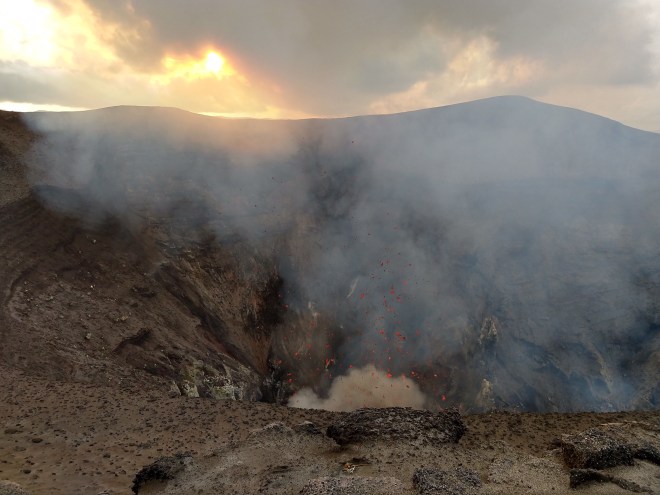
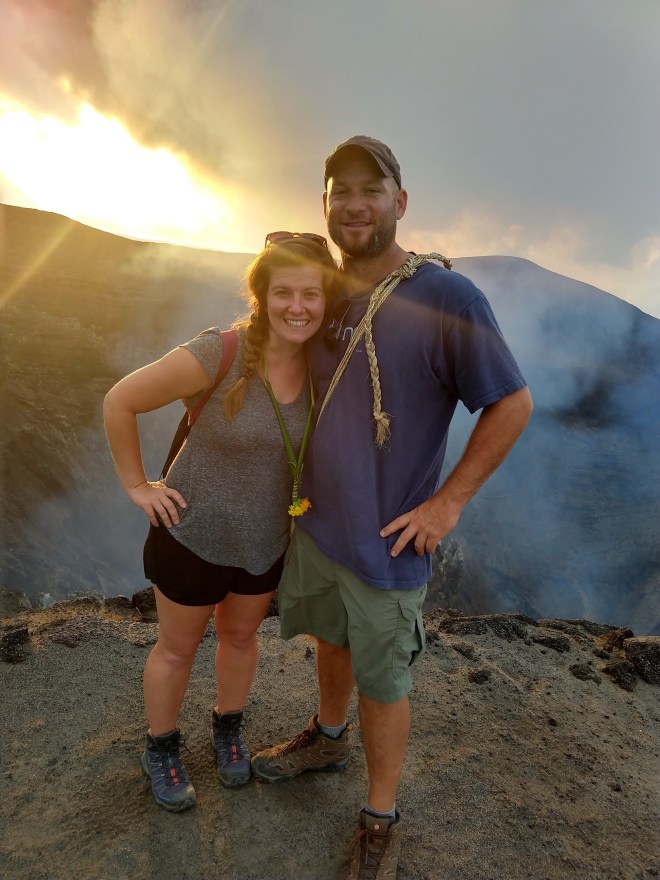
Old boat masts look so cool!

This is the second level on the Beagle. It still had a large space for storage, but behind Kirk are the rooms with bunks. It seemed to have a better use of space than Magellan’s boat.

These are the final two boats we toured, although we spent significantly less time on the Ancud – I actually don’t remember much about it as we were rushing to go catch a bus (that ended up being 45 minutes late 😂), but it was a Chilean boat used to claim the Straits of Magellan in some way.

The James Caird perhaps had the most fascinating story, although the boat itself is simply what you see here. The journey of this little life boat is considered one of the greatest maritime feats of all time. You can read more at the link below, but the short story is that a man named Shackleton lead an extremely dangerous expedition to try and cross Antarctica by land, but after losing their ship to the sea, he and a few others took this tiny lifeboat to get help and ultimately saved his men by crossing the sea during the most dangerous sailing season down south. The lifeboat was altered to be more sea worthy (adding a deck/sail/rocks to the bottom of it to balance weight), but imagine facing over 20 foot waves on this thing! It’s a really fascinating story!

https://www.coolantarctica.com/Antarctica%20fact%20file/History/Shackleton-Endurance-Trans-Antarctic_expedition.php

I leave you with a picture Kirk took of a semi-sunken boat we passed out the way into town. The colors were so beautiful!

I’ll try to update on Colchagua Valley soon!