Our brief 10 days in Australia were all spent in Cairns, Queensland, the gateway to the Great Barrier Reef. We booked an Airbnb with a pool that was walking distance from the beach, which turned out to be a bit farther from the city than we realized. Thankfully our hosts had bikes we could borrow, so we were able to get around to nearby restaurants and the grocery store. Still, without a car we found ourselves spending a lot of time in our Airbnb, which turned out to much better than we imagined.
Traveling for such a long time brings it’s challenges. As an introvert traveling on a budget (usually staying in Airbnbs) it’s often difficult continually invite yourself into someone’s home, sharing spaces while encountering a constant stream of new personalities with each destination. It’s a catch 22 though, because though it can be exhausting to constantly meet people, sharing space with people is also how you get to the heart of a land. While one family can’t tell you everything there is to know about a place, it certainly gives you a better look into a life different than your own than merely staying at a hotel does. That probably describes why I had so much to say about Vanuatu, but also speaks for our time in Australia.
During our time in Cairns, we found ourselves staying with a family of four, Peter, Vicki, and their two adolescent sons, Josh and Henry. A guy who would probably best be described as a “good ole boy” from Australia, Peter is the most entertaining host we’ve encountered so far. He is full of stories and laughs, but has an ease about him that’s warm and welcoming. His wife, Vicki, is a perfect counterpart for him. She is equally warm and easy going, taking everything in stride while keeping a steady balance within the family. I don’t remember the last time we laughed as hard as we did with these two, and in the midst of the laughter, we learned a lot about the country in which we found ourselves.
One story (that somehow had us cackling) was about Peter being injured while playing Footy (Australian football). Long story short (and the not-so-funny version), Peter broke his leg and ended up with a severe, life-threatening staff infection that put him in the hospital for three months. At the end of the story I couldn’t help thinking about the cost. Even with insurance, a that a stay like costs a fortune in the States. Knowing Australia’s healthcare system was different than ours, we asked, “What does a stay like that cost someone here?”
Do you know the answer?
It’s zero, nothing. It’s all completely covered in their universal healthcare.
This got us thinking, so we asked plenty of questions to learn more. Some of this is going to get a little number-y, but it’s also fascinating. If you care to learn more, read along. If not, there are pictures of the reef towards the bottom :).
It turns out Australia has a system in which the government automatically takes out 2-3.5% of a person’s earnings (depending upon a person’s income) and puts it toward their universal healthcare. After that, all of a person’s basic medical needs are met, including dental.
It’s true that some things aren’t covered and that some things are more easily covered than others (that seems to be a lot of people’s concern about potential universal healthcare in the States), but you might be interested to know that even with the exceptions, there are plenty of options still available. For example, Peter told us that because he broke his leg, he got care immediately, but if he had torn his ACL, he would have been put on a waiting list to have it repaired. However, even with a torn ACL, a person can opt to wait the 1-2 years to have it fixed for free or pay a private insurer and get it fixed immediately. There are always options.
Now, I’ve done some calculating since we left Australia, and I’m shocked by the numbers. If you really want to participate, take a moment to calculate 2% of your income (multiply your salary by .02 to see how much you’d have to pay yearly for their universal healthcare) and compare it with your current insurance premiums and deductibles.
If you are feeling too lazy, here are a few examples – a person making $40,000 a year would only be paying $800 a year for healthcare. Someone making $100,000 would be paying $2,000 yearly. A person making 300,000 still falls in the 2% category and pays $6,000 a year. (And as a side note, these amounts are taking directly out of your check, like taxes, so it’s paid in small increments throughout the year).
With taxes having just been filed, I can tell you that even with my last place of employment paying around $600 a month for me to be insured (over $7,200 a year, total), I still paid over $2,000 in medical bills (including dental) last year. That means that a person making $300,000 annually in Australia, paid less for healthcare than I did on a fresh out of grad school salary of $32,000, plus benefits.
That’s crazy (and it doesn’t even account for the fact that our dollar is currently stronger than theirs – or in other words, they paid even less for healthcare once you convert their dollar amount to USD).
Are you ready for the next crazy thing we learned?
Minimum wage in Australia is $18.29 an hour (that’s $14.08 USD) which, on a 40 hour work week, comes out to $38,043 gross income a year ($29,293 USD). With taxes taken out (which are higher in Australia than in the US) a person making minimum wage still brings home an actual $33,800 (or $26,029 USD). And keep in mind, that number has all healthcare included.
In the States, a person making the federal minimum wage earns $7.25 USD an hour. If a person works a 40 hour work week consistently the whole year (without getting sick) they will have a gross income of $15,080. With taxes taken out that’s $13,618 – and that doesn’t include healthcare.
Now, those are all estimations, and that was a lot of numbers to have read through, but the final numbers:
$26,029 USD yearly working minimum wage in Australia (with healthcare covered)
Versus
$13,618 USD yearly working minimum wage in the US (with no health care)
That’s a staggering difference.
What’s interesting about Australia is that the cost of living is only around 10% higher than the US (Buying groceries, we didn’t even notice a difference) – the cost of living is only 10% higher, but their lowest paid individuals are making nearly 100% more than ours.
If we aren’t caring for people at the bottom, what are we doing?
In the end, I don’t know all the outcomes and effects of raising minimum wage and implementing universal healthcare, but given what we’ve seen in other places (like New Zealand) and heard from fellow European travelers (who also have similar systems to Australia), I thought it was worth mentioning. Can you imagine a world where you don’t have to worry about what seeking medical help will cost? That sounds liberating!
Anyway, that info might have been more than you bargained for, but I thought it was too fascinating not to share! Now, time for pictures!
One of our days in Cairns we took the Skyrail to Kuranda Village. This cable car in particular glides you over parts of the Queensland Rainforest, stopping to let you walk down and view Barron Falls, a well known waterfall in the area. The end of the Skyrail drops you in Kuranda Village, which I can now only refer to as an immense tourist trap. Aside from the waterfalls, we ended up being pretty disappointed by the whole thing. We did see some cute koalas, but the habitat they were kept in made us a bit sad. I’ll post some photos of the sleepy creatures anyway though 🙂

On the Skyrail, going over the rainforest tree tops.

A short walk in the rainforest.
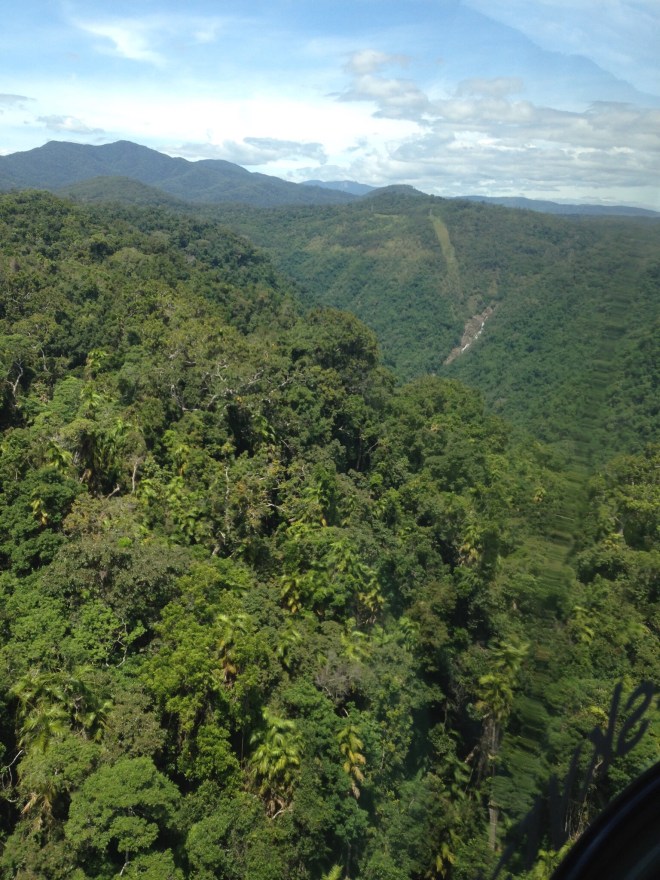
Barron Falls in the distance.
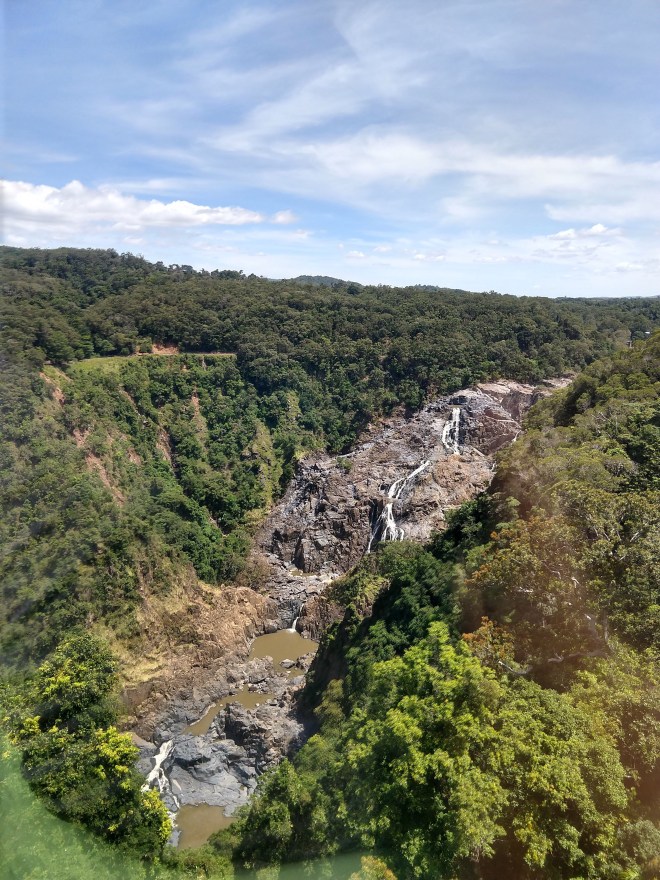
A closer view of Barron Falls from the Skyrail- this thing is huge! Kirk saw a picture of it in rainy season and it was even more impressive!

These are the first koalas we saw. It turns out Koalas sleep 16-22 hours a day, this was evident in our viewing experience 😂
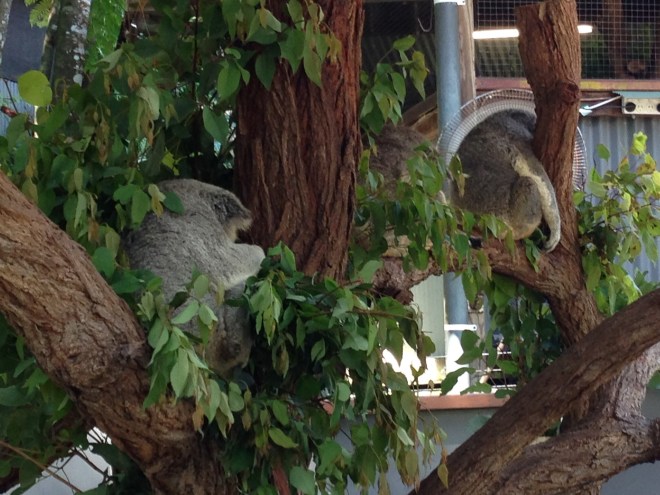
Three more sleeping koalas.

And the last two sleepers! The one in the front did wake up to scratch his head at one point, but went back to sleep immediately afterwards 😂.
And now, to the reef :)!
If you are unaware, at 1,400 miles long, the Great Barrier Reef is the world’s largest reef system – and sadly, it’s quickly dying. I recently read an article that said that since 2016 the reef has lost half of all it’s corals. Recent rising ocean temperatures are taking a heavy toll on the once brightly colored organism. The first heat wave came in 2016, killing a third of the reef, and the second wave came in 2017, bringing the reef to the half point at which it is now. Large sections of the reef are now bleached out, and most people are contributing it to global warming. I know a lot of people out there still don’t believe in global warming, but most Australians would say that these pale colored corals are dying proof of it. Whatever you believe, one thing is sure – if you want to see the Great Barrier Reef, you should visit soon!
We got a tip from our hosts that since much of the reef has lost it’s color, the best place to go view it is the outer reef. We searched online and booked the cheapest tour we could find, unsure what we were getting ourselves into. It turned out to be a crazy, awesome day.
Upon arriving on the boat, 3 announcements were made that the sea was going to be particularly rough that day, so everyone should consider taking Dramamine. It was already in my system prior to the announcements, but upon that advice, Kirk took it too – and it’s a good thing. That boat ride was an especially rough 2 and a half hours. We watched as nearly every one of the 40+ people on board took the offered barf bags, though only a few ended up actually using them. It was a tiring ride either way, and most people slept the way there!
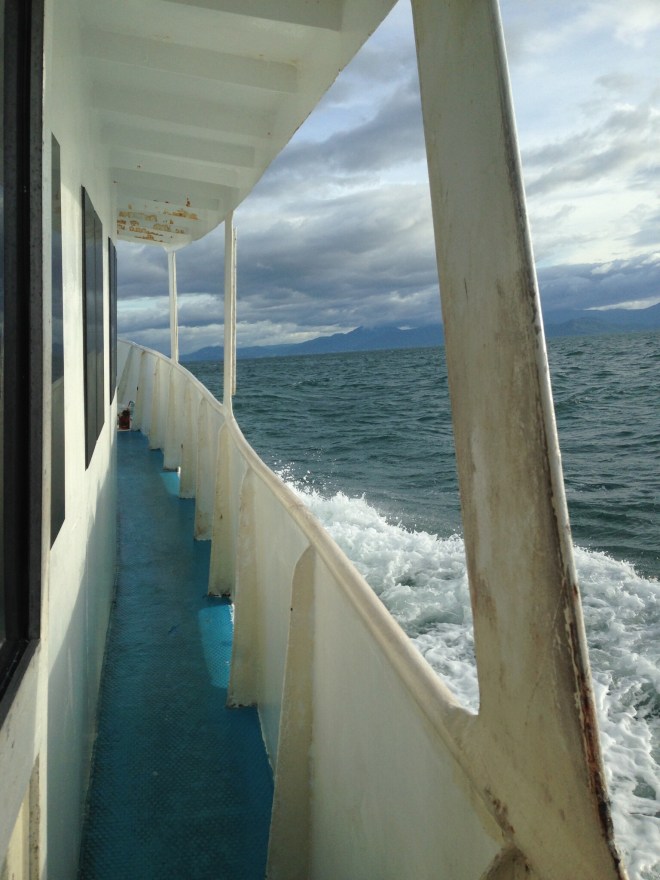
A view from the boat side

Lots of napping :).
The tour included two stops, Hasting’s reef and Breaking Patches. At our first stop, Hasting’s Reef, I eagerly jumped off the boat into the water – and quickly found myself freaking out. The same waves that had rocked the boat on our journey there, were throwing me around, hitting me in the face, and coming in my snorkel! I quickly grabbed onto the boat ladder to regain my composure. After a lot of self talk, the acceptance of a life vest, and Kirk’s coaching, I got back in and reminded myself to breathe. It took a few minutes, but my body got used to the flow of the waves, and the real key – keeping my face in the water. I found the waves only came in the snorkel when I was fighting against them – when I gave in and rolled along with them, everything was fine! There’s probably a life lesson in there somewhere :).
At Hasting’s reef the water was a bit cloudy, but we still saw a lot of beautiful fish. The second reef, Breaking Patches, ended up being the best place we’ve snorkeled this trip, especially when we broke away from the group. None of the pictures show the full amount of fish we saw, but hopefully they show some of the fishes’ colors! Even at aquariums I’ve never seen so many colorful fish!
We’ve confused which pictures are from where, so I’ve grouped them all together :). Kirk took most of the pictures, as he has no fear of the water and was able to dive down near fish with just his snorkel on. Here’s a peak into what we saw!

—
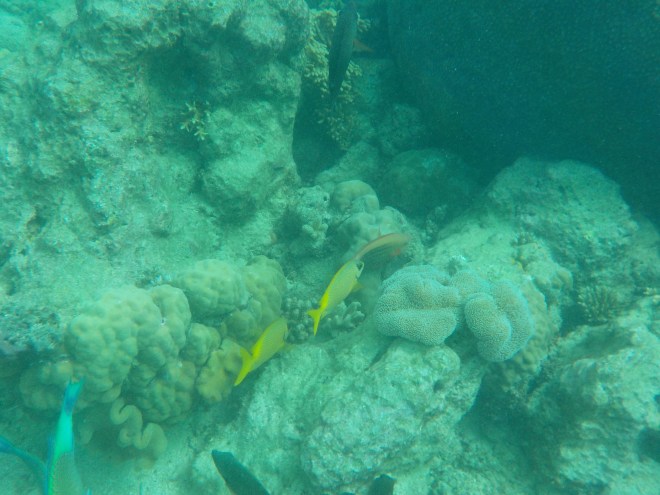
Those yellow fish always traveled in pairs!
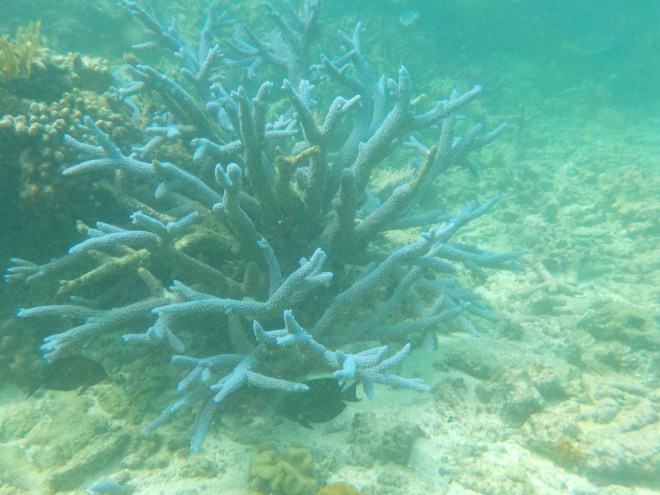
Some coral that isn’t bleached yet :).
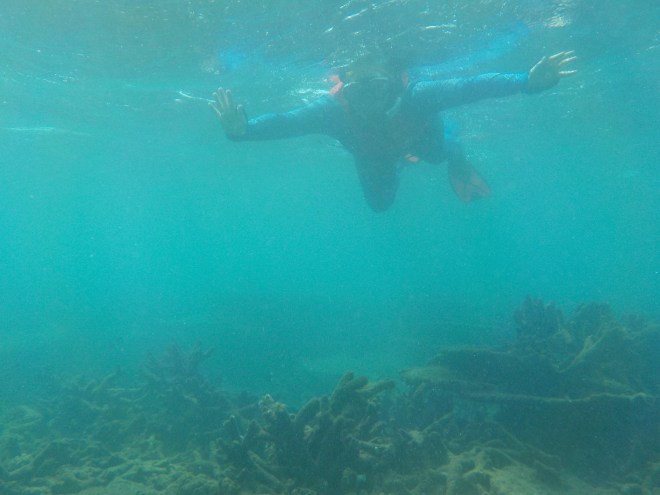
Me in my “stinger suit” – “stinger” refers to jellyfish. Since it was jellyfish season, we had to wear these, though we didn’t actually see any! Also, the water here was much clearer than it looks in this picture, and though I’m unsure how you can’t see any in the photo, we were surrounded by fish! I remember asking Kirk to take the picture because there was a school of them swimming by!

—
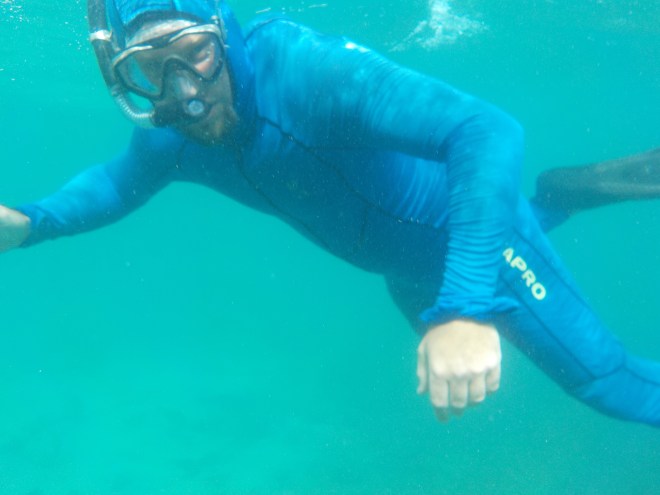
🙂

Aren’t these beautiful? These yellow ones were often in pairs too.
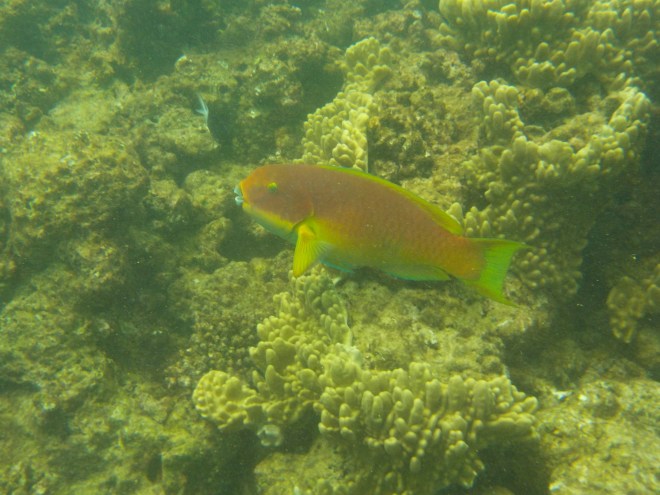
Red parrot fish

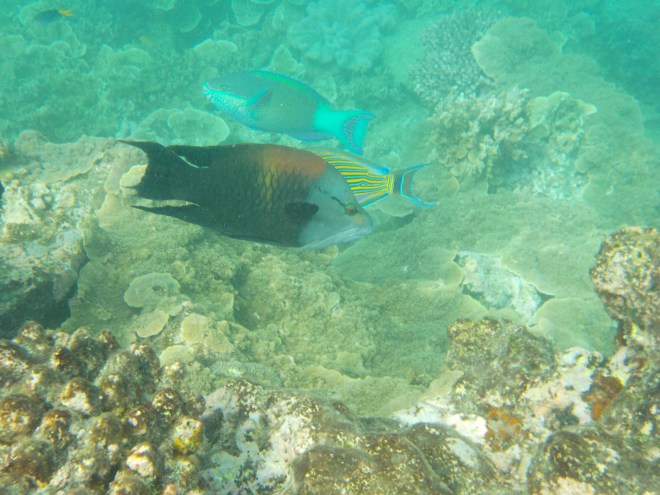
Blue parrot fish
—
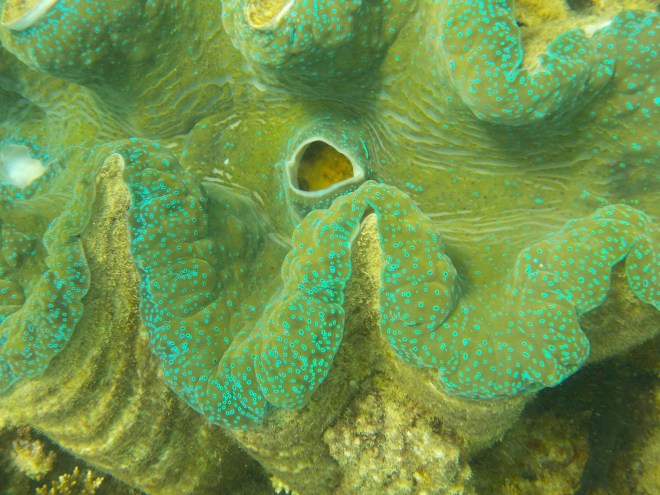
Giant clam, this guy was around a meter wide!
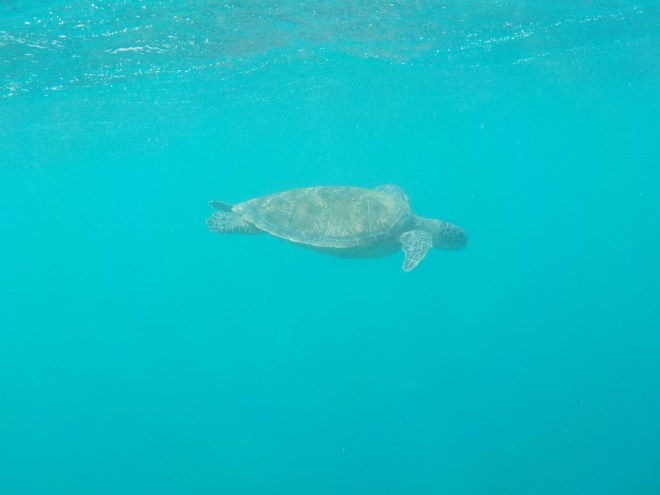
This was definitely Hasting’s Reef. I lost Kirk for a little bit and when we found each other again he told me he had seen a sea turtle. You’re getting the only view I saw of it! At the next reef Kirk saw a shark, but I missed that too. Unfortunately that one was too fast for him to get a picture, but he said it was pretty big!

Sea Cucumber
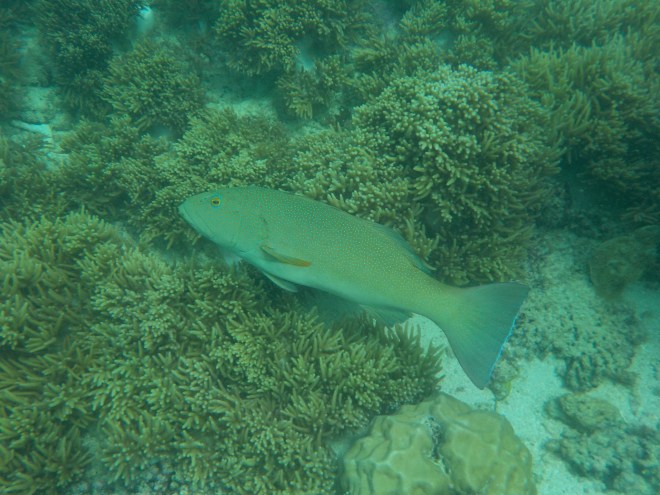
This guy’s spots glowed bright in the dark!
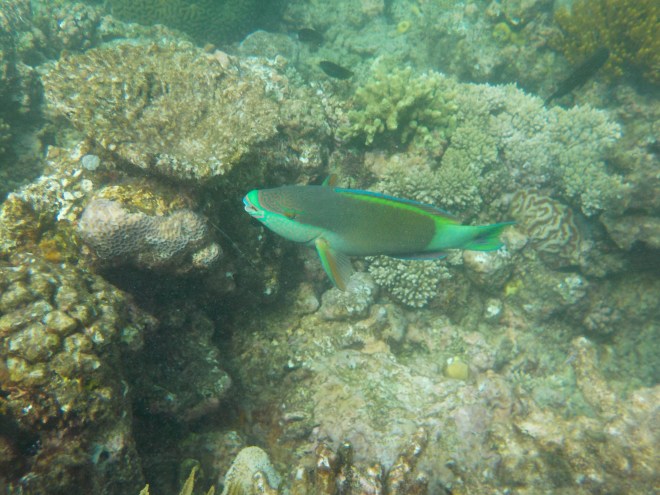
Another type of parrot fish – the parrot fish were my favorite. There are so many different varieties, all with beak-like mouths and bright colors!
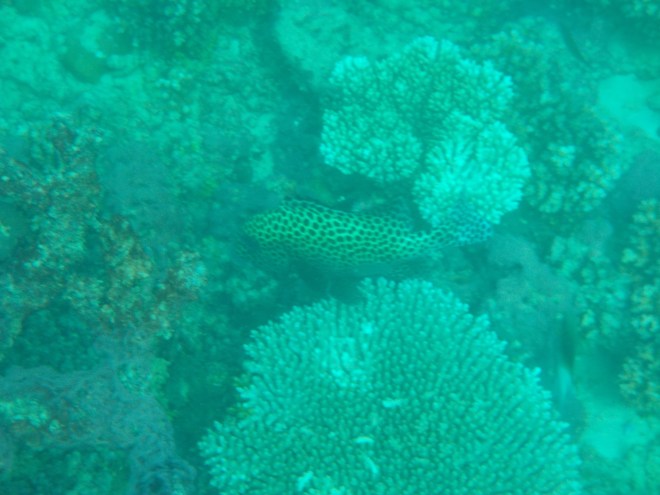
Another spotted guy

A smaller giant clam, that was still large. His coloring was different than the others we saw.
I loved the way this coral waved with the sea!

A better idea of how many fish were usually around us!
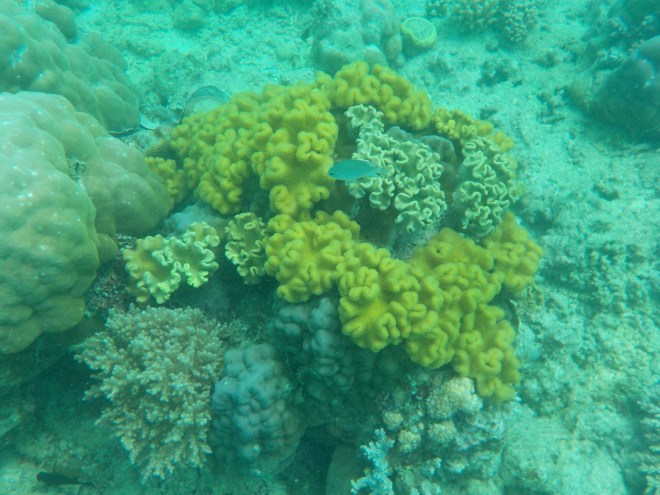
Another coral still full of color 🙂

One of Kirk swimming down.

You can sort of see how the spots glow in this picture 🙂
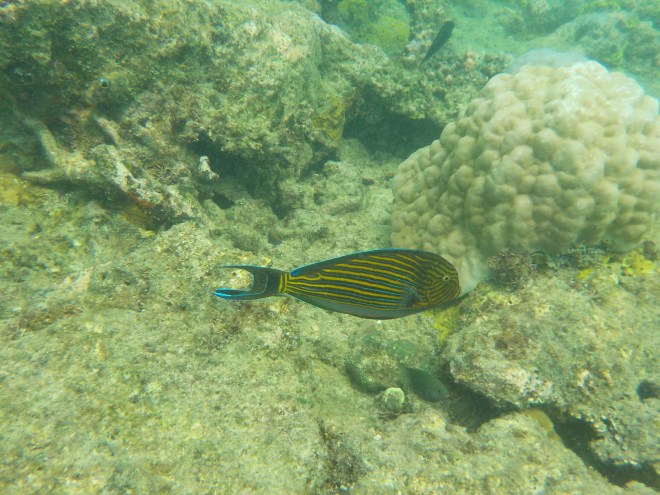
—
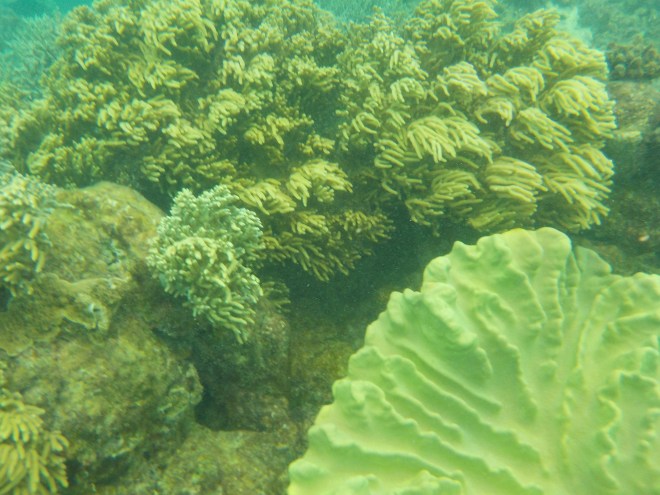
Different types of coral
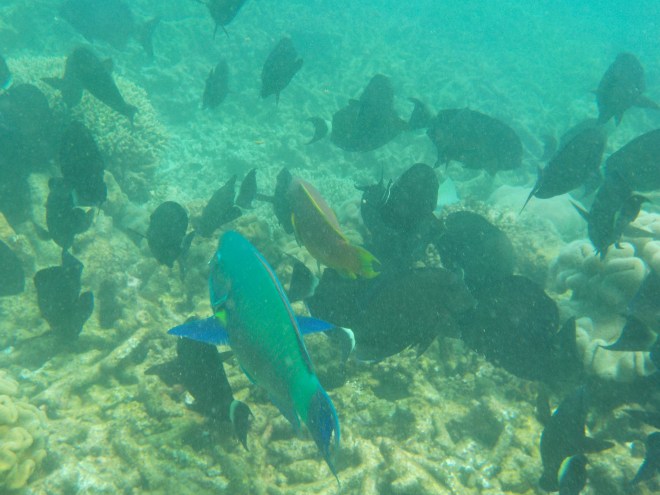
School of fish with some parrot fish
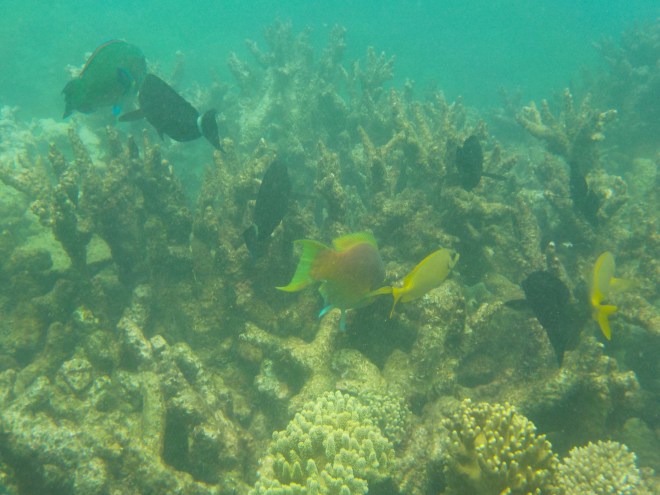
—

As we left the reef we watched as the sun began to set over the ocean. It turned out to be a lovely day in spite of the waves. I think it always feels good to see beauty and conquer fears.
When we arrived back at our Airbnb that night we heard some interesting news. While out on the reef we had been surprised at the lack of other boats on the water – it turns out that the sea was so rough that nearly every company except ours had canceled their tours (there was actually a cyclone nearby, though we only got rain from it in the early morning)! Personally, I think it added to the adventure of the whole thing while also contributing to my pride of having snorkeled in those waves :).
Our final days in Cairns we found ourselves with house sitters. Peter, Vicki, and family went on vacation, leaving their house in the hands of Zach and Brad, two aboriginal young men with whom Peter works. Peter had already told us stories about these fearless guys swimming with local crocodiles that wandered near their place of work during a flood, and Kirk was excited to meet them and discuss what life had been like for them growing up. After all, many native tribes in Australia still live on islands off the mainland, and Kirk wondered what types of similarities, if any, those islands might have with Vanuatu.
It was fascinating talking and getting to know these guys. Both were from aboriginal clans (of which there are hundreds in Australia), and had grown up on their family’s native land – one on an island, and the other on mainland Australia. Both were very proud of their heritage and were invested in keeping their native languages and customs alive. We listened intently to story after story about their customs, including different types of “magic” that are still performed amongst the people. They even pulled up YouTube videos of a festival that happens every two years where all the local tribes get together to sing and dance for each other, chronicling some of their tribe’s history and folklore through artistic expression. The videos were pretty awesome, and if you are interested in watching any, you can google “Laura Festival Queensland” and some should come up.
Perhaps the most fascinating part of our conversation was about how the Australian government has left or reinstituted a lot of the rights of the tribes (although this has not always been the case – and many clans have suffered because of it, much like indigenous peoples in the States). There is currently a governmental program in place to slowly restore clans claims to their historical lands, and native peoples in Australia (in particular, on the islands off the coasts), are now often left to their own, still hunting customary foods in the sea and dealing with tribal conflict through customary means (rather than through Australian government -or police). What’s interesting is that some of the foods the tribes customarily hunt are sea turtles and manatees, and while it’s now legal for them to hunt and eat these, it’s illegal for them to sell them or for anyone outside of the tribes to eat them. Though it was a little shocking for me to hear this (especially after hearing stories my entire life about the efforts in the States to save sea turtles) it’s kind of cool to see a government entrusting a peoples with rights they once had and seem to have managed fairly well. I suppose I don’t actually know much about the current population of sea turtles around Australia, but these guys have lived on this land for thousands of years without causing extinction of the turtles, so that’s at least something.
It actually reminded me of some of the culture Kirk told me about in Vanuatu. While he was living on the islands, Kirk learned that anytime he saw a staff with a namale leaf attached, it meant whatever was there was forbidden in some way. These leaves are used to mark unsafe roads, taboo areas, and also, reefs that need to be restored. The chiefs in Vanuatu keep track of when fish in the area get low, and will mark a reef forbidden until the population of fish come back. It’s cool to learn how people’s traditional customs look out for things like this, and also makes me wonder if some of the clans around Australia have similar systems. For now, I don’t know – that question came to mind after we’d already left, but it’s sure all interesting to think about.
I suppose that’s about it for out time in Cairns. I leave you with a few final pictures of our time there.

Cairns was the first time I have ever ridden a bike on the highway! It’s pretty scary, but at least they have large shoulders and lots of bike lanes!
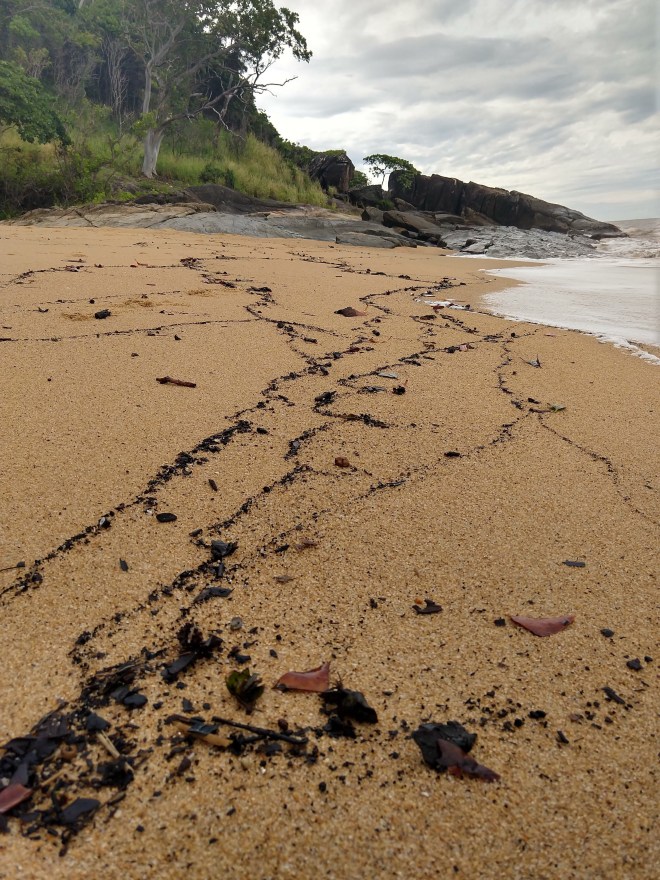
This is at Trinity Beach, the popular beach closest to our Airbnb. I love these lines the tide had created!
We actually ended up not getting in the water here, though we lounged around on the beach quite a bit. As it turns out, many beaches in Australia are dangerous because of the crocodiles. Daytime is a safer bet, but it’s especially dangerous at night!
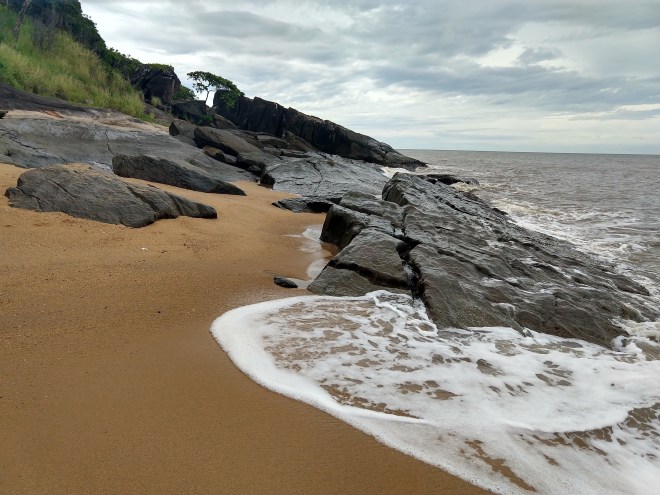
A final picture at Trinity :). That sand really was a caramel color, and it was some of the coarsest sand we’ve encountered!
Next blog, Hong Kong. Spoiler alert: We loved it!!

 The Yonderers
I learned about the healthcare system in Australia from my Aussie friend, Helen Boyd. (She died last year, by the way.) Yep, the USA is kind of backwards from Australia. Even our water drains out of the drain in the opposite direction of theirs! I remember when I first heard of their healthcare system, I just about wanted to move there. Well, is I were an Auzzie, I suppose I would say: “Bob’s your uncle,” to the next step in the journey.
LikeLike